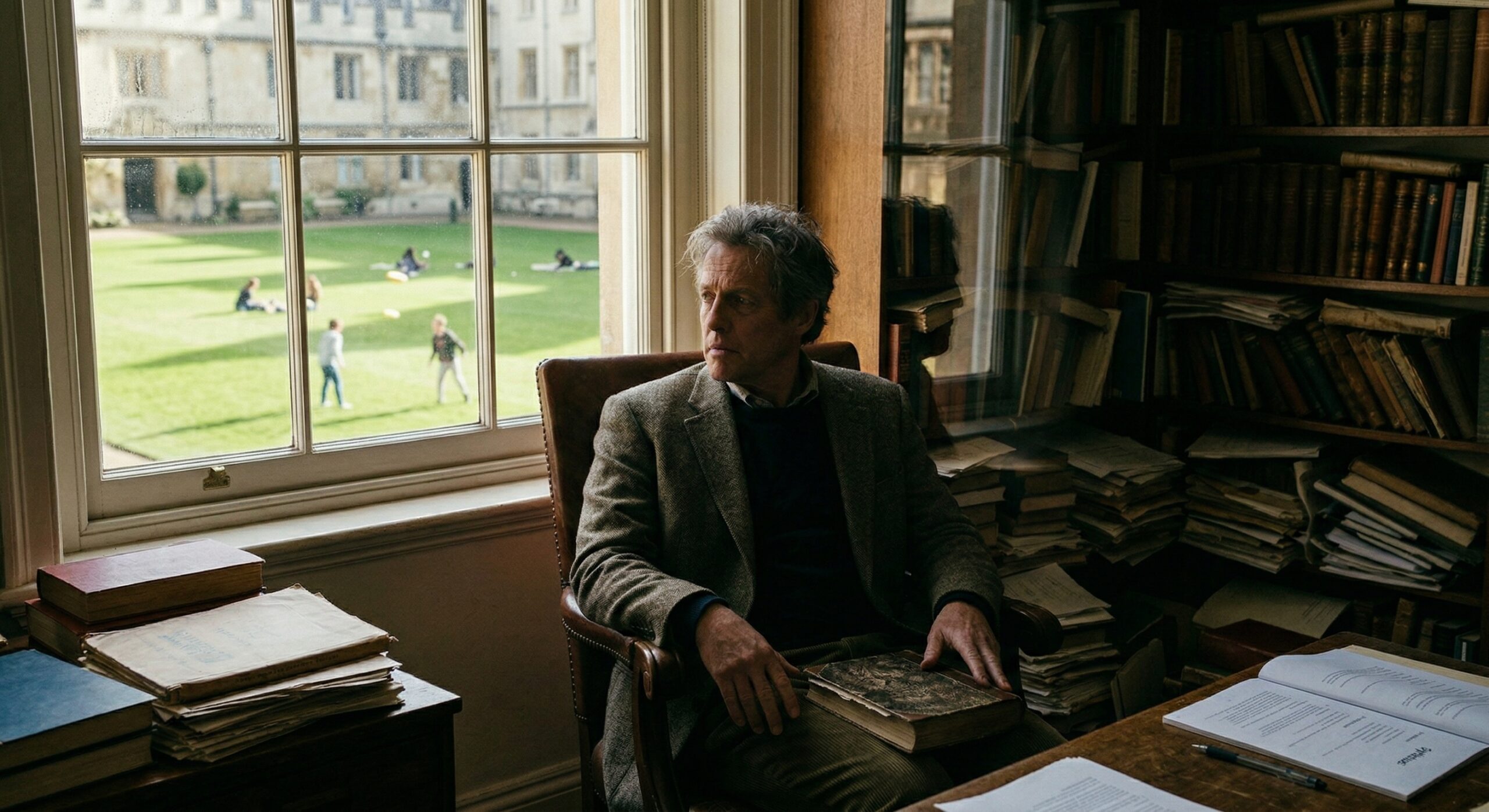
Professor Alistair Finch leaned back in his mahogany armchair, the springs groaning like a tired sentry. His office was a graveyard of books, where the dust motes performed a slow, suspended waltz in the afternoon sun. He watched them with a look of profound suspicion. Outside, the university quad was a picture of collegiate serenity—students sprawled on manicured grass, the rhythmic thud of a distant Frisbee, the absolute lack of catastrophe.
“It is too quiet,” Finch remarked to his only visitor, a junior faculty member who had come for a syllabus signature and stayed for the inevitable descent into the uncanny. “The air has a certain… oily stillness. It is the peace of the fattened calf before the harvest.”
He stood, pacing a three-step path between a bust of Cicero and a teetering stack of journals. “I don’t believe in jinxes, but just in case, I’m going to knock on wood.” He rapped his knuckles twice against the desk—once for the present, once for whatever was breathing down the neck of the future.
“You think I’m indulging in the theatrics of the senile,” Finch said, his voice dropping into that rhythmic, cadence-heavy lilt that made his lectures feel like secular sermons. “You think I’ve spent too much time reading Schopenhauer by candlelight. And perhaps I have. The old pessimist knew that vipers aren’t born in the storm; they are hatched in the sun, in those moments of settled peace when we forget that the ground is actually a lid. When the world is comfortable, we stop looking at the shadows in the grass.”
He gestured vaguely toward the window, toward the bright, expensive cars in the faculty lot. “We have been winning for a very long time. The bread is soft, the wine is chilled, and the Wi-Fi reaches even the darkest corners of our souls. But Montaigne—bless that nervous Frenchman—had it right: the more things go well, the more I am afraid of the end. Success is a heavy weight to carry. It creates a vacuum that the universe abhors.”
Finch stopped by a shelf and pulled out a slim, battered volume. “I’ve been looking into the inane. Nostradamus, the quatrains of the feverish, the ramblings of men who saw the world ending in every eclipse. I don’t follow them, mind you. I find the industry of prophecy to be a particularly greasy sort of commerce. And yet… the coincidences are starting to look like a pattern, aren’t they? Like a face forming in the clouds just before the lightning strikes. I have been digging into the sources of these premonitions—not just the visions of the mad, but the warnings of the ancient and the distant.”
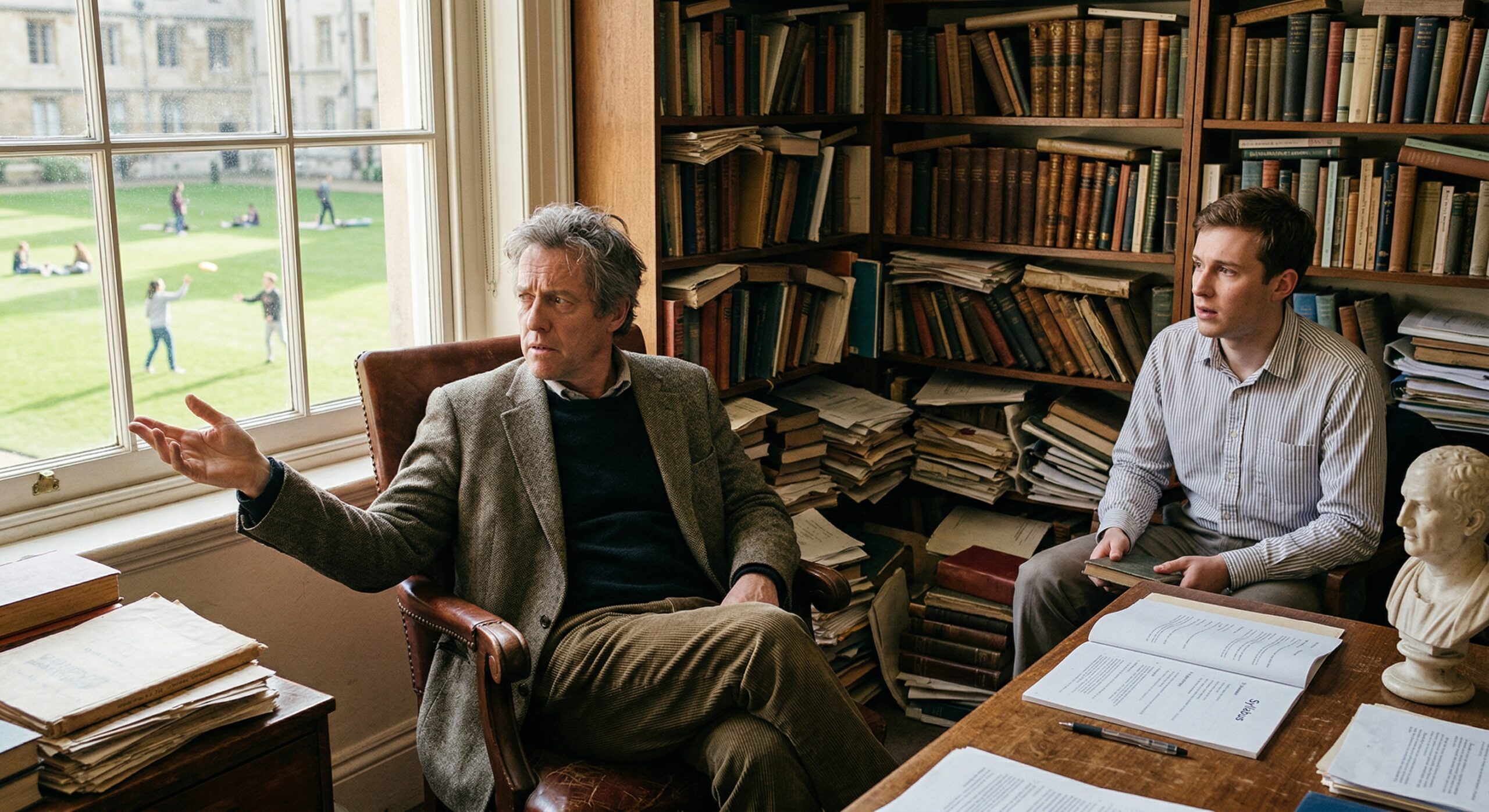
He leaned in closer, his voice a conspiratorial rasp. “Look at the rivers. The Euphrates is retreating, pulling back its skirts like a guest who has seen something unpleasant under the dinner table. There is an ancient warning that the drying of this river precedes a final conflict. It’s a literal drying of the well, a sign that the physical laws are beginning to fail us, or perhaps that the world is no longer willing to sustain our hubris. Even the anonymous voices of history whisper it: ‘The clouds are gathering; the horizon is blurred.'”
He began to count on his fingers, his movements sharp. “The bridge is breaking, my boy. The transition from a single dominant power to multiple competing centers—what the strategists call systemic polarity shifts—is, to the mystical mind, the fracturing of a universal order. It is the literal breaking of the structural bridge that once maintained global stability, signaling the end of a unified world-spirit. We are standing in the middle of the span, wondering why the cables are humming a funeral dirge.”
He paused, a wry smile touching his lips. “And the giants. The academics talk about the Thucydides Trap, citing the narrowing gap between established and rising powers. But I see the arrival of a ‘challenger’ archetype. It is an inevitable clash between an aging ‘ruling spirit’ and a disruptive force seeking to define a new, harsher age. We are forging the sword again. Have you seen the military expenditures? They hit record highs every year now—over two trillion dollars globally. This isn’t just policy; it is a collective, subconscious preparation for a conflict that the psyche senses is already written in the stars. We are sharpening our steel because we can no longer trust our words.”
Finch moved to his chalkboard, which was covered in a frantic sprawl of equations and historical dates. “The gates are closing. The economists call it de-coupling—the decline in global trade and financial integration. But mystically, it is a ‘turning inward.’ Tribes are dragging their benches to the door, preparing for the darkness they sense is coming. And here, in our own house? It is divided. Extreme domestic polarization and social fragility are simply the ‘Universal War of All Against All’ manifesting within our own walls. We see it in the climate of tribalism right here in the States, where ideological differences turn neighbors into existential threats. When the internal spirit of a nation is fractured, it must eventually project that conflict outward.”
He picked up a piece of chalk, but didn’t write. “The ‘Moral Inversion’ is complete. We measure our leaders by the height of their self-promotion and the depth of their deceptive rhetoric. We measure success by the ability to exploit divisions rather than foster stability. And the ‘Fever of the Blood’—that hyper-nationalism you see in the exclusionary rhetoric of state-driven fervor—is the outward sign that society has abandoned reason for a primal, destructive tribal identity. This “loss of Dharma” is a cornerstone of the Kali Yuga—the final, most degraded age in the Hindu and Buddhist cycle of time. I’ve been wading through the Puranic texts and the Maitreya prophecies; they don’t just speak of a generic moral decay, but of a specific, structural “forgetting.” It is a time when people abandon the internal compass of duty for the external gravity of the coin.
You see it in this mass exodus toward the Western centers of commerce. It is a migration of the body that demands a surrender of the spirit. They trade their ancient, rigorous ethical frameworks—the very structures that once stabilized their civilizations—for a seat at the table of economic advancement. In the rush for a high-speed, material-centric lifestyle, the path is not just abandoned; it is diluted until it is unrecognizable.
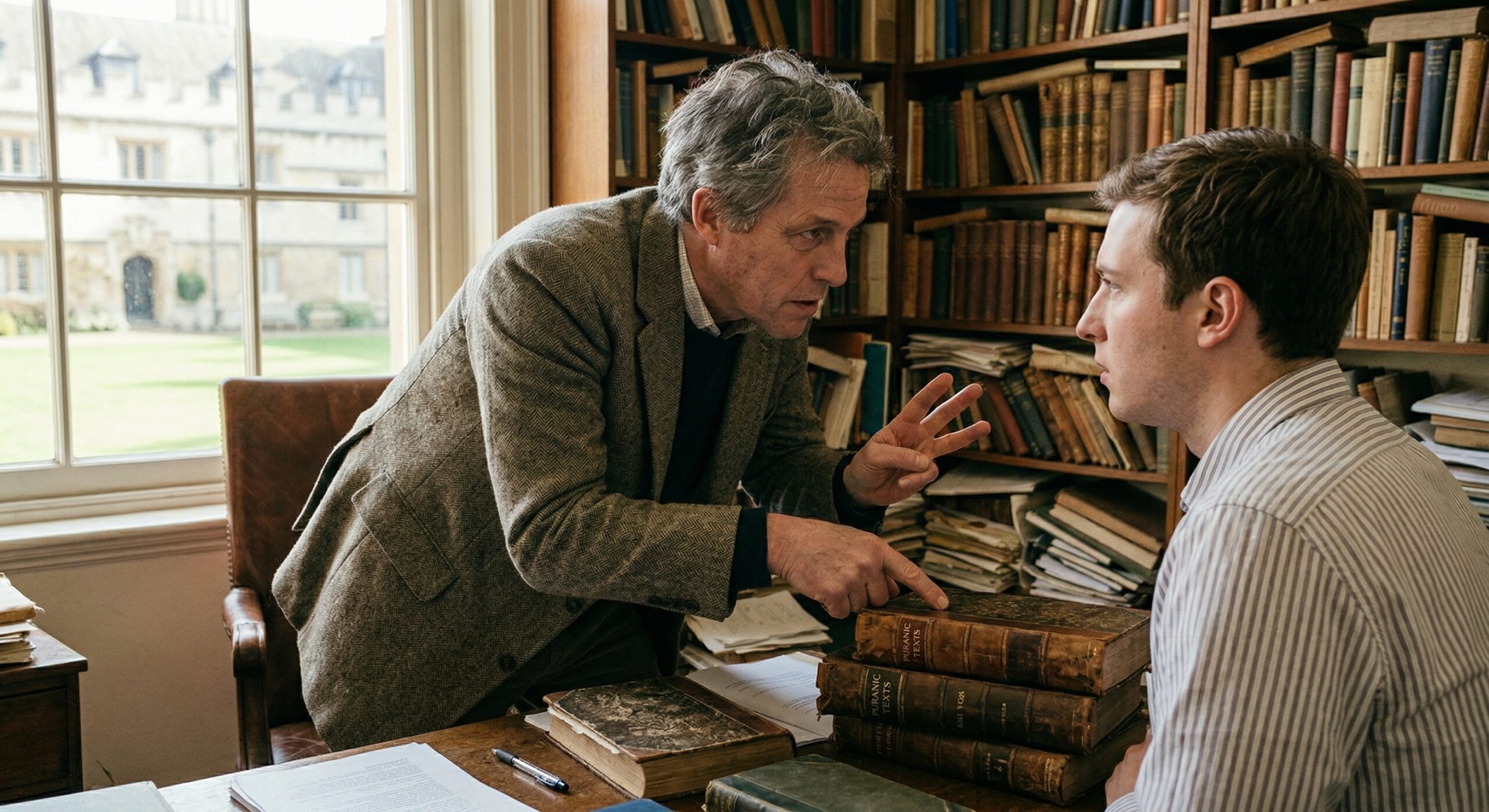
And notice, my boy, that I haven’t even touched the mounds of Judeo-Christian prophecy. I haven’t mentioned the trumpets of the Apocalypse, the mark of the beast, or the valley of Megiddo. I find those far too noisy for my taste. No, I am looking at the quieter rot—the systematic erosion of spiritual duty as humanity migrates toward a shiny, hollow security.
Finch sighed, tapping the board near a list of resource metrics. “Even the ‘Drying of the Well’ is measurable now. As strategic commodities decline, we see the ‘Entangling Web’ of alliance networks tightening. These rigid defense pacts are like mechanical paths to ruin—once the web is spun, a single spark will consume the entire forest. As Pliny the Elder noted, the only certainty is that nothing is certain. He was an optimist.”
The professor sat back down, the poetic rhythm of his speech slowing. “We are reaching the stage, as H.G. Wells warned, where the problems we must solve are going to become insoluble. The complexity of our rot has outpaced the simplicity of our tools. We’ve had a long, bright afternoon, but the vipers are definitely out of their shells, and I don’t like the way they’re looking at the sun.”
He looked at his visitor, who remained silent, clutching the unsigned syllabus. “I’m not predicting the date,” Finch added with a sudden, sharp bark of a laugh. “I’m not that far gone. I am merely gathering the premises. The coincidences are too uncanny to ignore, even for a man of science.”
Finch picked up his pen, signed the paper with a flourish that looked suspiciously like a lightning bolt, and handed it back. “There you are. Now, go enjoy the sun while it’s still behaving itself. I have some more inane texts to ignore.”
As the door clicked shut, the professor turned back to the window. The Frisbee was still in the air. The grass was still green. But in the reflection of the glass, he saw the silhouette of his own office—a house of paper waiting for a single, stray spark. He didn’t move. He simply waited for the first drop of rain to hit the pane.