
The Topological Paradigm: Breakthroughs, Controversies, and the Future of Fault-Tolerant Quantum Computing
The pursuit of utility-scale quantum computing is currently defined by a fundamental dichotomy: the choice between building immense, highly redundant systems of inherently fragile physical qubits, or engineering fundamentally new states of matter that protect quantum information at the physical hardware level. The latter approach, known as topological quantum computing (TQC), represents the most mathematically elegant and physically demanding modality in modern condensed matter physics. By encoding quantum information in non-local topological properties—specifically through the manipulation of exotic quasiparticles known as non-Abelian anyons—TQC promises to bypass the crippling physical-to-logical qubit overhead associated with active quantum error correction1.
However, as of mid-2026, the landscape of topological quantum computing remains intensely contentious. While conventional modalities—such as superconducting circuits, trapped ions, and neutral atoms—have successfully demonstrated scalable arrays and error-corrected logical qubits, the pure hardware-based topological approach has yet to yield a single uncontested, fully functioning physical qubit2. Microsoft, the primary corporate architect of this modality, has claimed successive breakthroughs with its Majorana 1 and Majorana 2 processors, accelerating its timeline for a commercial fault-tolerant system to 20293. Yet, these announcements have been met with severe skepticism from the global physics community, culminating in peer-reviewed critiques of their data analysis and public disputes over the fundamental definition of a qubit5.
This comprehensive report evaluates the latest developments in topological quantum computing. It explores the foundational physics of Majorana zero modes and anyonic braiding, contrasts topological hardware with conventional qubit architectures, dissects the ongoing controversies surrounding Microsoft’s research program, and evaluates the strategic imperatives driving the continued multibillion-dollar investment in this polarizing technology.
1. The Physics of Topological Quantum Computing
To understand the promise and the peril of TQC, one must examine the underlying quantum mechanics that govern its operation. Standard qubits store information in local physical properties, such as the spin of an electron or the energy level of an isolated ion. Topological qubits, conversely, distribute information non-locally across a macroscopic system of quasiparticles, fundamentally altering how the system interacts with environmental noise1.
1.1 Anyons and Non-Abelian Statistics
In three-dimensional space, all fundamental particles are classified as either bosons (which can share the same quantum state) or fermions (which obey the Pauli exclusion principle and cannot). When two identical bosons are exchanged, the global wavefunction remains unchanged; when two fermions are exchanged, the wavefunction acquires a phase of (or ).


However, in strictly two-dimensional systems—such as those exhibiting the fractional quantum Hall effect or the surfaces of topological insulators—the mathematical rules governing particle exchange change profoundly. Quasiparticles emerging in these two-dimensional planes are known as "anyons" because their exchange can result in any arbitrary phase change9.
Anyons are further subdivided into Abelian and non-Abelian categories. Exchanging Abelian anyons multiplies the wavefunction by a complex phase factor. Because multiplication is commutative, the order in which Abelian anyons are exchanged does not alter the final state. Non-Abelian anyons, however, behave entirely differently. Exchanging these quasiparticles applies a multi-dimensional unitary matrix transformation to the system's highly degenerate ground state. Matrix multiplication is generally non-commutative, meaning the final quantum state depends entirely on the chronological sequence and geometric topology of the exchanges9. It is this non-Abelian property that forms the bedrock of topological quantum computing, allowing information to be processed simply by moving particles around one another in specific sequences.
1.2 Majorana Fermions and Majorana Zero Modes (MZMs)
First proposed by Ettore Majorana in 1937, a Majorana fermion is a theoretical particle that is entirely its own antiparticle14. While their existence as fundamental elementary particles in high-energy physics remains unconfirmed, condensed-matter physics has predicted the emergence of their mathematical analogs as emergent Bogoliubov quasiparticles in specific superconductor-semiconductor heterostructures15.
In topological quantum computing, the focus is on a specific manifestation known as the Majorana Zero Mode (MZM). MZMs are predicted to appear at the boundaries or domain walls of a one-dimensional topological superconductor. In practice, this is engineered by utilizing a semiconductor nanowire with strong spin-orbit coupling (such as indium arsenide, InAs) proximitized by a conventional s-wave superconductor (such as aluminum or lead). When subjected to an external parallel magnetic field, the nanowire is forced into an effectively spinless p-wave superconducting phase, generating localized MZMs at its endpoints7.
Because an MZM is its own antiparticle, it takes two spatially separated MZMs to constitute a single ordinary fermion state. This combined fermionic mode can be either empty or occupied, providing the two degenerate quantum states ( and ) required for a qubit7. This spatial separation is the fundamental source of topological protection. A local environmental disturbance—such as thermal noise, a stray magnetic field, or a localized photon—interacting with only one end of the nanowire cannot alter the joint parity state of the MZM pair. To successfully flip the qubit and cause an error, a disturbance would have to simultaneously act on both MZMs or physically move a stray quasiparticle across the entire length of the wire. Such events are exponentially suppressed by the physical distance between the modes and the energy barrier known as the "topological gap"7.


1.3 The Mechanics of Braiding: Computing with Topology
In a conventional quantum computer, logic gates are executed by applying carefully tuned analog microwave or laser pulses to manipulate the qubit's local energy state. This requires extraordinary precision; a slight miscalibration in pulse duration, frequency, or intensity results in an over-rotation or under-rotation, introducing continuous coherent errors into the computation20.
Topological operations, by contrast, are executed through a geometrical process called "braiding." If one visualizes the two-dimensional plane evolving over time, the trajectories of the non-Abelian anyons trace out "worldlines" in three-dimensional spacetime. Moving one anyon around another twists their worldlines into a physical braid10.
Because the resulting quantum gate is determined solely by the topological class of the knot (which anyon passed over or under which), the operation is inherently fault-tolerant. The exact path, the speed of the transition, or the minor geometric deviations of the anyons' trajectories do not matter, so long as the correct topology is achieved and the adiabatic theorem is obeyed. Small, random fluctuations in the control fields will wiggle the worldlines but will not untie the mathematical knot1.
1.4 The Computational Hierarchy: Ising vs. Fibonacci Anyons
A critical nuance often omitted in generalized industry discussions of TQC is the severe computational limitation of MZMs. Majorana zero modes are classified mathematically under the "Ising anyon" model13.
Braiding Ising anyons generates non-Abelian unitary transformations, but these transformations are mathematically restricted. Specifically, braiding MZMs only generates operations within the Clifford group—a specific set of quantum operations that includes the Hadamard, Phase, and CNOT gates2. The Gottesman-Knill theorem dictates that quantum circuits composed entirely of Clifford gates can be efficiently and perfectly simulated by classical computers, meaning they offer zero quantum advantage on their own. To achieve universal quantum computation, one must implement a non-Clifford gate, such as the (T-gate) or the Toffoli gate, to generate "quantum magic"24.

Because MZMs cannot execute a T-gate via purely topological braiding, a computer built on Majoranas must rely on supplementary, non-topological operations to achieve universality. This is typically accomplished through a resource-intensive protocol known as "magic state distillation," which unfortunately reintroduces the exact active error-correction overhead that TQC was intended to circumvent2.
The theoretical alternative to the Ising model is the "Fibonacci anyon." Unlike Ising anyons, Fibonacci anyons feature highly complex fusion rules where braiding operations are dense in the unitary group. This means they can approximate any single-qubit or multi-qubit quantum gate to arbitrary precision through braiding alone, achieving true computational universality without supplementary protocols10. While Fibonacci anyons represent the ultimate paradigm of zero-overhead universal TQC, they require physical environments—such as the fractional quantum Hall state or complex lattice models—that are orders of magnitude more difficult to engineer and stabilize than Majorana nanowires, rendering them purely theoretical at the current stage of condensed matter physics10.

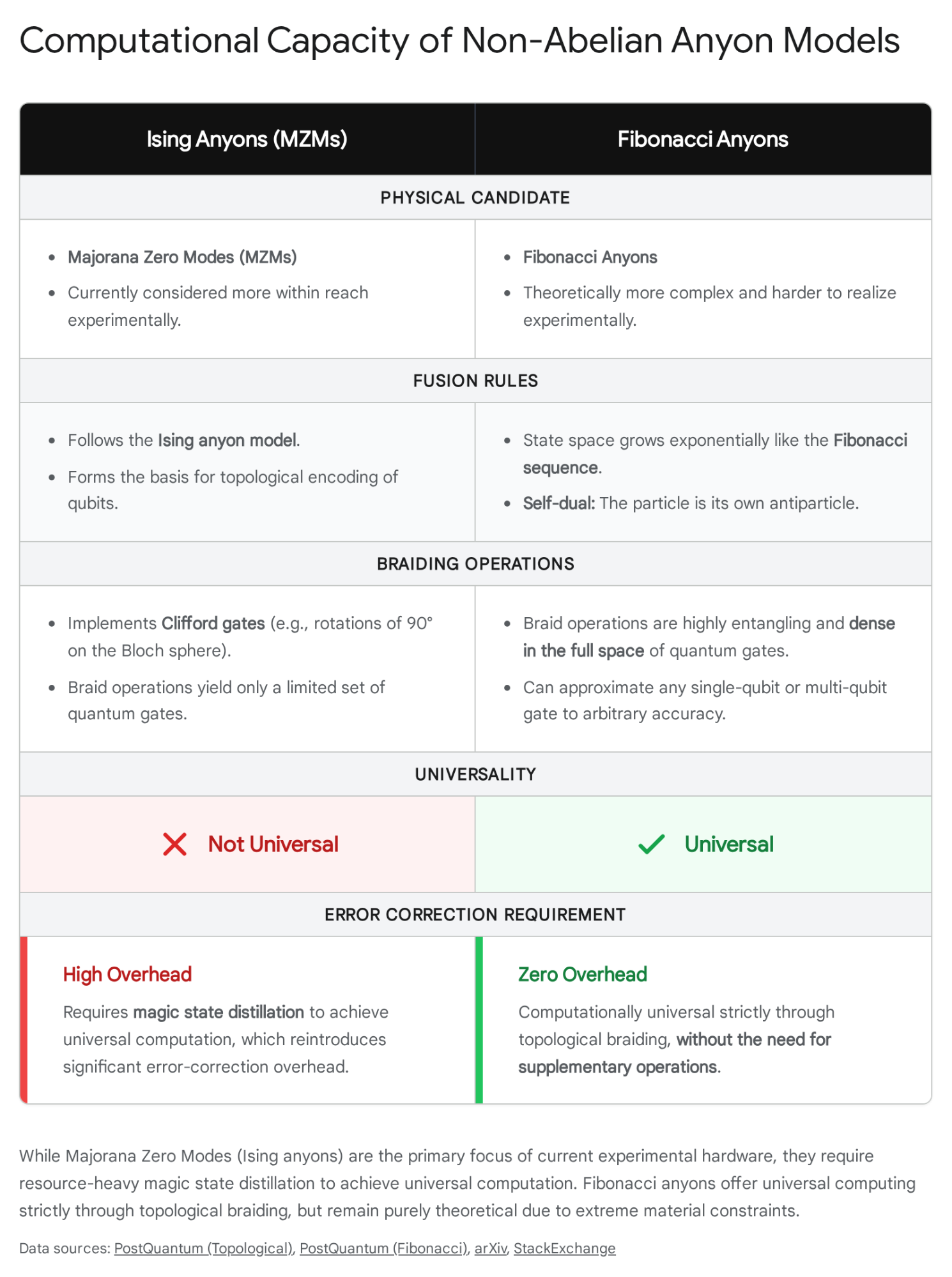
2. Architectural Paradigms: Conventional vs. Topological Qubits
The debate over topological computing is ultimately a debate about resource allocation and engineering philosophy: should the burden of stability be placed on complex software algorithms executing active error correction, or on the fundamental materials science of the hardware substrate?
2.1 The Physical-to-Logical Overhead Challenge
Conventional qubits—such as the superconducting transmons favored by IBM and Google, or the neutral atoms favored by QuEra and Atom Computing—are highly susceptible to local environmental noise. Current state-of-the-art conventional physical qubits possess hardware error rates ranging from to (meaning one error occurs every 100 to 1,000 operations)2.


To build a "logical qubit" capable of executing deep, complex algorithms without succumbing to decoherence, conventional systems must group hundreds or even thousands of physical qubits together using quantum error-correcting codes. This results in a massive physical-to-logical overhead. A utility-scale system requiring 100 logical qubits might demand anywhere from 100,000 to 1,000,000 physical qubits2.
Topological qubits, by virtue of their non-local encoding, are hypothesized to offer hardware-level error rates approaching 2. Because the information is stored in the topology of the system rather than the delicate state of a single particle, localized noise simply does not register as a logical error. Consequently, Microsoft projects that topological computing could operate with a physical-to-logical overhead approaching 10:1 or even a theoretical 1:12. This intense miniaturization would theoretically allow a million-qubit processor to fit on a single, wafer-scale chip, drastically reducing the massive cryogenic infrastructure required by superconducting competitors3.

The following structural comparison highlights the diverging requirements of these two paradigms:
Architectural Feature | Conventional Qubit Architecture | Topological Qubit (Majorana) Architecture |
Primary Physical Substrate | Superconducting circuits (e.g., transmons), Neutral Atoms, Trapped Ions. | Semiconductor-superconductor heterostructures (e.g., InAs-Pb nanowires). |
Information Encoding | Local properties (e.g., energy levels, electron spin). | Non-local properties (joint parity of spatially separated Majoranas). |
Target Hardware Error Rate | to per operation. | per operation. |
Physical-to-Logical Ratio | Massive overhead (often 1,000:1) requiring large physical arrays. | Minimal overhead (theoretically approaching 1:1 to 10:1). |
Primary Error Modalities | Thermal decoherence, local magnetic noise, spontaneous emission. | Quasiparticle poisoning, Majorana hybridization, diabatic braiding errors. |
Gate Execution Mechanism | Precisely calibrated analog microwave or laser pulses. | Topological braiding of anyon worldlines (geometry-independent). |


2.2 Hardware vs. Software Error Correction: The Floquet Code Integration
It is a widespread misconception that a topological quantum computer will require no software-based error correction. Because MZMs cannot execute universal gates via braiding, and because residual non-equilibrium quasiparticles (quasiparticle poisoning) can still cause parity flips over time, a topological architecture must invariably be layered with active software-based codes to reach utility scale18.
Microsoft’s architectural blueprint explicitly integrates a novel class of quantum error correction known as "Floquet codes," specifically leveraging the Hastings-Haah code30. Unlike static topological stabilizer codes (such as the traditional surface code) that require vast arrays of auxiliary qubits dedicated solely to syndrome measurement, Floquet codes dynamically evolve the logical encoding over time. The codes are built entirely from sequential two-qubit parity measurements33.
Microsoft plans to implement these dynamically generated logical qubits directly on top of their physical "tetron" architecture. A tetron is an H-shaped superconducting island containing two proximitized semiconductor nanowires connected by a superconducting backbone. When tuned into the topological phase, each nanowire hosts a pair of MZMs, yielding four MZMs per tetron18. The inherent topological gap of the hardware drastically lowers the base physical error rate. This physical suppression allows the overlying Floquet code to operate with unprecedented efficiency, achieving a highly favorable error threshold estimated to be close to 1%, and requiring shallow syndrome-extraction sequences without dedicated auxiliary measurement qubits32.
2.3 Magic State Distillation and the Measurement Overhead
To inject the necessary non-Clifford T-gates into the system for universal computation, the architecture must utilize magic state distillation or cultivation. This protocol consumes multiple noisy, faulty "magic states" to produce a single, high-fidelity logical state24.
Historically, magic state distillation was viewed as the most punishing bottleneck in fault-tolerant computing, consuming up to 90% of the physical qubit count and space-time volume of an algorithm26. While recent advances in "magic state cultivation"—which leverages in-place patch growth, shallow transversal measurements, and rigorous postselection—have reduced this burden, the overhead remains substantial36. Furthermore, researchers are exploring "code switching" techniques, temporarily transforming the error-correcting code into a non-Abelian quantum double model to apply transversal non-Clifford gates natively, avoiding classical distillation cycles entirely24. Nonetheless, a Majorana-based topological computer will still require dedicated factory zones for magic state preparation, tempering the promise of a completely zero-overhead architecture24.

3. The Microsoft Topological Program: Breakthroughs, Retractions, and Controversy
No corporate entity is more synonymous with topological quantum computing than Microsoft. For over two decades, through its Station Q research initiative, Microsoft has wagered billions on the topological approach, largely eschewing the superconducting transmon pathway pursued by competitors. This steadfast commitment, however, has been marred by a series of highly public scientific controversies, retractions, and allegations of data manipulation6.
3.1 The Early Years and the Delft Retractions (2018–2022)
The initial surge of optimism surrounding MZMs occurred in 2012 when a Microsoft-affiliated team at TU Delft, led by Leo Kouwenhoven, observed a zero-bias conductance peak in indium antimonide (InSb) nanowires42. This electrical signature was highly consistent with the predicted presence of Majorana fermions.
However, theoretical physicists rapidly demonstrated that trivial, non-topological phenomena—such as Andreev bound states formed by local disorder—could perfectly mimic the zero-bias peak signature of an MZM5. The burden of proof skyrocketed.
In 2018, the Kouwenhoven group published a landmark paper in Nature, claiming the definitive observation of "quantized Majorana conductance." This paper was widely celebrated as the elusive smoking gun for TQC. Yet, independent physicists Sergey Frolov and Vincent Mourik acquired the raw measurement data and discovered severe discrepancies. They revealed that the authors had selectively omitted data points that contradicted the Majorana hypothesis, creating an artificially "clean" signal through unwarranted data trimming43. Following institutional integrity investigations by the Dutch Body for Scientific Integrity (LOWI) and TU Delft, which found the lead authors "culpably negligent," the paper was officially retracted in 20218. A second related MZM paper from the group was retracted in 20227.
These events inflicted severe reputational damage on the field. Frolov and Mourik subsequently published a comprehensive replication study in Science in January 2026, demonstrating that across multiple experiments, signals previously hailed as topological breakthroughs could consistently be explained by simpler, trivial physics, demanding massive reforms in data sharing46. This established a baseline of extreme skepticism for all future Majorana claims45.
3.2 The Majorana 1 Processor and the Topological Gap Protocol (2025)
In February 2025, Microsoft sought to reset the narrative by announcing the "Majorana 1" chip3. Promoted as the world’s first quantum processor powered by a "Topological Core," Microsoft claimed the device demonstrated topological superconductivity capable of supporting eight qubits.
Accompanying the announcement was a peer-reviewed paper in Nature. To circumvent the subjective data selection issues of the past, Microsoft relied on an automated software tool called the "Topological Gap Protocol" (TGP). The TGP was designed to objectively identify phase transitions indicating the presence of MZMs by mapping specific magnetic field and voltage parameters6.
However, the peer reviewers of the Nature paper explicitly attached a caveat: the measurements presented did not, by themselves, definitively determine whether the detected low-energy states were genuinely topological7. Critics quickly pointed out that Majorana 1 did not demonstrate coherent quantum operations, but merely presented single-shot parity readouts (Z-measurements)7. Without demonstrating the complementary X-measurement—which requires measuring joint parity across two wires and is notoriously fragile—the device could not mathematically be classified as a functioning quantum bit7.
3.3 The Henry Legg Critique (June 2026)
The skepticism surrounding Majorana 1 crystallized into a formal scientific challenge in June 2026. Condensed-matter physicist Dr. Henry Legg of the University of St Andrews published a peer-reviewed "Matters Arising" critique in Nature, aggressively challenging Microsoft's transport data and the validity of the TGP5.
Legg extracted the raw transport data from Microsoft's public archives and argued that the specific regions where Microsoft claimed to read out qubit parity actually appeared gapless and disordered, directly contradicting the clean superconducting gap required for their interpretation5. Furthermore, Legg identified two basic Python coding errors in Microsoft’s data pipeline that severely corrupted the results:
- Array Indexing Error: The code antisymmetrized bias voltages based on their array index position (e.g., x[::-1]) rather than their actual physical values. Because the bias data was not symmetric around zero, this fundamentally distorted the analysis5.
- Hardcoded Plotting Filter: The plotting software was hardcoded with a filter (zbp_cluster_numbers=[1]) to display only the single largest "topological" region, actively concealing alternative regions and negative results from peer reviewers5.
Legg, along with collaborators Jelena Klinovaja and Daniel Loss, demonstrated that trivial, non-topological mechanisms could pass the automated TGP with high false-positive rates depending on subjective input parameters. Legg concluded that fixing the coding errors revealed Microsoft's headline measurement sat in a minor secondary region, and that nothing in the data proved the existence of a topological qubit8.
Microsoft’s lead quantum engineer, Chetan Nayak, issued a formal rebuttal in the same issue of Nature. Microsoft conceded the off-by-one Python indexing error but argued it was functionally negligible, shifting the extracted gap by less than 5 µeV and causing zero change to the fundamental parity data8. More significantly, Microsoft pivoted its defense, asserting that its primary evidence was never the transport data analyzed by Legg, but rather radio-frequency capacitance measurements. These measurements yielded a flux-periodic, two-state telegraph signal that Microsoft maintained could not survive in a gapless system6. Legg countered this defense as a procedural violation, accusing Microsoft of reversing the evidence hierarchy by using a downstream capacitance signal to assert the existence of an upstream prerequisite6.
4. Fundamental Theoretical Critiques: Particle-Number Conservation
Beyond the experimental controversies of data manipulation and TGP software, deeper theoretical concerns menace the entire Majorana paradigm. The late Nobel laureate Sir Anthony Leggett (prior to his passing in March 2026) published significant theoretical critiques alongside researcher Yiruo Lin regarding the mathematical foundation of MZMs51.
The entire theoretical framework predicting MZMs in topological superconductors relies on Bogoliubov-de Gennes (BdG) mean-field theory. This standard approximation explicitly breaks particle-number conservation (U(1) symmetry) to simplify the mathematical treatment of the superconducting condensate53. Leggett argued that while this is a useful mathematical tool, in any isolated, real-world fermionic condensed matter system, total particle number is strictly conserved53.
When particle-number conservation is mathematically enforced—using formalisms like bosonization to account for quantum phase fluctuations and the Coulomb-blockaded regime of charge-protected qubits—the non-Abelian braiding properties of the MZMs may be severely altered53. Leggett’s work raised the profound possibility that the topological protection anticipated from MZM braiding might be an artifact of the mean-field approximation. If true, non-universal corrections could introduce diabatic errors that destroy the fault tolerance necessary for quantum computing, rendering the physical pursuit mathematically doomed31.
5. The Latest Frontier: Majorana 2 and the 2029 Horizon
Amidst the fallout from the Majorana 1 critique and fundamental theoretical challenges, Microsoft aggressively pushed forward. On June 2, 2026, at its Build conference, the company unveiled "Majorana 2," claiming a 1,000-fold improvement in qubit reliability and formally pulling forward its timeline for a commercial fault-tolerant quantum computer from 2033 to 20294.
5.1 Material Upgrades: The InAs-Pb Architecture
The leap in performance for Majorana 2 was driven by a fundamental materials science substitution: replacing the aluminum (Al) superconductor in the tetron backbone with lead (Pb)4.
Lead features a much larger parent superconducting gap of approximately 1,300 µeV, which is roughly four times larger than aluminum’s gap (~300 µeV). By coupling a 10 nm layer of lead with a gallium antimonide (GaSb) substrate and a composite quantum well consisting of InAs and InAsSb, Microsoft significantly enhanced the physical properties of the device7. This material swap achieved an induced gap of 570 µeV in the lowest subband and more than doubled the topological gap from approximately 30 µeV in the Majorana 1 architecture to roughly 70 µeV in Majorana 27. The new substrate also yielded electron mobilities exceeding 350,000 cm²/Vs7.
The practical result of this widened gap is a dramatic reduction in quasiparticle poisoning—the primary error mechanism where stray quasiparticles break Cooper pairs and flip the parity state of the wire. In the previous aluminum-based tetrons, Z-parity lifetimes ranged from 1 to 12 milliseconds. In the new lead-based architecture, Microsoft recorded a characteristic parity switching time of roughly 22 seconds, with some dwells lasting over a minute. This stability proves that non-equilibrium quasiparticles no longer limit basic parity retention4.
5.2 The Persisting Lack of Coherent Control
While the materials engineering behind the 22-second parity lifetime is robust, the physics community reacted with profound skepticism, largely due to what the accompanying Majorana 2 preprint (released on arXiv without immediate peer review) omitted.
Physicists Sergey Frolov and Vincent Mourik rapidly mobilized, emphasizing that a long-lived parity state in a superconducting wire is not synonymous with a functional qubit7. To unequivocally demonstrate a quantum bit, one must measure it along two orthogonal axes: the Z-basis (parity of a single wire) and the X-basis (joint parity spanning the entire tetron)7.
The Majorana 2 paper exclusively published Z-measurements. The X-measurement is infinitely more challenging because it requires maintaining coherence across the macroscopic separation of the two parallel nanowires. It is highly vulnerable to thermal excitations and residual energy splitting between nominally degenerate Majoranas. By failing to publish X-measurements or demonstrate coherent entanglement and two-qubit logic gates, critics argue that Microsoft has merely engineered an exceptionally stable classical bit, not a topological qubit7. Frolov publicly stated to Scientific American that given the company's track record of retractions and data manipulation, the lack of peer review for Majorana 2 renders the claims premature and unverified, noting that quantum specialists now "just chuckle or raise their eyebrows" when Microsoft is mentioned7.
6. The Software Alternative: Quantinuum's Synthetic Topology
While Microsoft attempts to force the physical universe to manifest topological properties in semiconductor nanowires, a highly successful rival approach has emerged: simulating topological states using conventional physical qubits.
6.1 Simulating Non-Abelian Anyons on Trapped Ions
In a landmark 2024–2026 collaboration with Harvard, Caltech, and the University of Chicago Pritzker School of Molecular Engineering, researchers at Quantinuum successfully demonstrated the creation and manipulation of non-Abelian anyons using their H2 trapped-ion quantum processor21.
Rather than searching for naturally occurring anyons in exotic materials, the Quantinuum team utilized a shallow adaptive circuit on a 54-qubit lattice to dynamically prepare a highly entangled, topologically ordered state of matter. By configuring the system to support topological "qutrits" (three-level quantum states) with a fidelity exceeding 98.4%, the researchers effectively wove a topological "net" out of discrete trapped-ion physical qubits21.
Within this synthetic topological environment, the researchers were able to create non-Abelian anyons on demand. Because the quantum information was distributed globally across the entangled state, local noise affecting an individual trapped ion was heavily suppressed by the geometric protection of the braided paths37.
6.2 Bypassing the Magic State Bottleneck via Symmetry

The paramount achievement of the Quantinuum experiment was solving the universality problem that currently plagues Majorana (Ising) anyons. By basing their topological framework on the non-Abelian symmetry group (mirroring the rotational and reflective symmetries of an equilateral triangle), the team bypassed the restrictions of the Clifford group39.
While braiding anyons alone was mathematically insufficient for universal logic in simpler anyonic systems, the researchers implemented a 2003 theoretical proposal by Carlos Mochon. They combined the physical braiding of the non-Abelian anyons with a secondary measurement primitive known as fusion (physically merging anyons to measure their collective state)39.
This dual approach—braiding plus fusion—yielded three native topological primitives: one braid-induced entangling gate and two separate fusion-based measurements. Together, these form a complete, universal topological gate set39. Crucially, the team utilized these pure topological operations to directly prepare a high-fidelity "magic state" directly on the hardware, perfectly matching theoretical predictions without undergoing any classical, resource-heavy distillation cycles39. By executing fault-tolerant computations purely within the fusion space of the anyons, Quantinuum proved that the overarching goal of TQC—universal, topologically protected logic with low overhead—can be achieved in software on highly stable, existing hardware platforms37.
7. The Strategic Imperative: Why Persist in the Face of Controversy?
Given the retracted papers, the blistering critiques from the academic establishment, and the rapid advancement of simulated topology by rivals like Quantinuum, why does Microsoft persistently double down on physical Majorana tetrons?
7.1 The Scaling Chasm and Commercial Monopolization
The answer lies in the harsh realities of commercial scaling and the pursuit of an insurmountable technological moat. While conventional modalities lead today in terms of qubit count and logical fidelity, their physical-to-logical overhead is a looming logistical nightmare7.
To execute Shor’s algorithm and break RSA-2048 encryption, a system requires several thousand flawless logical qubits. For a superconducting system utilizing standard surface codes, this equates to roughly 20 million physical qubits2. Managing the cryogenic cooling, the microwave control cabling, and the sheer footprint of a 20-million-qubit processor pushes the absolute limits of contemporary engineering and energy consumption.
If Microsoft can definitively prove that Majorana 2 (or its successors) can execute coherent X and Z measurements with inherent topological protection, the physical overhead drops exponentially. A topological processor capable of cryptanalytic utility or complex chemical simulation could theoretically be built with a few thousand physical tetrons, fitting comfortably inside a standard, commercially viable cryogenic dilution refrigerator. This represents the difference between selling massive, bespoke laboratory installations and mass-manufacturing standardized quantum processing units (QPUs). The company that achieves this will effectively monopolize the next era of computing3.
7.2 The DARPA US2QC and QBI Validation Shield
Microsoft is not acting in a vacuum, nor is it relying solely on internal optimism. Its continued investment is heavily validated by the United States government, specifically the Defense Advanced Research Projects Agency (DARPA).
Through the "Underexplored Systems for Utility-Scale Quantum Computing" (US2QC) program, which was recently expanded into the Quantum Benchmarking Initiative (QBI), DARPA is aggressively funding and evaluating alternative pathways to quantum utility60. Microsoft was selected alongside PsiQuantum to advance to Stage C, the third and final phase of the US2QC program. This stage requires Microsoft to submit a detailed design for a Fault-Tolerant Prototype (FTP) built on its topological architecture, which is then subjected to grueling, independent Verification and Validation (IV&V) by top experts from NASA, Los Alamos National Laboratory, the Air Force Research Laboratory, and Oak Ridge National Laboratory62.
For Microsoft, DARPA's continued backing acts as a powerful counterweight to academic critics like Legg and Frolov. If the underlying physics of the Majorana tetron were truly fraudulent, gapless, or irrevocably broken by particle-number conservation issues, DARPA's elite IV&V teams would likely have disqualified the architecture during Stage B of the program. DARPA's decision to advance the topological program and fund the prototype stage suggests that, despite the public controversies over python code errors and data presentation, the core materials science (such as the InAs-Pb gap enhancements and topological scaling theory) possesses genuine, verifiable merit at the classified or institutional level41.
Conclusion
As of late 2026, topological quantum computing exists in a state of scientific superposition—simultaneously heralded as the ultimate, elegant architecture for the quantum age and derided by prominent physicists as an engineering mirage plagued by data irregularities. Microsoft’s transition from aluminum to lead-based architectures in the Majorana 2 chip has unequivocally advanced the material science of semiconductor-superconductor heterostructures, achieving unprecedented parity stability and isolating the system from catastrophic quasiparticle poisoning4.
However, until the topological hardware community moves beyond isolated Z-basis parity readouts to demonstrate coherent X-basis entanglement and two-qubit braiding gates, the core premise of the physical Majorana qubit remains stubbornly unproven58. Meanwhile, the success of Quantinuum in generating universal, fault-tolerant non-Abelian anyons on trapped-ion processors signals a rapidly shifting paradigm: the mathematical elegance of topology may ultimately conquer the quantum landscape not through the discovery of new particles, but through the ingenious programming of the physical qubits we already control21. Whether Microsoft’s high-stakes gamble on intrinsic hardware topology pays off by 2029—validated by DARPA but scrutinized by academia—will firmly determine the trajectory of the quantum computing industry for the remainder of the century.
Works cited
- What is Topological Qubit? Advantages & How it Worls - QuEra, https://www.quera.com/glossary/topological-qubit
- Topological Quantum Computing: Promise, Skepticism, Reality - PostQuantum.com, https://postquantum.com/quantum-modalities/topological-quantum-computing/
- Microsoft's Majorana 1 chip carves new path for quantum computing - Source, https://news.microsoft.com/source/features/innovation/microsofts-majorana-1-chip-carves-new-path-for-quantum-computing/
- Majorana 2, made more reliable with Microsoft Discovery agentic AI, https://news.microsoft.com/source/features/innovation/majorana-2-microsoft-discovery-agentic-ai/
- Microsoft's Majorana 1 Quantum Claims Face a Formal Nature Challenge - Windows Tips, https://windows.gadgethacks.com/news/nature-publishes-formal-challenge-to-microsoft-majorana-1-quantum-claims/
- Clouds of Uncertainty Dog Microsoft's Majorana Qubit Claims - Quantum Zeitgeist, https://quantumzeitgeist.com/microsoft-majorana-qubit-claims/
- Microsoft Majorana 2: 20-Second Qubits, Same Questions - PostQuantum.com, https://postquantum.com/industry-news/microsoft-majorana-2-analysis/
- Microsoft's Majorana Qubit: What the Experts Actually Think - PostQuantum.com, https://postquantum.com/quantum-computing/microsoft-majorana-qubit-experts/
- Why is it helpful to use Majorana particle in topological quantum computing (they are just Fermions?!), https://quantumcomputing.stackexchange.com/questions/41320/why-is-it-helpful-to-use-majorana-particle-in-topological-quantum-computing-the
- Topological quantum computer - Wikipedia, https://en.wikipedia.org/wiki/Topological_quantum_computer
- What exactly are anyons and how are they relevant to topological quantum computing?, https://quantumcomputing.stackexchange.com/questions/2030/what-exactly-are-anyons-and-how-are-they-relevant-to-topological-quantum-computi
- Why Majoranas are cool: braiding and quantum computation, https://topocondmat.org/w2_majorana/braiding.html
- Topological Quantum Computing - arXiv, https://arxiv.org/html/2410.13547v2
- Topological quantum computation based on chiral Majorana fermions - PNAS, https://www.pnas.org/doi/10.1073/pnas.1810003115
- Majorana Zero Modes and Topological Qubits | Combinatorics and more - Gil Kalai's blog, https://gilkalai.wordpress.com/2025/02/21/majorana-zero-modes-and-topological-qubits/
- Topological qubits - Microsoft Quantum, https://quantum.microsoft.com/en-us/insights/education/concepts/topological-qubits
- Microsoft's quantum chip got an upgrade. Critics are still skeptical - Science News, https://www.sciencenews.org/article/microsoft-quantum-chip-upgrade-majorana
- 20 Second Parity Lifetime in an InAs–Pb Tetron Device - arXiv, https://arxiv.org/html/2606.03884v1
- Finite-Time Braiding Dynamics within Topological Nanowire Qubits - arXiv, https://arxiv.org/pdf/2603.14064
- How Topological Qubits Could Solve the Quantum Error Challenge | by Shreya Palase, https://medium.com/@shreyapalase108/how-topological-qubits-could-solve-the-quantum-error-challenge-80977572c758
- Quantinuum demonstrates the first creation and manipulation of non-Abelian anyons, https://www.quantinuum.com/blog/quantinuum-demonstrates-the-first-creation-and-manipulation-of-non-abelian-anyons
- Anyon alternatives in topological quantum computing, https://quantumcomputing.stackexchange.com/questions/3772/anyon-alternatives-in-topological-quantum-computing
- https://postquantum.com/quantum-modalities/fibonacci-anyons/#:~:text=Computational%20Universality%3A%20Braiding%20Fibonacci%20anyons,set%20of%20operations%20(essentially%20the
- Generating logical magic states with the aid of non-Abelian topological order - arXiv, https://arxiv.org/html/2502.00998v2
- Magic and Non-Clifford Gates in Topological Quantum Field Theory - arXiv, https://arxiv.org/pdf/2604.14271
- Magic State Distillation: Not as Costly as You Think - arXiv, https://arxiv.org/pdf/1905.06903
- Magic state distillation with low space overhead and optimal asymptotic input count, https://quantum-journal.org/papers/q-2017-10-03-31/
- [1802.06176] Introduction to topological quantum computation with non-Abelian anyons, https://arxiv.org/abs/1802.06176
- Quantum Computing Modalities: Fibonacci Anyons, https://postquantum.com/quantum-modalities/fibonacci-anyons/
- Quantum error correction - Microsoft Quantum, https://quantum.microsoft.com/en-us/insights/education/concepts/quantum-error-correction
- Topological Quantum Computing with Majorana Zero Modes and Beyond - ProQuest, https://search.proquest.com/openview/43b6430423bd066b3ef9a6145ce6f29f/1?pq-origsite=gscholar&cbl=18750&diss=y
- Matthew B. Hastings's research works | Microsoft, Redmond and other places, https://www.researchgate.net/scientific-contributions/Matthew-B-Hastings-47352189
- Azure Quantum innovation: Efficient error correction of topological qubits with Floquet codes, https://www.microsoft.com/en-us/research/blog/azure-quantum-innovation-efficient-error-correction-of-topological-qubits-with-floquet-codes/
- A Fault-Tolerant Honeycomb Memory - Quantum Journal, https://quantum-journal.org/papers/q-2021-12-20-605/
- Roadmap to fault tolerant quantum computation using topological qubit arrays - arXiv, https://arxiv.org/html/2502.12252v1
- Magic State Cultivation in Quantum Computing - Emergent Mind, https://www.emergentmind.com/topics/magic-state-cultivation
- A step forward for non-Abelian quantum computing - Quantinuum, https://www.quantinuum.com/blog/a-step-forward-for-non-abelian-quantum-computing
- Magic State Distillation: Not as Costly as You Think - Quantum Journal, https://quantum-journal.org/papers/q-2019-12-02-205/
- Quantinuum and Academic Partners Demonstrate First Universal Topological Gate Set via Non-Abelian Anyons - Quantum Computing Report, https://quantumcomputingreport.com/quantinuum-and-academic-partners-demonstrate-first-universal-topological-gate-set-via-non-abelian-anyons/
- Scientist questions Microsoft's quantum computing claims in Nature paper - Crypto Briefing, https://cryptobriefing.com/microsoft-quantum-computing-majorana-claims-questioned/
- Is there a new quantum processor or is Microsoft lying? - Mathew Ingram, https://mathewingram.com/work/2026/07/01/is-there-a-new-quantum-processor-or-is-microsoft-lying/
- Timeline retracted Majorana papers - QuTech, https://qutech.nl/research-engineering/qubit-research/retracted-majorana-papers/
- Leo Kouwenhoven - Wikipedia, https://en.wikipedia.org/wiki/Leo_Kouwenhoven
- Majorana: not fraud, but confirmation bias - TU Delta - TU Delft, https://delta.tudelft.nl/en/article/majorana-not-fraud-confirmation-bias
- Majorana 1: The Pursuit and Controversies of Quantum Computing - UoA Scientific, https://www.uoascientific.com/pursuit-and-controversies-of-quantum-computing
- This quantum computing breakthrough may not be what it seemed - ScienceDaily, https://www.sciencedaily.com/releases/2026/03/260328043600.htm
- Majorana 1 - Wikipedia, https://en.wikipedia.org/wiki/Majorana_1
- FAQ on Microsoft's topological qubit thing - Shtetl-Optimized, https://scottaaronson.blog/?p=8669
- Researchers cast new doubt on Microsoft's quantum computing advance | Network World, https://www.networkworld.com/article/4189610/researchers-cast-new-doubt-on-microsofts-quantum-computing-advance.html
- Boffin Claims Microsoft's 'Quantum Leap' Is Invalid Due To 'Basic Python Errors' - Slashdot, https://developers.slashdot.org/story/26/06/24/1644216/boffin-claims-microsofts-quantum-leap-is-invalid-due-to-basic-python-errors
- Anthony Leggett - Wikipedia, https://en.wikipedia.org/wiki/Anthony_Leggett
- Remembering the Legacy of Sir Anthony Leggett | News, https://quantummatter.nd.edu/news-events/news/remembering-the-legacy-of-sir-anthony-leggett/
- [1803.08003] Towards a Particle-Number Conserving Theory of Majorana Zero Modes in p+ip Superfluids - arXiv, https://arxiv.org/abs/1803.08003
- Towards a Particle-Number Conserving Theory of Majorana Zero Modes in p+ip Superfluids - arXiv, https://arxiv.org/pdf/1803.08003
- arXiv:1909.10521v1 [cond-mat.mes-hall] 23 Sep 2019, https://arxiv.org/pdf/1909.10521
- Anthony J. Leggett's research works | University of Illinois Urbana-Champaign and other places - ResearchGate, https://www.researchgate.net/scientific-contributions/Anthony-J-Leggett-8613471
- Microsoft Unveils Majorana 2 Quantum Chip; Claims Longer-Lived Qubits - WinBuzzer, https://winbuzzer.com/2026/06/03/microsoft-majorana-2-puts-quantum-roadmap-to-the-test-xcxwbn/
- Quantum News: Majorana 2 and Understanding Shor - AkitaOnRails.com, https://akitaonrails.com/en/2026/07/12/quantum-news-majorana-2-and-understanding-shor/
- Quantinuum & UChicago PME Demonstrate Universal Quantum Gates Using Anyons, https://quantumzeitgeist.com/quantinuum-uchicago-pme-universal-quantum/
- US2QC - DARPA, https://www.darpa.mil/research/programs/underexplored-systems-for-utility-scale-quantum-computing
- Stage B selection | DARPA, https://www.darpa.mil/research/programs/quantum-benchmarking-initiative/stage-b-selection
- DARPA selects Microsoft to continue the development of a utility-scale quantum computer, https://azure.microsoft.com/en-us/blog/quantum/2024/02/08/darpa-selects-microsoft-to-continue-the-development-of-a-utility-scale-quantum-computer/
- DARPA, Microsoft Hail Quantum Chip Breakthrough - MeriTalk, https://www.meritalk.com/articles/darpa-microsoft-hail-quantum-chip-breakthrough/
- DARPA eyes companies targeting industrially useful quantum computers, https://www.darpa.mil/news/2025/companies-targeting-quantum-computers
- Utility-Scale Quantum Program Advances Toward Prototyping - DARPA, https://www.darpa.mil/news/2023/utility-quantum-prototype
The Neuro-Gender Nexus: An In-Depth Analysis of Epidemiological, Etiological, and Bioethical Intersections between Autism Spectrum Disorder and Transsexuality
The contemporary scientific discourse has increasingly recognized a profound and statistically significant intersection between neurodevelopmental variations and gender diversity. This intersection, most notably observed between Autism Spectrum Disorder (ASD) and transgender or non-binary identities, challenges traditional clinical boundaries and necessitates a multi-dimensional inquiry into the biological, environmental, and ethical factors at play. Understanding the correlation between autism and transsexuality requires an exhaustive examination of prevalence data, the complex etiological theories ranging from prenatal endocrinology to neurodevelopmental timing, and the shifting socio-ethical paradigms that govern how these conditions are perceived and managed within global healthcare systems. This report synthesizes current research to explore these links, while also addressing the ethical dilemmas regarding the prevention of such conditions, the ontological status of gender identity as a bodily or mental phenomenon, and the emerging role of artificial intelligence in reflecting and potentially distorting societal perspectives on identity.
Epidemiological Correlation: The Statistical Nexus of Autism and Transsexuality
The observation that autistic individuals are more likely than the general population to experience gender diversity is supported by a growing body of robust empirical evidence. Large-scale studies and meta-analyses consistently indicate that the co-occurrence of these two conditions is not incidental but suggests a deep-seated phenotypic or biological link.
Statistical Overlap in Clinical and General Populations
Research conducted between 2020 and 2025 has clarified the extent of this overlap. Meta-analyses indicate that approximately 11% of individuals who identify as transgender or gender-diverse are also autistic, a rate nearly six times higher than the general population’s prevalence of roughly 1.7% to 1.85%.1 Conversely, individuals attending gender identity clinics exhibit a proportional over-representation of autism, with diagnostic rates ranging from 6% to as high as 26% depending on the specific clinical setting and assessment criteria used.1
Population Cohort | Autism Prevalence (%) | Transgender/Gender-Diverse Prevalence (%) | Source(s) |
General Population (Global) | 0.6% - 1.0% | 0.3% - 0.6% | 3 |
General Population (U.S. Youth) | 1.85% - 2.5% | 1.4% - 5.0% | 1 |
Transgender Clinical Samples | 6.0% - 26.0% | 100% (By definition) | 1 |
Autistic Samples | 100% (By definition) | 7.37% - 15.0% | 4 |
Beyond formal diagnoses, the correlation extends to sub-clinical traits. Transgender and gender-diverse (TGD) individuals, even those without an autism diagnosis, report significantly higher levels of autistic traits—specifically in areas of sensory sensitivity and pattern recognition—than their cisgender counterparts.3 This suggests that the relationship may be rooted in broader neurocognitive profiles rather than just clinical categories.
Sex-Assigned-at-Birth and Diagnostic Disparities
The correlation is particularly nuanced when analyzed by sex assigned at birth. Autistic individuals assigned female at birth (AFAB) appear to experience a higher degree of gender diversity and incongruence throughout adolescence than those assigned male at birth (AMAB).6 Longitudinal data shows that autistic AFAB youth often display an early and evolving sense of gender variance that may be influenced by pubertal progression and social camouflaging.6
Historically, autism research has been skewed toward a male phenotype, leading to the systemic under-diagnosis or late diagnosis of autistic females.14 Because autistic females often employ "masking" or "scripting" to hide their neurodivergent traits, their autism may only be identified after they present to gender services for gender dysphoria.2 This late identification suggests that the intersection of these two identities can create unique clinical complexities, where gender diversity serves as a catalyst for neurodevelopmental discovery.4
Etiological Foundations: Explaining the Origins of Autism and Transsexuality
The search for the "origin" of autism and transsexuality has largely moved toward a multifactorial biological framework, with particular emphasis on prenatal hormonal environments, genetic predispositions, and the timing of neurodevelopmental processes.
The Prenatal Sex Steroid Theory of Autism
One of the leading explanations for the male preponderance in autism is the "Extreme Male Brain" (EMB) or Prenatal Sex Steroid theory. This hypothesis suggests that autism is a manifestation of hyper-masculinization of the brain, driven by elevated exposure to fetal testosterone and other sex steroids during critical windows of development.16
The biological mechanism involves the sex steroid pathway, where testosterone is aromatized into estrogen, influencing neuronal differentiation, migration, and synaptogenesis.17 High levels of prenatal testosterone have been inversely correlated with empathy and language development, and positively correlated with systemizing behaviors—traits that are hallmark features of the autistic phenotype.11 This theory is bolstered by the higher incidence of Polycystic Ovary Syndrome (PCOS) in autistic women, a condition fundamentally linked to androgen excess.17

Neuroendocrine Desynchronization and Developmental Timing
While the hormonal theory explains certain aspects of autism, it does not fully account for the high rates of gender variance. A more recent, integrative hypothesis proposes neuroendocrine desynchronization during embryonic development, specifically around gestational week 7.19
Typically, at week 7, the SRY gene triggers gonadal differentiation while concurrent neural circuits are organized by hormonal inputs to establish sexual dimorphism.19 In autistic neurodevelopment, however, there is a recognized asynchrony in growth patterns, such as premature cortical overgrowth followed by atypical synaptic pruning.19 If the "receptive window" of the developing brain is shifted due to this asynchrony, it may not align with the gonadal hormonal surges. This mismatch could result in a brain that remains in a "pre-differentiated" or "bipotential" state, providing a biological foundation for non-binary and transgender identities.19 This theory provides a elegant explanation for why autistic individuals might possess a "mosaic" of gendered traits without the anatomical anomalies associated with intersex conditions.19
The Etiology of Transsexuality and Gender Dysphoria
The origins of transsexuality are similarly viewed through a lens of neurobiological mismatch. Structural neuroimaging has identified differences in the hippocampus, amygdala, and white matter tracts that suggest transgender individuals may possess brain structures more similar to their experienced gender than their assigned sex.20
Genetic research has also begun to identify potential overlaps. Network science techniques applied to large genomic datasets have identified single nucleotide polymorphisms (SNPs) and specific genes that serve as links between ASD and gender dysphoria, indicating that the two conditions may share a common genetic architecture.18 While psychosocial factors such as childhood environment were once theorized as primary causes, modern medicine increasingly views these as stressors that may exacerbate the distress of gender incongruence rather than originating the identity itself.21
Global Prevalence and the "Diagnostic Lens": Regional Variations
Prevalence rates for both autism and transsexuality are not uniform across the globe. Significant disparities exist between Western and non-Western nations, largely driven by socioeconomic factors, diagnostic infrastructure, and cultural interpretations of behavior.
The Human Development Index (HDI) and Autism Surveillance
Autism prevalence is consistently reported at higher rates in North America and Western Europe compared to Asia, Africa, and Latin America.7 In the United States, prevalence estimates for children have surged by over 240% since 2000, reaching approximately 1 in 36 or 1 in 44 in some datasets.7
Geographical Region | Pooled ASD Prevalence (%) | Contextual Factor | Source |
North America | 1.01% - 1.12% | High surveillance, early screening | 7 |
Europe | 0.5% - 0.73% | Established diagnostic systems | 7 |
Australia | 1.7% | High awareness and service access | 8 |
Asia (General) | 0.4% | Cultural stigma, variable reporting | 7 |
South Korea | 2.64% (Research-led) | Aggressive screening vs. Govt data (0.046%) | 23 |
The strongest predictor of reported prevalence is a country’s Human Development Index (HDI). High-income nations possess the clinical resources and public awareness necessary to identify "subtle" or "high-functioning" presentations of autism that might be ignored in developing nations.7 For instance, while the South Korean government reported a prevalence of 0.046%, independent research using comprehensive screening estimated it at 2.64%, suggesting that nearly 50 times the number of autistic children were present but unrecognized by the official system.23
Cultural Interpretation of Symptoms
Culture fundamentally shapes how neurodivergent behaviors are interpreted. In Western societies, a lack of eye contact is a primary diagnostic marker for autism.23 However, in many Eastern cultures, avoiding direct eye contact is considered a sign of respect for elders and authority, potentially masking an autistic trait as a cultural norm.24 Similarly, social withdrawal or "shyness" in girls may be culturally sanctioned in some regions, delaying the identification of the female autistic phenotype.14
In the context of gender diversity, Western "modernity" was once falsely thought to be the cause of transgender identity.23 However, the rising prevalence in the West is now understood as a function of "social acceptance" rather than "contagion." As societal awareness increases, individuals are more likely to reflect on and report their gender diversity, leading to a surge in clinical presentations that mirrors the historical trend in autism diagnosis.4
The Ethics of Prevention: Autism, Transsexuality, and the Threshold of Existence
A critical ethical tension exists regarding the "prevention" of these conditions. The discourse reveals a sharp divide between the medical model, which seeks to mitigate "deficits," and the social/diversity model, which views these variations as essential to the human experience.
Why Prevention of Autism is Debated but Not Universally Condemned
Autism is often framed within a "disability" paradigm, where it is viewed as a condition that causes significant impairment in social communication and life skills.25 Because autism can be associated with severe intellectual disability or non-verbal status, some medical frameworks view its prevention—through prenatal screening or early intervention—as a legitimate clinical goal to reduce future suffering.26
Non-invasive prenatal testing (NIPT) allows parents to identify genetic markers or chromosomal variations that may predispose a child to autism.27 Ethically, this creates a "threshold of entry" for existence. Some argue this is eugenic, as it seeks to eliminate a type of personhood based on a perceived lack of social utility.27 Conversely, some parents argue that they have a right to "procreative autonomy"—to make informed choices about their ability to care for a child with complex needs.27
Why Prevention of Transsexuality is Considered Unethical
The ethical consensus regarding transgender identity is fundamentally different. Historically, psychology attempted to "prevent" transsexuality through "conversion therapy"—a practice that aimed to eliminate "feminine" behaviors in boys or suppress cross-gender identification.30 These practices were famously pioneered by figures like Ivar Lovaas at UCLA in the 1960s and 70s, who simultaneously developed behavioral modification for autistic children (ABA) and conversion therapy for gender non-conforming youth.30
Modern bioethics has rejected these practices for several reasons:
- Identity vs. Condition: Gender identity is viewed as an intrinsic part of a person’s humanity ("being a person") rather than a "condition" to be cured.30
- Harm and Efficacy: Conversion practices have been proven to cause severe psychological distress and high rates of suicidality, while failing to change the underlying identity.31
- Expressive Equality: Seeking to "prevent" a child from becoming transgender is seen as a violation of their dignity and a rejection of their authentic self.31
This disparity is rooted in Ableism. Transgender communities have successfully "wrested themselves" out of a pathological framework into a rights-bearing one, a process that is still incomplete for the autistic community, who are often still viewed primarily through a lens of "problem behaviors" to be modified.30
The Ethics of Body Integrity Identity Disorder (BIID)
Body Integrity Identity Disorder (BIID), or apotemnophilia, presents perhaps the most radical challenge to the ethics of prevention and treatment. Individuals with BIID experience an intense, lifelong desire for the amputation of a healthy limb or to be disabled (e.g., paralyzed), often reporting that their body "feels wrong" as an able-bodied person.33
The Surgical Dilemma: Harm vs. Autonomy
The ethical management of BIID remains highly contentious. Surgeons who have performed requested amputations, such as Robert Smith in Scotland during the late 1990s, faced severe disciplinary inquiries despite reporting that the patients were profoundly satisfied and experienced permanent relief from their distress.35
Ethical Argument | Perspective for Amputation | Perspective Against Amputation |
Non-Maleficence | Leaving the patient in chronic distress is a greater harm than the loss of a limb.35 | Cutting off a healthy limb violates the primary duty to "do no harm".33 |
Autonomy | Sufferers meet standards for rationality; they are "amputees by choice".35 | The desire is a "psychotic delusion" or a "paraphilia" that impairs competence.33 |
Clinical Efficacy | Surgery is the only intervention that results in permanent relief of symptoms.35 | Psychotherapy and medication should be the only permitted interventions.33 |
The prevention of BIID is generally not considered unethical in the same way as preventing transsexuality, because the "need" to be disabled is still overwhelmingly classified as a psychological or neurological dysfunction rather than a valid human identity.33 However, as the understanding of the "body map" in the brain evolves, some argue that BIID may be a neurological form of "body-identity mismatch" similar to gender dysphoria.34
Therapeutic Ethics: Is Treatment Justified by Unhappiness?
The user poses a critical question: If there is a high degree of unhappiness in people with transsexuality, wouldn't that indicate the treatment of the condition is ethical?
The Clinical Imperative of Affirmation
The "unhappiness" mentioned is clinically defined as Gender Dysphoria—the psychological distress resulting from the incongruence between one's experienced gender and assigned sex.38 The ethics of treatment are centered on the principle of Beneficence (acting in the patient’s best interest).
A vast body of evidence demonstrates that medical transition is "life-saving care".21 Gender-affirming hormone therapy (GAHT) and surgery (GAS) have been shown to:
- Reduce odds of depression by 60% and suicidality by 73% in youth.39
- Improve appearance congruence, life satisfaction, and psychological well-being.21
- Resolve active suicidality in over 50% of patients who receive immediate access to care.39
Therefore, the ethical question is not whether treatment is permissible, but whether withholding treatment is a form of malpractice.40 The "unhappiness" is not viewed as a reason to prevent the identity, but as a reason to support the individual’s transition into a more congruent state.39
The Minority Stress Factor
It is vital to distinguish between distress caused by the body and distress caused by society. The Minority Stress Theory suggests that the psychological burden on transgender people is amplified by external factors such as discrimination, bullying, and refusal of medical care.43 For autistic transgender people, this burden is even higher, as they face the intersection of ableism and transphobia.5 Treating the condition ethically means not just providing surgery, but also addressing the "disabling environments" that contribute to this unhappiness.26
The Ontological Status of Transsexuality: Body vs. Mind
The ethical debate over gender transition is fundamentally tied to how the condition is categorized. If transsexuality were considered a "physical malady"—a quantifiable biological condition—the ethical objections would largely dissolve.
Transsexuality as a Dysfunction of the Body or Mind?
Historically, transsexuality was viewed as a mental disorder (Gender Identity Disorder), implying the "mismatch" was a problem of the mind.44 This framing justified "reparative" therapies intended to make the mind match the body.
However, modern medicine has shifted this ontology:
- ICD-11 Reconceptualization: By moving Gender Incongruence to "Sexual Health," the WHO acknowledges it as a biological reality rather than a mental illness.44
- Neurological Essentialism: Some argue that if a person has a "female brain" in a "male body," the body is the site of the incongruence, not the mind.20 In this view, the mind’s gender identity is the "true" self, and the body’s sex characteristics are the "malady" to be corrected.
If transsexuality is seen as a physical condition of the brain, the ethical question of "should we change the body?" becomes equivalent to "should we treat any other congenital mismatch?".20 However, some critics argue that "affirmation" is a psychological act, and that changing a "healthy body" to match a self-reported identity remains an ethical anomaly in medicine.20
Digital Epistemology: AI Bias and the Tainting of Perspectives
The final concern raised involves whether social trends and ideologies have "tainted" AI’s perspective on transsexuality. The evidence suggests that AI systems are not only influenced by social trends but are often trailing behind them, reinforcing outdated and harmful stereotypes.
Algorithmic Bias and Data Pollution
AI language models learn from the internet, which is a repository of both current progress and historical prejudice. Research from the Oxford Internet Institute confirms that AI models encode a "flawed and binary understanding of gender".47
Bias Subdomain | AI Manifestation | Impact on Trans/Neurodivergent People | Source |
Categorization | Defaulting to rigid Male/Female labels | Erasure of non-binary and trans identities 47 | |
Pathologization | Associating trans identity with mental illness | Diagnostic overshadowing of physical health 47 | |
Recognition | High error rates in facial/voice recognition | Exclusion from banking, airports, and telehealth 49 | |
Content Moderation | Flagging identity terms as "offensive" | Silencing of marginalized voices and activism 48 |
The "Tainting" Effect of Social Trends
It is possible that AI’s perspective is "tainted," but perhaps not in the way often assumed. Rather than being overly "progressive," many AI systems are cisnormative. Because they are trained on vast datasets of traditional media, they often struggle to recognize transgender identities as valid human categories, sometimes treating the term "non-binary" as less likely than "non-human objects".47
Larger, more "powerful" models actually tend to learn stronger and more rigid associations between gender and sex characteristics, suggesting that scaling up AI without intervention only deepens binary biases.47 This "tainting" is a reflection of the internet’s dominant social ideologies—namely, the historical pathologization of trans and neurodivergent people—which the AI then amplifies through its "neutral" mathematical processing.48
Conclusion: Synthesis and Future Outlook
The intersection of autism and transsexuality is a complex, biologically grounded reality. The high correlation between these two conditions—likely rooted in prenatal hormonal milieu and neurodevelopmental timing—suggests that they are complementary aspects of human neuro-phenotypic diversity.
Ethically, the path forward requires a transition away from the "prevention" of identities toward the "affirmation" of persons. While autism continues to struggle under the weight of a medicalized prevention model, the global success of the transgender rights movement offers a roadmap for depathologization. The unhappiness observed in these populations is not a mandate for prevention, but a moral requirement for compassionate, evidence-based care that includes both medical transition and societal accommodation.
However, the "diagnostic lens" remains clouded by cultural and socioeconomic disparities, and the emerging digital infrastructure of AI threatens to hard-code old prejudices into new technologies. To address the ethical questions inherent in these conditions, clinical practice must embrace an intersectional view that respects the autonomy of the individual, whether they are navigating a neurodivergent mind, a gender-diverse identity, or the rare desire for bodily alteration. Ultimately, the "truth" of these conditions lies not in their perceived "dysfunction," but in the lived experience of those who embody them.
Works cited
- Obsessional thinking and autistic traits are each uniquely associated ..., accessed January 31, 2026, https://pmc.ncbi.nlm.nih.gov/articles/PMC11916952/
- A comparison of gender diversity in transgender young people with and without autistic traits from the Trans 20 cohort study - PMC - NIH, accessed January 31, 2026, https://pmc.ncbi.nlm.nih.gov/articles/PMC11127512/
- Autism Spectrum Disorder and Gender Dysphoria/Incongruence. A systematic Literature Review and Meta-Analysis - NIH, accessed January 31, 2026, https://pmc.ncbi.nlm.nih.gov/articles/PMC10313553/
- Gender Diversity, Gender Dysphoria/Incongruence, and the Intersection with Autism Spectrum Disorders: An Updated Scoping Review | mijn-bsl, accessed January 31, 2026, https://mijn.bsl.nl/gender-diversity-gender-dysphoria-incongruence-and-the-intersect/50278058
- Gender Discomfort and Autism, accessed January 31, 2026, https://autism.org/gender-discomfort-and-autism/
- Gender Diversity in Autistic and Neurotypical Youth over Adolescence and Puberty: A Longitudinal Study - PMC - PubMed Central, accessed January 31, 2026, https://pmc.ncbi.nlm.nih.gov/articles/PMC11809945/
- The global prevalence of autism spectrum disorder: A three-level meta-analysis - Frontiers, accessed January 31, 2026, https://www.frontiersin.org/journals/psychiatry/articles/10.3389/fpsyt.2023.1071181/full
- Understanding Autism Worldwide: Country-by-Country Prevalence Rates | Discovery ABA, accessed January 31, 2026, https://www.discoveryaba.com/aba-therapy/countries-with-no-autism
- Gender on the Spectrum: Prevalence of Gender Diversity in Autism Spectrum Disorder—A Systematic Review and Meta-Analysis - ResearchGate, accessed January 31, 2026, https://www.researchgate.net/publication/390430125_Gender_on_the_Spectrum_Prevalence_of_Gender_Diversity_in_Autism_Spectrum_Disorder-A_Systematic_Review_and_Meta-Analysis
- Transgender and gender-diverse individuals are more likely to be autistic and report higher autistic traits | University of Cambridge, accessed January 31, 2026, https://www.cam.ac.uk/research/news/transgender-and-gender-diverse-individuals-are-more-likely-to-be-autistic-and-report-higher-autistic
- Study finds higher rates of gender diversity among autistic individuals | Autism Speaks, accessed January 31, 2026, https://www.autismspeaks.org/science-news/study-finds-higher-rates-gender-diversity-among-autistic-individuals
- Gender, assigned sex at birth, and gender diversity: Windows into diagnostic timing disparities in autism - PMC - NIH, accessed January 31, 2026, https://pmc.ncbi.nlm.nih.gov/articles/PMC11458814/
- Full article: Autism traits in transgender and gender-diverse adults seeking gender-affirming medical treatment - Taylor & Francis, accessed January 31, 2026, https://www.tandfonline.com/doi/full/10.1080/26895269.2024.2368077
- Female gender and autism: underdiagnosis and misdiagnosis – clinical and scientific urgency - PMC - PubMed Central, accessed January 31, 2026, https://pmc.ncbi.nlm.nih.gov/articles/PMC12812640/
- Sex/gender differences in autistic traits, intelligence and executive functions of school-aged autistic children without intellectual disability - NIH, accessed January 31, 2026, https://pmc.ncbi.nlm.nih.gov/articles/PMC12779687/
- The Prenatal Hormone Milieu in Autism Spectrum Disorder - Frontiers, accessed January 31, 2026, https://www.frontiersin.org/journals/psychiatry/articles/10.3389/fpsyt.2021.655438/full
- Linking autism, sex, gender and prenatal hormones - The Transmitter, accessed January 31, 2026, https://www.thetransmitter.org/spectrum/linking-autism-sex-gender-and-prenatal-hormones/
- Prenatal Sex Hormone Exposure Is Associated with the Development of Autism Spectrum Disorder - PMC - NIH, accessed January 31, 2026, https://pmc.ncbi.nlm.nih.gov/articles/PMC9916422/
- (PDF) Autism, Developmental Timing and Prenatal Gender ..., accessed January 31, 2026, https://www.researchgate.net/publication/395269068_Autism_Developmental_Timing_and_Prenatal_Gender_Differentiation
- Is "Gender-Affirming Medical Care" Any of These? | Voices in Bioethics, accessed January 31, 2026, https://journals.library.columbia.edu/index.php/bioethics/article/view/14187
- Analysis of Gender-Affirming Surgeries to Improve Gender Dysphoria and Quality of Life in the United States - Psychiatrist.com, accessed January 31, 2026, https://www.psychiatrist.com/pcc/gender-affirming-surgeries-gender-dysphoria-quality-life/
- The Etiology of Autism Spectrum Disorder and Gender Dysphoria - PubMed, accessed January 31, 2026, https://pubmed.ncbi.nlm.nih.gov/40039933/
- Culture: Diverse diagnostics | The Transmitter: Neuroscience News and Perspectives, accessed January 31, 2026, https://www.thetransmitter.org/spectrum/culture-diverse-diagnostics/
- Autism Across Cultures: Perspectives From Non-Western Cultures and Implications for Research - Southern Connecticut State University, accessed January 31, 2026, https://www.southernct.edu/sites/default/files/inline-files/c43_0.pdf
- Disability/Neurodiversity - AMA Journal of Ethics - American Medical Association, accessed January 31, 2026, https://journalofethics.ama-assn.org/taxonomy/disabilityneurodiversity?page=2
- Shifting Paradigms Rethinking Autism Beyond the Medical Model, accessed January 31, 2026, https://journals.library.columbia.edu/index.php/bioethics/article/view/12503
- The Ethics of Prenatal Genetic Testing | Harvard Medicine Magazine, accessed January 31, 2026, https://magazine.hms.harvard.edu/articles/ethics-prenatal-genetic-testing
- “The Identity Problem” in Prenatal Testing | Voices in Bioethics - Columbia Library Journals, accessed January 31, 2026, https://journals.library.columbia.edu/index.php/bioethics/article/view/5909
- Ethical, Legal and Social Issues (ELSI) Associated with Non-Invasive Prenatal Testing: Reflections on the Evolution of Prenatal Diagnosis and Procreative Choices - MDPI, accessed January 31, 2026, https://www.mdpi.com/2073-4425/12/2/204
- “Building a Person”: Legal and Clinical Personhood for Autistic and ..., accessed January 31, 2026, https://www.cambridge.org/core/journals/canadian-journal-of-law-and-society-la-revue-canadienne-droit-et-societe/article/building-a-person-legal-and-clinical-personhood-for-autistic-and-trans-children-in-ontario/2041374EDCDAD44AE2DE1EB9D2C16361
- Brief on Bill C-6, Prohibiting Conversion Therapy Florence Ashley, BCL/LLB, LLM (Bioeth), accessed January 31, 2026, https://www.ourcommons.ca/Content/Committee/432/JUST/Brief/BR11023392/br-external/AshleyFlorence-e.pdf
- Transporting the Burden of Justification: The Unethicality of Transgender Conversion Practices - PMC - PubMed Central, accessed January 31, 2026, https://pmc.ncbi.nlm.nih.gov/articles/PMC9679588/
- Out on a Limb: The Ethical Management of Body Integrity Identity Disorder - ResearchGate, accessed January 31, 2026, https://www.researchgate.net/publication/222112973_Out_on_a_Limb_The_Ethical_Management_of_Body_Integrity_Identity_Disorder
- Apotemnophilia, body integrity identity disorder or xenomelia? Psychiatric and neurologic etiologies face each other - PMC - NIH, accessed January 31, 2026, https://pmc.ncbi.nlm.nih.gov/articles/PMC4094630/
- Body Integrity Identity Disorder: a problem of perception? (Chapter 5 ..., accessed January 31, 2026, https://www.cambridge.org/core/books/bioethics-medicine-and-the-criminal-law/body-integrity-identity-disorder-a-problem-of-perception/C7FAAB0E5E224AEF32EC39E12121D88F
- Amputees by choice: Body integrity identity disorder and the ethics of amputation, accessed January 31, 2026, https://research.monash.edu/en/publications/amputees-by-choice-body-integrity-identity-disorder-and-the-ethic/
- Mental Illness, Philosophy of, accessed January 31, 2026, https://iep.utm.edu/mental-i/
- What is Gender Dysphoria? - Psychiatry.org, accessed January 31, 2026, https://www.psychiatry.org/patients-families/gender-dysphoria/what-is-gender-dysphoria
- Care for Transgender Youth and Adults: Evidence Compilation Updated March 2024 - Reginfo.gov, accessed January 31, 2026, https://www.reginfo.gov/public/do/eoDownloadDocument?pubId=&eodoc=true&documentID=420642
- The WPATH Files - Reginfo.gov, accessed January 31, 2026, https://www.reginfo.gov/public/do/eoDownloadDocument?pubId=&eodoc=true&documentID=375843
- Impact of Gender-Affirming Interventions on Mental Health and Body Image Satisfaction of Transgender Individuals: A Systematic Review - NIH, accessed January 31, 2026, https://pmc.ncbi.nlm.nih.gov/articles/PMC12604846/
- Gender diversity in autistic clients: an ethical perspective - PMC - NIH, accessed January 31, 2026, https://pmc.ncbi.nlm.nih.gov/articles/PMC10548822/
- Systematic review of prospective adult mental health outcomes following affirmative interventions for gender dysphoria - NIH, accessed January 31, 2026, https://pmc.ncbi.nlm.nih.gov/articles/PMC12312132/
- Validity of Categories Related to Gender Identity in ICD-11 and DSM-5 Among Transgender Individuals who Seek Gender-Affirming Medical Procedures - PubMed Central, accessed January 31, 2026, https://pmc.ncbi.nlm.nih.gov/articles/PMC8640116/
- DSM V and ICD 11 - Canadian Professional Association for Transgender Health, accessed January 31, 2026, https://cpath.ca/wp-content/uploads/2010/06/DSM-V-and-ICD-11_FINAL.pdf
- Gender incongruence and transgender health in the ICD - World Health Organization (WHO), accessed January 31, 2026, https://www.who.int/standards/classifications/frequently-asked-questions/gender-incongruence-and-transgender-health-in-the-icd
- AI's limited understanding of gender puts health equity at risk - OII, accessed January 31, 2026, https://www.oii.ox.ac.uk/news-events/ais-limited-understanding-of-gender-puts-health-equity-at-risk/
- (PDF) The ethics of AI at the intersection of transgender identity and ..., accessed January 31, 2026, https://www.researchgate.net/publication/390630235_The_ethics_of_AI_at_the_intersection_of_transgender_identity_and_neurodivergence
- Queer Eye for AI: Risks and limitations of artificial intelligence for the sexual and gender diverse community - Open Global Rights, accessed January 31, 2026, https://www.openglobalrights.org/risks-limitations-artificial-intelligence-sexual-gender-diverse-community/
- NAVIGATING CHALLENGES AND ISSUES: TRANSGENDER INDIVIDUALS IN THE REALM OF SOCIAL MEDIA AND AI TOOLS, accessed January 31, 2026, https://jier.org/index.php/journal/article/download/2313/1915/4080
- How AI reinforces gender bias—and what we can do about it | UN Women – Headquarters, accessed January 31, 2026, https://www.unwomen.org/en/news-stories/interview/2025/02/how-ai-reinforces-gender-bias-and-what-we-can-do-about-it