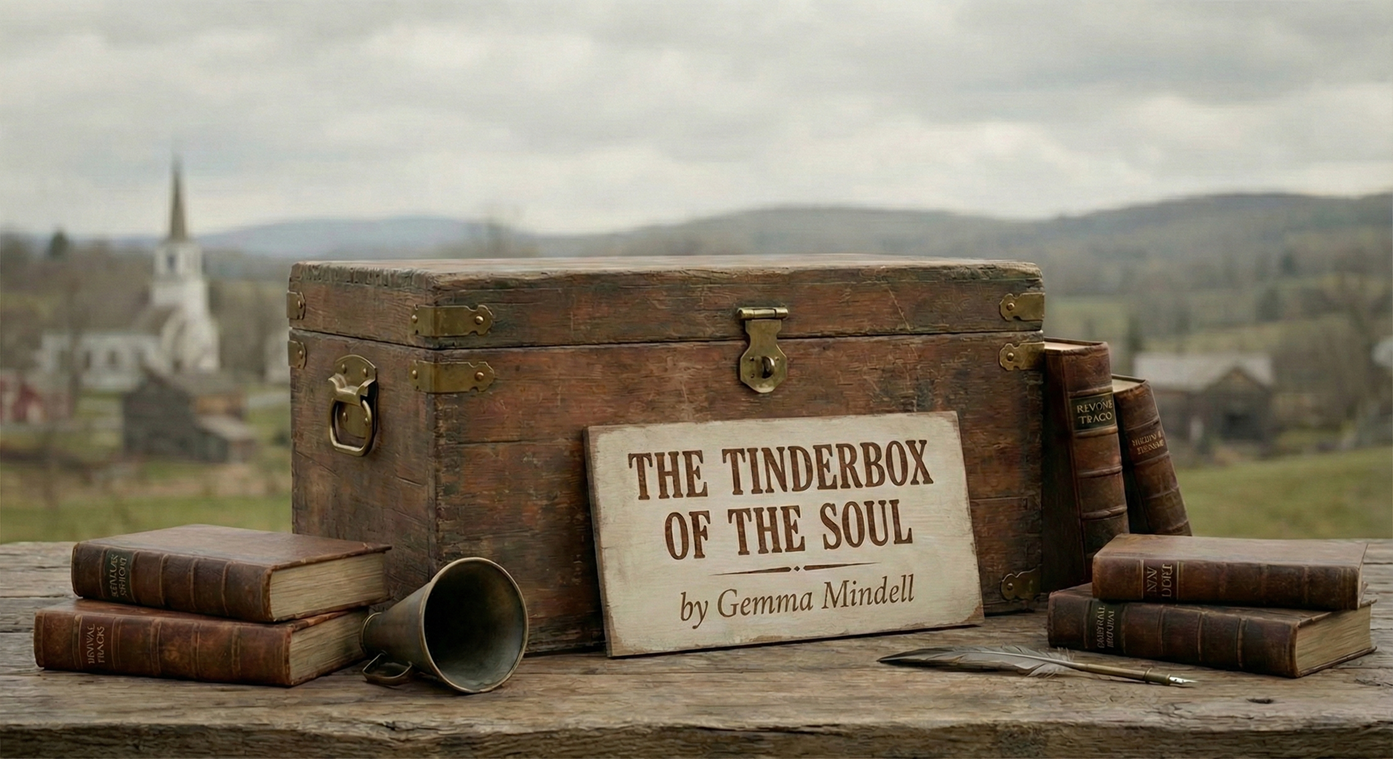
The Tinderbox of the Soul
by Gemma Mindell
West of the Catskills, north of the plains,
Along the ditch that Clinton dug,
The Erie Canal brought goods and grain,
And something strange in the water supply.
In the early nineteenth century,
Upstate New York caught a fever.
Not of malaria or the flu,
But of the spirit, hot and wild.
They called it the “Burned-over District,”
A phrase coined by Finney, the revivalist,
Who looked across the rolling hills
And sighed with a preacher’s grim despair,
“There is no fuel left to burn here.
We have saved them all, or damned them all,
And no one is listening to reason.”
It was a spiritual petri dish,
Where the mold of orthodoxy failed,
And new, bizarre cultures bloomed
In the heat of religious anarchy.
Let us examine the strange exports,
The products of this fever dream,
Where prophets walked in cornfields
And God spoke through the floorboards.
In Palmyra, where the winters bite,
Young Joseph Smith had a vision.
Or several visions, depending on the year.
He dug a hole in a hillside steep,
And found, he said, a book of gold.
The neighbors were skeptical, naturally,
For gold is heavy and hard to hide.
But Joseph had the Seer Stones,
Urim and Thummim, spectacles of God.
He put a rock inside his hat,
And buried his face in the felt lining,
Dictating words to a man nearby.
It was a story of ancient wars,
Of Israelites in canoe-like boats,
Crossing the ocean to America.
The skeptics laughed at the “Gold Bible,”
But the product took root in the soil.
When Martin Harris, a follower,
Lost the first hundred-sixteen pages
(Likely hidden by his angry wife),
Joseph didn’t panic for long.
He simply found a new translation,
A workaround from the heavenly server.
From this burned-over soil rose a faith
That marched west to a salt-rimmed lake,
Building an empire from a hat.
Then came the farmer, William Miller.
He wasn’t a prophet, but a mathematician
Of the biblical and ominous kind.
He read the book of Daniel close,
And calculated the end of time.
“Two thousand and three hundred days,”
Meant years, of course, in prophecy math.
He did the subtraction and the sums,
And pointed to eighteen forty-three.
“The Lord is coming,” Miller cried,
“Get your affairs in order now.”
The Millerites believed the hype.
They were the ultimate product of doom.
Farmers let their potatoes rot.
Why harvest crops you will not eat?
Shopkeepers closed their wooden doors,
Giving away their dry goods stock.
“Gone to Glory,” the signs proclaimed.
The date arrived. The sun went down.
The sun came up. The world remained.
“A calculation error!” Miller said.
“It is October of forty-four!”
The faithful nodded and waited again.
Some say they made “Ascension Robes,”
White linen gowns to fly to God.
On the Great Day of Disappointment,
They stood on roofs and rocky hills,
Waiting for gravity to lose its grip.
But gravity, stubborn as a mule,
Held them firmly to the earth.
The world did not end that Tuesday night,
But the Seventh-day Adventists were born
From the ashes of the math that failed.
In Hydesville, just a buggy ride away,
The Fox Sisters heard a bump in the night.
Kate and Maggie, young and bored,
Heard rapping sounds upon the floor.
“Mr. Splitfoot, do as I do!”
They snapped their fingers; the ghost replied.
One rap for no, and two for yes,
Or three for “Please buy tickets now.”
It was the birth of Spiritualism,
A product exported to the world.
Séances became the parlor game.
Tables floated, or seemed to float,
And ectoplasm (cheesecloth mostly)
Oozed from the mouths of mediums.
For decades, the sisters fame grew large.
They spoke to Franklin, Washington,
And dead Aunt Gertie for a fee.
The Burned-over District loved a ghost.
It wasn’t until the end of life,
That Maggie revealed the holy trick.
It wasn’t spirits from the void,
But the cracking of their big toe joints.
They had double-jointed feet, you see,
And banged their toes against the wood
To simulate the voice of death.
A nonsensical product, built on bones,
That gave the grieving false relief.
And then, the strangest fruit of all.
John Humphrey Noyes, a Yale man,
Decided he was perfect now.
Not just good, but free from sin.
He started a commune at Oneida,
Where monogamy was deemed a crime.
“Complex Marriage,” he named the scheme.
Every man married to every woman,
A free-love flowchart of the soul.
They practiced “Male Continence,”
A method of discipline severe,
To stop the babies from arriving
Unless the committee gave the nod.
They called it Stirpiculture then,
A breeding program for the saints.
The neighbors whispered, shocked and awed,
But Oneida had a business plan.
They didn’t just make love and pray;
They started making animal traps.
The “Newhouse Trap,” a steel-jawed bite,
To catch the beaver and the bear.
From perfecting souls to killing fur,
The business model pivoted.
When the free love finally fell apart,
And Noyes fled to Canada’s woods,
The company dropped the complex marriage
And focused on the dinner table.
They made the finest forks and spoons.
Yes, the Oneida Silverware,
Found in grandmother’s holiday chest,
Is the legacy of a sex cult
That thought they’d solved the problem of sin.
The fire eventually burned itself out.
The prophets died or moved out West.
The Erie Canal was choked with weeds,
Replaced by trains and interstate roads.
But the Burned-over District left its mark.
A legacy of searching souls,
Who looked at standard liturgies
And said, “I think I’ll make my own.”
From golden books to cracking toes,
To waiting for the sky to fall,
And crafting spoons for wedding gifts,
They proved that in the American mind,
The line between the divine truth
And utter nonsense is very thin,
And often crossed with confidence.