
The Therianthropic Spectrum: A Comprehensive Analysis of Alterhuman Identity, Phenomenological Experience, and Clinical Zoanthropy
Introduction to Therianthropy and Alterhumanity
The human condition has long been defined by its perceived separation from the natural world—a rigid boundary distinguishing Homo sapiens from the remainder of the animal kingdom. The ontological framework of Western society fundamentally relies on human exceptionalism, positing that human consciousness, identity, and physical form are inextricably linked and entirely distinct from those of non-human entities. However, throughout history, and increasingly within contemporary digital society, a subset of individuals has consistently challenged this anthropocentric boundary. These individuals identify as "therianthropes," a term derived from the Greek words therion (wild animal) and anthropos (human). Therianthropy represents an experiential phenomenon wherein an individual identifies internally, psychologically, or spiritually as a non-human animal, despite possessing a biologically human body.1
While mainstream society often struggles to categorize this phenomenon, frequently conflating it with delusion, severe psychiatric illness, or performative internet culture, scholarly research across anthropology, sociology, and clinical psychology reveals a highly nuanced and multidimensional landscape.1 Therianthropy exists under the broader conceptual umbrella of "alterhumanity." Coined in 2014, the term alterhumanity serves as an overarching category encompassing any identity that constitutes an alternative to common societal conceptions of humanity.1 This category includes therians, otherkin (those identifying as mythological or non-earthly beings, such as dragons or elves), and various other non-human identities.1
To fully comprehend therianthropy requires a rigorous interdisciplinary approach that bridges the gap between phenomenological identity studies and psychiatric pathology. This report provides an exhaustive examination of therianthropy, tracing its historical roots and subcultural evolution from ancient folklore to modern online communities. It dissects the psychological and spiritual dimensions of the identity, explicitly defining the specific terminology and lived experiences reported within the community. Furthermore, it addresses the clinical validity of the identity, utilizing contemporary psychological literature to argue forcefully against the stigmatizing notion that non-human identified individuals are inherently mentally unstable or "goofy in the head." Finally, to provide a complete picture of human-animal identity mapping, the report delineates the clear boundary between benign therianthropy and clinical lycanthropy—a severe, dangerous psychiatric delusion—by analyzing thoroughly documented medical cases where delusional animal transformation resulted in deeply detrimental and socially unacceptable acts.4
Historical Origins and Subcultural Evolution
The conceptual framework of humans transforming into or possessing the essence of animals is as ancient as human mythology itself. It is present in global shamanistic traditions, animistic religions, and the folklore of virtually every human civilization, from the berserkers of Norse mythology to the nahual of Mesoamerican traditions. However, the specific lexical and cultural codification of "therianthropy" as a personal, lived identity has a distinct evolutionary trajectory, moving from academic descriptors of myth to a self-ascribed label.
Academic Lineage and Early Terminology
In academic literature, the earliest recorded use of the term in a non-clinical, spiritual context occurred in a 1915 publication by Frank Brinkley and Dairoku Kikuchi, A History of the Japanese People from the Earliest Times to the End of the Meiji Era.1 In this seminal text, the authors utilized the word "therianthropy" to describe the spiritual aspects of human transformation into wild animals within Japanese folklore, defining it conceptually as the combination of human and animal forms.1 For decades, the term remained confined to the realms of anthropology, religious studies, and comparative mythology, utilized primarily to describe the beliefs of ancient or non-Western cultures rather than contemporary identities.
Historically, academia has bifurcated its approach to contemporary therianthropy. Psychiatry has traditionally viewed any cross-species identification through a strictly pathologizing lens, linking such beliefs to mental illness, delusion, or psychotic breaks, effectively erasing the individual's agency in constructing their identity.1 Conversely, anthropology has often treated the phenomenon as a manifestation of contemporary shamanism, animistic belief systems, or neo-pagan spiritualism, analyzing it through the lens of cultural practices.1
The Digital Genesis of the Modern Subculture
The genesis of the modern Western therian subculture is deeply intertwined with the advent of the early internet. The community began to coalesce structurally in 1993 on the Usenet newsgroup alt.horror.werewolves.1 Initially created as a forum for discussing werewolf fiction, cinema, and horror media, the digital space quickly attracted individuals who resonated with the concept of lycanthropy not as a fictional horror trope, but as a deeply felt personal reality. By the early 1990s, participants in these online enclaves began adopting the word "therianthropy" as a self-descriptor, moving away from purely mythological terminology like "werewolf" or "lycanthrope" to establish a distinct, personal identity separate from fiction.1
As internet access expanded, so too did the community's infrastructure. Dedicated forums such as The Werelist and Wulfhowl (which later transitioned into Kinmunity, broadening its focus to otherkin as a whole) became crucial digital gathering spaces.6 These platforms allowed for the aggregation of shared experiences, the development of a unique lexicon, and the establishment of community norms. In 2003, the community officially adopted the theta-delta (ΘΔ) symbol as the emblem of therianthropy, representing the integration of the human soul or mind with the animal essence.1 By 2014, recognizing the overlapping experiences between therians and other non-human identified groups, the term "alterhuman" was coined to provide a unified umbrella label, fostering solidarity and facilitating broader sociological research into non-normative identity structures.1
Era | Milestone in Therianthropic History | Significance to the Subculture |
1915 | Publication of A History of the Japanese People... | First academic use of "therianthropy" to describe the spiritual combination of human and animal forms. 1 |
1993 | Formation of alt.horror.werewolves Usenet group | The digital genesis of the modern community; users begin adopting the term as a personal identity. 1 |
Late 1990s | Establishment of forums like The Werelist | Creation of dedicated, moderated spaces allowing for the development of subcultural lexicon and shared norms. 6 |
2003 | Adoption of the Theta-Delta (ΘΔ) symbol | The establishment of a unified visual emblem representing the integration of human and animal identity. 1 |
2014 | Coining of the term "Alterhuman" | The creation of an umbrella term to unite therians, otherkin, and related non-human identity frameworks. 1 |
The Nature of the Identity: Spiritual and Psychological Therianthropy
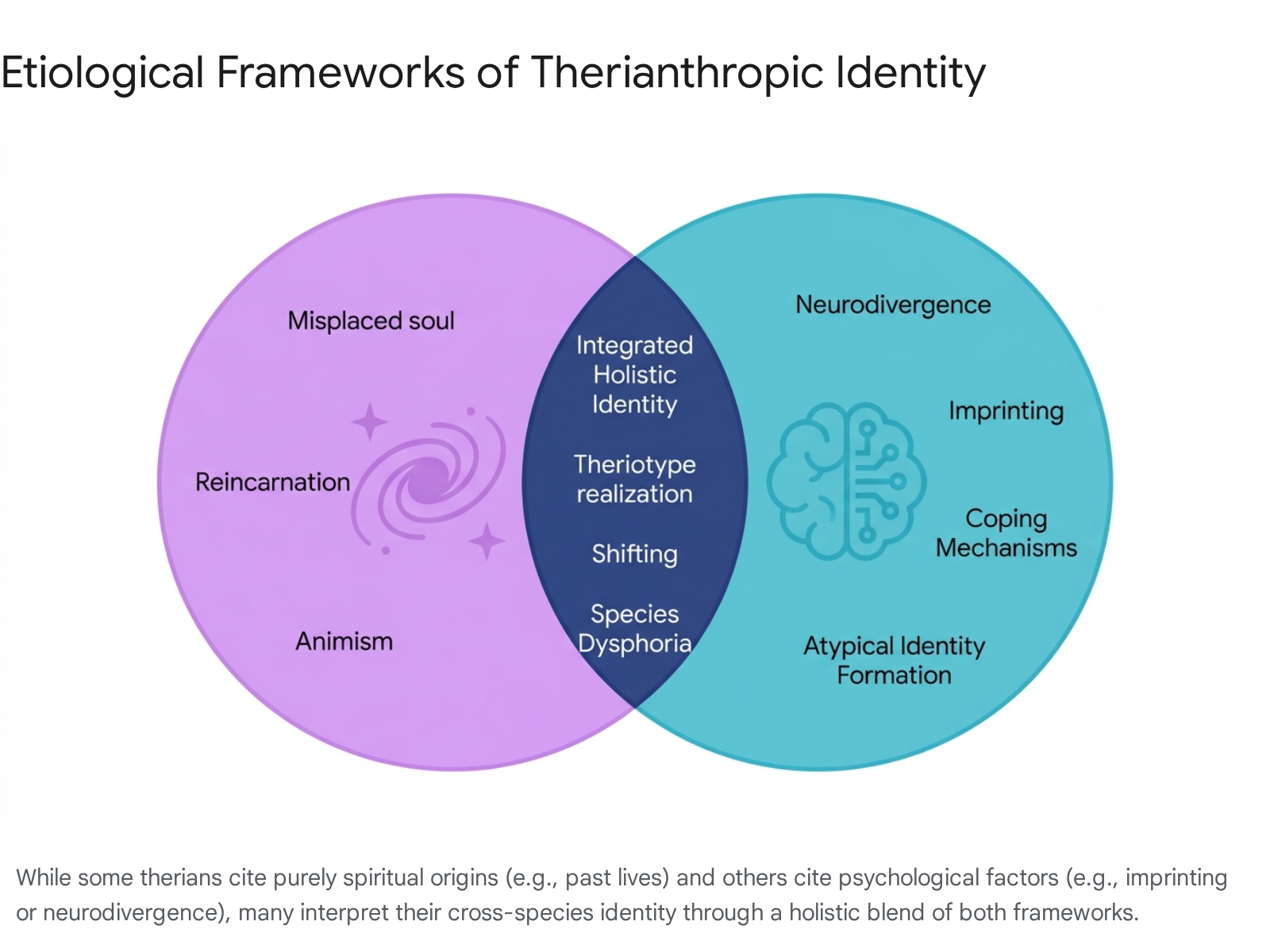
Within the alterhuman community, the etiology of therianthropy—how and why one comes to identify as an animal—is generally categorized into two primary frameworks: Spiritual Therianthropy and Psychological Therianthropy. However, it is vital for researchers and clinicians to understand that these are not mutually exclusive diagnostic criteria. Rather, they are personal interpretive lenses through which individuals make meaning of their non-human identity. Qualitative phenomenological research indicates that individuals interpret their experiences using a variety of explanations, often developing a holistic interpretation that blends both frameworks.2
Spiritual Therianthropy
Spiritual therians interpret their non-human identity through a metaphysical, religious, or spiritual lens. For these individuals, the biological body is unequivocally human, but the soul, essence, or spirit is fundamentally that of an animal.7 The mechanisms for this belief vary widely among practitioners, but they frequently include concepts of reincarnation and past lives. In this framework, the individual believes they lived a previous life as their identified animal, and that the animal's soul subsequently transitioned into their current human body, retaining its original instincts, memories, and spiritual resonance.7
Others within the spiritual framework subscribe to the concept of a "misplaced soul." This belief posits that an error in the cosmic, divine, or spiritual order resulted in an animal spirit being incarnated into a human form by mistake.7 Spiritual therianthropy does not necessarily require adherence to an organized religion. Instead, it often aligns with animistic philosophies, where boundaries between human and non-human consciousness are viewed as permeable and spiritually interconnected. However, it is a persistent misconception among the general public and early researchers that all therianthropy is spiritually derived.9 While spiritual narratives offer profound meaning and existential grounding for many, a significant portion of the community explicitly rejects metaphysical explanations, viewing their identity through entirely different paradigms.9
Psychological Therianthropy
Psychological therians view their identity entirely through the lens of psychology, neurobiology, and developmental conditioning. They do not hold spiritual beliefs regarding their animal nature; rather, they posit that their mind is fundamentally wired, structured, or conditioned in an animal-like manner.7 The explanations within psychological therianthropy are grounded in secular self-analysis, introspection, and contemporary cognitive theories.
Some psychological therians attribute their identity to intense early childhood imprinting. In this model, a deep psychological attachment to, or fascination with, a specific animal species during critical developmental windows resulted in the deep internalization of that animal's traits, behaviors, and social dynamics into the individual's core personality.11 Others view their therianthropy as an atypical neurobiological configuration or an innate variation in human identity formation, operating similarly to how sexual orientation or gender identity develops naturally within a population.12
Furthermore, for some individuals, identifying as an animal serves as a profound psychological coping mechanism. Within academic discussions, the concept of the "Therian Shadow"—a concept rooted in Jungian psychology—has been utilized to explain this phenomenon. The theory suggests that Western culture systematically represses untamed, instinctual, or "uncivilized" behaviors.13 By identifying as an animal, psychological therians can safely integrate these repressed instinctual drives (the Jungian shadow) into their conscious identity in a controlled, manageable way.13 They mitigate the psychological damage of societal repression by asserting that they are in control of these theriotype behaviors, thus achieving a more integrated and healthy psychological state.13
Ultimately, the boundary between spiritual and psychological therianthropy is highly porous. Qualitative research, such as Interpretative Phenomenological Analyses (IPA) conducted within the community by researchers like Grivell et al., reveals that many therians adopt a hybrid interpretation.2 An individual may believe their consciousness is a byproduct of atypical neurobiology or early childhood coping mechanisms while simultaneously holding animistic beliefs regarding their connection to nature, seamlessly blending the two frameworks to make sense of their lived reality.2
Framework | Core Belief System | Common Etiological Explanations | Relationship to Biology |
Spiritual Therianthropy | Metaphysical, religious, or animistic. | Reincarnation (past lives), misplaced souls, cosmic anomalies. 7 | The physical body is human, but the internal soul or spirit is intrinsically non-human. 7 |
Psychological Therianthropy | Secular, neurobiological, developmental. | Early childhood imprinting, neurodivergence, Jungian shadow integration, coping mechanisms. 7 | The physical body is human, and the mind/brain is uniquely structured or conditioned to produce animalistic cognition. 7 |
Holistic/Hybrid | Integrative. | A combination of atypical neurodevelopment and spiritual affinity with nature. 2 | Acknowledges the biological reality while embracing spiritual or psychological dualities. 7 |
The Lexicon of Alterhumanity: Theriotypes and Shifting Phenomena
To effectively engage with the lived experience of therianthropes, researchers and clinicians must understand the highly specific nomenclature the community has developed over decades. This lexicon serves to articulate phenomenological states, internal sensations, and identity constructs that lack standard linguistic equivalents in normative society.
Theriotype
A "theriotype" (sometimes referred to as a kintype in broader otherkin communities) is the specific non-human animal species with which a therian identifies.11 While the earliest internet communities focused heavily on wolves and large canines (hence the genesis in alt.horror.werewolves), contemporary theriotypes span the entire animal kingdom, including felines, avians, reptiles, marine life, and even insects.1 An individual may have a single theriotype or multiple (polytherians).
Crucially, a therian does not consciously "choose" their theriotype in the way one might choose a favorite animal or a roleplaying character. Rather, the process is universally described in phenomenological research as a journey of self-discovery.11 This journey often involves deep introspection, meditation, and the rigorous analysis of intrinsic behavioral urges, involuntary sensory experiences, and childhood memories.11 Grivell et al. (2014) published a foundational interpretative phenomenological study revealing that this journey often begins with recollecting early childhood experiences of feeling animal-like and involuntarily engaging in behaviors associated with specific animals, such as growling, biting, or specific locomotive patterns.11
Shifting
"Shifting" is the cornerstone of the therianthropic experience. It refers to a temporary, transient alteration in an individual's state of consciousness, perception, or sensory awareness that brings them into closer alignment with their theriotype.1 Shifting is heavily debated, meticulously categorized, and rigorously self-policed within the community.
Notably, the concept of physical shifting (p-shifting)—the belief that one can literally change their biological cellular form into an animal—is overwhelmingly rejected by the therian community as scientifically impossible and biologically absurd.16 Claims of p-shifting in online spaces are consistently met with harsh rebuke, with community leaders categorizing such claims as either deliberate mythomania, attention-seeking, or evidence of severe clinical psychiatric illness requiring immediate medical intervention.16 The accepted forms of shifting are strictly non-physical, residing entirely within the realms of cognition, emotion, and somatosensation.
Mental Shifts (M-Shifts): A mental shift involves a temporary alteration in cognitive processing and emotional state where the individual's thought patterns, instincts, and urges become intensely aligned with the psychology of their theriotype.14 During a mental shift, higher-order human reasoning and social conditioning may take a secondary role to primal, animalistic instincts.14 The individual might experience a heightened urge to hunt, a sudden change in body language and vocalization, or a hyper-awareness of their environment consistent with prey or predator dynamics.15 However, a defining characteristic that separates a mental shift from a psychotic episode is that the individual almost always retains full reality testing; they remain acutely aware that they inhabit a human body and are bound by the physics and social constraints of human society.15
Phantom Shifts (P-Shifts): Phantom shifts represent a profound and highly specific somatosensory phenomenon. Functioning conceptually similar to the neurological condition of phantom limb syndrome experienced by amputees, a phantom shift involves the acute, distinct sensation of body parts that belong to the theriotype but do not physically exist on the human body.6 For example, a canine or feline therian may feel the intense tactile sensation of a tail, complete with the kinesthetic sense of it wagging or twitching in response to emotional stimuli.6 An avian therian might sense the weight, span, and aerodynamic drag of wings on their back; a reptilian therian might feel the texture of tough scales across their skin.6 These somatosensory aberrations are experienced as incredibly realistic and can be triggered by specific environmental stimuli or occur entirely spontaneously.18 During a strong phantom shift, the individual may experience an intense feeling of alienation from their biological human form, leading to profound psychological distress when their physical reality contradicts their sensory input.18
Species Dysphoria
The acute distress, anxiety, and depression arising from the dissonance between a therian's internal non-human identity (and accompanying sensory shifts) and their external human biology is termed "Species Dysphoria".1 Modeled conceptually on the psychiatric understanding of gender dysphoria, species dysphoria describes a profound sense of physical wrongness and dissatisfaction with the human body.1
Academic research has increasingly focused on this phenomenon, demonstrating that species dysphoria is highly prevalent within alterhuman populations. In a rigorous academic study conducted by Nat L. Bricker utilizing the specially designed Species Dysphoria Scale, quantitative data indicated that 76.4% of non-human identified participants explicitly endorsed experiencing this profound dissatisfaction.14 This finding is consistent with multiple internal community surveys that have repeatedly found that over 75% of respondents experience significant species dysphoria.14
The dysphoria can manifest in dual modalities: as a persistent, depressive ache for the specific morphology of the theriotype (e.g., distress over lacking fur, claws, a muzzle, or specific skeletal structures), or as a general feeling of repulsion toward human biomechanics and the necessity of existing in a human form at all.18 As the well-known queer author Pat Califia notably articulated in 1997 regarding their own anomalous internal experiences, "I'm never sure if I have gender dysphoria or species dysphoria. I often try to explain that I'm really a starfish trapped in a human body and I'm very new to your planet".19 When species dysphoria is triggered—often following a vivid mental or phantom shift where the individual catches sight of their human reflection—it can result in severe depressive episodes.15 This frequently necessitates "camouflaging," where the individual suppresses their distress and hides their identity to avoid societal ostracization, which in turn compounds their psychological burden.14
Psychological Profiling and Depathologization: Challenging the "Goofy in the Head" Stigma
Because the notion of identifying as an animal fundamentally violates deeply entrenched Western ontological categories of human exceptionalism, therianthropes are frequently subjected to intense societal mockery. They face persistent pathologization from the general public and are frequently dismissed as being "goofy in the head," suffering from clinical psychosis, or engaging in elaborate, performative attention-seeking. However, a rapidly growing body of rigorous psychological, sociological, and developmental research decisively refutes this inherent pathologization, arguing for a contextual understanding of alterhumanity.2
First and foremost, therianthropy, in itself, is not classified as a mental disorder by the Diagnostic and Statistical Manual of Mental Disorders (DSM-5) or the International Classification of Diseases (ICD-11).17 The presence of an unusual belief or a non-normative identity does not automatically fulfill the criteria for psychiatric illness, which requires the presence of clinically significant distress or impairment directly caused by a pathological mechanism. Dr. Amaya Prado, a clinical psychologist and member of the Madrid College of Psychology, addresses the growing visibility of adolescent therians, noting that this phenomenon is best understood through the lens of developmental psychology rather than clinical pathology.12 Among adolescents, identifying as a therian serves critical psychological functions relating to identity formation.12 It provides a mechanism for youth to experiment with symbolic identities, seek a shared community, and find validation in spaces where they do not feel alienated or marginalized for being "different".12
Extensive empirical studies conducted by the International Anthropomorphic Research Project (IARP, also known as FurScience)—a multidisciplinary team of social psychologists, anthropologists, and sociologists—have been instrumental in demystifying these communities.20 Utilizing peer-reviewed scholarship, the IARP has consistently demonstrated that unusual beliefs and cross-species identities are not synonymous with mental illness or psychosocial dysfunction.22 Furthermore, a comprehensive thesis study by Luiggi-Hernández successfully employed a matching paradigm to create equivalent non-human-identified and human-identified control groups (N=317).14 The quantitative analysis revealed no significant differences in baseline mental health outcomes between the therian/otherkin participants and the human-identified controls.14
When elevated levels of anxiety, depression, or psychological distress are present in therians, they are most accurately explained and predicted by the Minority Stress Model.14 This framework, originally developed to understand the mental health disparities in LGBTQ+ populations, posits that psychological distress in minority groups is not caused by the identity itself. Rather, it is the direct result of chronic exposure to minority stressors: societal stigmatization, prejudice, the exhausting necessity of "camouflaging" one's true self in public, and the lack of social support.14 The study found that camouflaging and species dysphoria were the primary predictors of psychological distress, while identity pride and community connectedness were the primary predictors of psychological well-being.14
Intriguingly, recent psychological research indicates that therianthropy can serve as a potent psychological protective factor for certain neurodivergent populations. Studies examining individuals high in schizotypy (a personality trait continuum involving unusual perceptual experiences and beliefs) and autism found complex interactions with alterhuman identity.22 While therians as a broad group sometimes scored lower on variables associated with positive social relationships (likely due to societal stigmatization), the data revealed that being a therian actively moderated the relationship between autism, introverted anhedonia (the inability to enjoy physical and social pleasures), and poor autonomy.22 By finding a cohesive narrative and a supportive community to contextualize their atypical sensory experiences and social alienation, therians effectively transform potentially isolating neurodivergent traits into a structured, meaningful, and empowered identity.14 Therefore, modern academic consensus strongly urges clinicians to adopt a contextual, non-pathologizing approach. Clinicians are advised to inquire about non-human identities without automatically framing them as delusions, focusing instead on reducing minority stress and increasing resilience factors.14
The Pathological Threshold: Clinical Lycanthropy and Zoanthropy
While therianthropy represents a benign, non-pathological identity structure utilized for self-understanding, there exists a severe, pathological extreme on the spectrum of animal-identification: Clinical Lycanthropy. This condition, alongside its variants such as clinical kynanthropy (the delusion of being a dog) or clinical zoanthropy (the delusion of being any animal), represents a profound psychiatric emergency.4
It is medically and forensically imperative to delineate strictly between a therianthrope and a clinical lycanthrope. A therian possesses intact reality testing; they know their biological body is unequivocally human, they reject physical shapeshifting as scientifically impossible, and they experience their identity as an internal psychological or spiritual state.15 In stark contrast, a clinical lycanthrope suffers from a true psychotic delusion. They hold a fixed, false, and unshakeable belief that their physical body is actually in the process of transforming, or has already completely transformed, into a non-human animal, despite all objective reality and evidence to the contrary.25
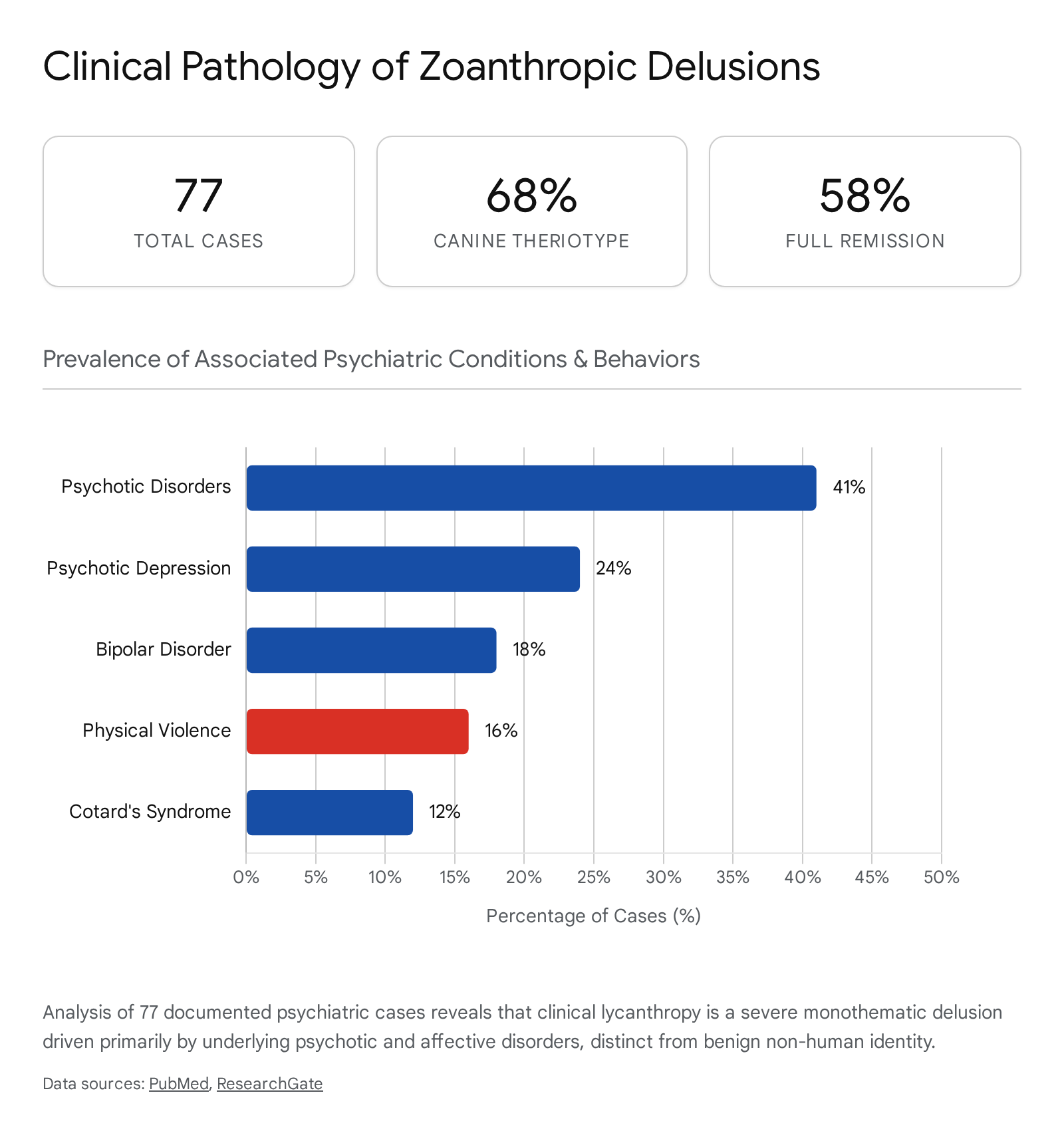
The severity of this psychiatric condition was exhaustively detailed in a landmark 2025 systematic review conducted by Dr. Jan Dirk Blom and Dr. Brian A. Sharpless, published in Neuroscience & Biobehavioral Reviews.4 Analyzing 77 documented psychiatric cases of clinical therianthropy, the researchers established the profound pathology underlying the delusion.4 Among the documented cases, 68% involved transformations into canines (lycanthropy and kynanthropy), highlighting a cultural or neurological predisposition toward these specific predators.4
The etiology of clinical lycanthropy is intimately tied to severe underlying psychiatric and neurological disorders. The systematic review identified the primary comorbidities driving the delusion: primary psychotic disorders (such as schizophrenia) accounted for 41% of cases, psychotic depression for 24%, bipolar disorder (mania with psychotic features) for 18%, and Cotard’s syndrome (the nihilistic delusion that one is dead or does not exist) for 12%.4 The delusion has also been documented, albeit rarely, as secondary to severe Obsessive-Compulsive and Related Disorders (OCRDs) and organic brain diseases.30
To explain the genesis of this bizarre delusion, Blom and Sharpless proposed a comprehensive "two-hit" pathophysiological model.4
- The First Hit (Cenesthesiopathy): This involves severe somatic hallucinations and somatosensory aberrations. Due to dysfunction in the parietal lobe or other sensory processing areas, the patient's brain generates intensely abnormal physical sensations.4 The patient literally feels the physical extrusion of fangs, the growth of fur across their skin, or the agonizing restructuring of their skeletal system.32
- The Second Hit (Delusion Formation): This involves a fundamental failure in cognitive belief-evaluation. To explain these terrifying and bizarre physical sensations, the compromised brain forms a monothematic delusion.4 To the patient, the transformation is not a metaphor or a spiritual affinity; it is an undeniable physical reality perceived through a malfunctioning neurosensory apparatus.25 As researchers note, if the brain insists the hands are claws, then from the perspective of the patient's lived experience, the claws are entirely real.34
The prognosis for clinical lycanthropy varies significantly based on the underlying etiology. While aggressive psychopharmacological treatment—often involving high-dose antipsychotics and antidepressants—resulted in full remission of the lycanthropic delusion in 58% of cases and partial remission in 33%, the underlying conditions driving the psychosis often remain highly chronic in nature, rendering the overall psychiatric prognosis generally poor.4
Documented Cases of Detrimental and Socially Unacceptable Acts
The critical importance of distinguishing between benign therianthropy and clinical lycanthropy becomes starkly evident when examining patient outcomes. While the therian subculture is fundamentally non-violent, focused on internal self-actualization, and deeply integrated into normative society, clinical lycanthropy has resulted in extensively documented cases of severe, socially unacceptable, and highly violent behavior.
The delusion of physical transformation effectively strips the patient of their human social conditioning, frequently leading to the expression of primal, predatory violence that matches the delusional theriotype. Notably, in the Blom and Sharpless review, 16% of individuals suffering from clinical lycanthropy engaged in other-directed physical violence.4 The medical literature provides several harrowing case studies illustrating how detrimental this delusion can be to both the patient and the public.
Case 1: Deadly Violence and Mythomanic Antisocial Behavior (Bénézech et al., 1989)
In a highly cited and chilling report published in the Annales Médico-Psychologiques, French psychiatrists Bénézech, De Witte, Etchepare, and Bourgeois documented a severe case of lycanthropy culminating in homicide.35 The patient was a 28-year-old male who was evaluated while imprisoned for committing acts of deadly violence.35 Over a period of many years, the patient experienced severe depersonalization episodes during which he held the fixed, unshakeable belief that he was physically transforming into a werewolf.35
During these psychotic episodes, the patient exhibited overt lycanthropic behavior, mimicking the nocturnal roaming and predatory aggression associated with the mythology of the werewolf.35 This delusion served to completely remove his psychological inhibitions, allowing him to act upon extreme violent impulses under the guise of an uncontrollable, predatory animal nature. Psychiatric evaluation found it difficult to place his complex pathology into a neat nosographical framework; while the lycanthropy was clinically evident, the picture was heavily complicated by severe alcoholism, a deep-seated antisocial personality disorder, hysteria, and mythomania.35 In this instance, the lycanthropic delusion served as the direct psychological vehicle through which murder was enacted, demonstrating the lethal potential of the untreated syndrome.35
Case 2: Extreme Violence Risk, Kynanthropy, and Vampirism (Mulholland et al., 2024)
A complex modern case study highlights the severe risk posed to the public by multifaceted zooanthropic delusions. Mulholland and colleagues documented the case of a 35-year-old male from urban India with a long-standing history of schizophrenia.37 The patient developed simultaneous, severe delusions of kynanthropy (transforming into a dog) and vampirism, precipitated by the discontinuation of his required antipsychotic medication.38
The patient exhibited intense behavioral changes, including aggressively growling and barking at others.37 More alarmingly, his delusional framework extended to an expressed, active craving to bite people on the neck to consume their blood, an urge stemming directly from his comorbid vampiric delusions.26 A clinical evaluation utilizing the HCR-20—a standardized professional tool for assessing the risk of future violence—yielded a score greater than 30, indicating an exceptionally high risk of violence and harm to others.27 His historical risk factors (previous violence, major mental illness), combined with his active psychotic drive to bite and consume blood, necessitated immediate and intense psychiatric confinement.27 The patient proved highly refractory to standard interventions, experiencing only minimal relief from massive doses of multiple antipsychotics (including olanzapine up to 80mg/day and haloperidol up to 25mg/day).39 Only through strict inpatient confinement and isolation from environmental stressors could his symptom intensity be slightly ameliorated, preventing him from acting out his violent, blood-seeking delusions upon the public.37
Case 3: Psychotic Agitation and Loss of Control (Rosenstock & Vincent, 1977)
Documented in the American Journal of Psychiatry, psychiatrists Rosenstock and Vincent detailed the case of a 49-year-old married woman who presented for urgent psychiatric evaluation due to the acute delusion that she was a wolf.40 Unlike the internal, manageable identity of a benign therian, this patient was entirely consumed by the physical delusion of transformation and the terrifying loss of somatic boundaries.
She reported to clinicians that she "felt like an animal with claws" and experienced intense, hallucinatory sensations of fangs and fur.40 Her behavior rapidly devolved into socially unacceptable, primal acts; she engaged in severe gnashing and snarling, stared into mirrors terrified by her own altered perception of her reflection, and experienced overwhelming urges to roam the night.40 During her episodes, she expressed a predatory and hypersexualized desire to "haunt the graveyards" in search of a "hairy creature," stating, "I am a wolf of the night; I am a wolf woman of the day... and anguish is my prey".40 The delusion completely stripped her of her human social conditioning, rendering her wildly agitated and entirely out of control until medical personnel intervened with daily psychotherapy and heavy regimens of neuroleptic medications, which eventually subdued the lycanthropic psychosis.40
Case 4: Multiple Serial Lycanthropy and Identity Fragmentation (Dening & West, 1989)
While clinical lycanthropy typically involves a single, fixed animal delusion, the breakdown of reality testing can be so severe that identity fragments entirely. Psychiatrists Dening and West documented a highly unusual and deeply distressing case of "multiple serial lycanthropy" in an adult female experiencing an acute psychotic illness.43
Over a very short period, the patient experienced the terrifying subjective reality of physically transforming into four entirely different species of animals.43 The clinicians noted that this was not merely a falsely held cognitive belief but an overwhelming "abnormal subjective experience" driven by intense somatic hallucinations.43 These hallucinations forced her to act out the wildly varying and socially disruptive behaviors of four different beasts in rapid succession, resulting in severe behavioral dysregulation, extreme distress, and the necessity of intensive inpatient psychiatric management.43
Case 5: Organic Brain Disease and Persistent Agitation (Huntington's Disease Comorbidity, 2023)
Demonstrating that clinical lycanthropy can arise from organic neurological decay rather than purely functional psychiatric illness, a 2023 case report documented a 63-year-old white British man with Huntington's disease (HD).32
The patient was admitted to a specialist neuropsychiatry unit following a two-year history of anxiety and obsessional preoccupations that ultimately progressed into full psychosis.32 The neurodegeneration of HD triggered severe cenesthesiopathy, leading to the clinical delusion of animal transformation. On admission, the patient was in a state of near-constant mental and physical agitation, exacerbated by the prominent choreiform (involuntary, jerky) movements affecting his upper body, which he incorporated into his animalistic delusion.32 His condition remained dangerously refractory, failing to improve despite the administration of various antidepressants and antipsychotics, illustrating the devastating impact of zoanthropic delusions when anchored in progressive brain disease.32
Case 6: The Historical Precedent of Cannibalism: Jean Grenier (1603)
To fully understand the historical intersection of lycanthropy, medical pathology, and extreme societal detriment, modern psychiatry frequently references the exhaustively documented 17th-century case of Jean Grenier.45 Grenier, a 13-year-old French shepherd boy who was physically small, underfed, and considered mentally delayed by his peers, openly boasted to local girls that he was a werewolf and stated plainly that children were "much more pleasant and delicate to eat".46
Following his arrest, Grenier stubbornly confessed to lycanthropy and to the actual murder and cannibalization of several local infants and children, describing in grisly detail how he used his hands and teeth to tear them apart—details that horrifyingly matched the physical evidence found on victims in the region.42 Rather than interpreting his claims as literal demonic shapeshifting—which would have resulted in standard execution by burning at the stake, as was common during the werewolf trials of the era—the local appeals court in Bordeaux ordered physicians to examine him.46
The physicians, acting as early expert psychiatric witnesses, evaluated his mental state and concluded the boy was suffering from severe "melancholy" (the era's equivalent of a psychotic or depressive psychiatric diagnosis).46 This organic illness, they argued, resulted in lycanthropic delusions that drove him to commit the horrific acts of murder and cannibalism.45 In a landmark moment for Western jurisprudence and the concept of criminal non-responsibility due to psychiatric illness, Grenier was spared the stake.48 He was instead confined for life to a Franciscan monastery for monitoring and spiritual care, cementing the early medical recognition that the severe delusion of animal transformation can drive humans to the absolute ultimate extremes of violent, socially destructive behavior.48
Case Study | Patient Profile | Primary Delusion | Detrimental / Socially Unacceptable Acts | Clinical Outcome / Intervention |
Bénézech et al. (1989) | 28-year-old male; antisocial personality, alcoholism. 35 | Lycanthropy (Werewolf). 35 | Committed deadly violence/homicide while experiencing depersonalization and roaming at night. 35 | Imprisonment; condition complicated by hysteria and mythomania. 35 |
Mulholland et al. (2024) | 35-year-old male; long-standing schizophrenia. 38 | Kynanthropy (Dog) and Vampirism. 37 | Growling, barking, and an active, expressed craving to bite necks and suck human blood. (HCR-20 > 30). 27 | Highly refractory to treatment; required massive doses of antipsychotics and strict inpatient confinement. 39 |
Rosenstock & Vincent (1977) | 49-year-old married female. 40 | Lycanthropy (Wolf). 40 | Severe agitation, snarling, gnashing teeth, and expressing urges to "haunt graveyards" for sexual/predatory purposes. 40 | Subdued only through intensive daily psychotherapy and heavy neuroleptic medication. 40 |
Dening & West (1989) | Adult female; acute psychotic illness. 43 | Multiple Serial Lycanthropy (4 species). 43 | Severe behavioral dysregulation and distress driven by the subjective reality of transforming into multiple beasts rapidly. 43 | Required intensive psychiatric management to address the extreme somatic hallucinations. 43 |
Jean Grenier (1603) | 13-year-old male; intellectually delayed. 46 | Lycanthropy (Werewolf). 46 | Murder and cannibalization of multiple local infants and children using teeth and hands. 46 | Diagnosed with "melancholy" by physicians; spared execution and confined for life in a monastery. 46 |
Conclusion
The study of humans identifying with, or believing themselves to be, non-human animals reveals a vast, deeply complex, and multidimensional spectrum of human experience. At one end of this spectrum lies the benign, subcultural phenomenon of therianthropy. For these individuals, identifying as a non-human animal is a deeply held spiritual belief regarding the nature of the soul, or a complex psychological framework utilized to navigate neurodivergence, integrate the Jungian shadow, build community, and manage identity formation.1 As modern psychological research decisively demonstrates, these individuals possess entirely intact reality testing, do not suffer from clinical delusions, and should not be stigmatized as mentally ill or "goofy in the head".14 Their experiences, such as mental and phantom shifts, are profound subjective phenomena that, while highly unusual, do not inherently correlate with negative mental health outcomes beyond the standard impacts of minority stress and societal ostracization.14
However, the medical literature unequivocally demonstrates the existence of the dark, pathological end of this spectrum: clinical lycanthropy and zoanthropy.4 Driven by severe underlying psychiatric illnesses, cenesthesiopathy, and a total, catastrophic collapse of reality testing, clinical lycanthropes suffer the terrifying and unshakeable delusion of literal physical transformation.4 As documented in exhaustive medical case studies spanning centuries, when the human mind genuinely believes it has become a beast, the social contract is frequently and violently broken. Stripped of human inhibition and guided by malfunctioning neurosensory apparatuses, clinical lycanthropes have engaged in profound agitation, extreme physical violence, cannibalism, and homicide.4 Understanding this entire spectrum—from non-pathological identity integration to severe psychotic delusion—is crucial for both the sociological acceptance and protection of alterhuman individuals, and the necessary clinical and forensic management of those suffering from dangerous psychiatric misidentifications.29
Works cited
- Therian subculture - Wikipedia, accessed July 1, 2026, https://en.wikipedia.org/wiki/Therian_subculture
- Therianthropy; the integration of animal and human identities - NomadIT, accessed July 1, 2026, https://nomadit.co.uk/conference/asa15/paper/23825
- Otherkin - Wikipedia, accessed July 1, 2026, https://en.wikipedia.org/wiki/Otherkin
- A systematic review on clinical therianthropy and a proposal to ..., accessed July 1, 2026, https://pubmed.ncbi.nlm.nih.gov/40350004/
- MAN TRANSFORMING INTO WOLF: A RARE CASE OF CLINICAL LYCANTHROPY - JNBS, accessed July 1, 2026, https://jnbs.org/uploads/files/JNBS.1401371806_en.pdf
- Life Stories of Therianthropes: An Analysis of Nonhuman Identity in a Narrative Identity Model - Academia.edu, accessed July 1, 2026, https://www.academia.edu/34647048/Life_Stories_of_Therianthropes_An_Analysis_of_Nonhuman_Identity_in_a_Narrative_Identity_Model
- A Guide: Therianthropy - Spirituality vs physiologically - Wattpad, accessed July 1, 2026, https://www.wattpad.com/1366997967-a-guide-therianthropy-spirituality-vs
- Psychological or Spiritual?? : r/Therian - Reddit, accessed July 1, 2026, https://www.reddit.com/r/Therian/comments/1apvefp/psychological_or_spiritual/
- Spiritual Therianthropy - Therian Wiki - Fandom, accessed July 1, 2026, https://therian.fandom.com/wiki/Spiritual_Therianthropy
- How do you know if you are a spiritual or a psychological therian? - Reddit, accessed July 1, 2026, https://www.reddit.com/r/Therian/comments/1fao2wg/how_do_you_know_if_you_are_a_spiritual_or_a/
- An Interpretative Phenomenological Analysis of Identity in the Therian Community, accessed July 1, 2026, https://www.researchgate.net/publication/262685394_An_Interpretative_Phenomenological_Analysis_of_Identity_in_the_Therian_Community
- What psychology says about 'therians,' the teens who identify as animals: 'It's not a disorder”, accessed July 1, 2026, https://www.hola.com/us/lifestyle/20260220885140/what-psychology-says-about-therians-teens-identify-as-animals-not-a-disorder/
- Grivell et al—An Interpretive Phenomenological Analysis of Identity in the Therian Community | anthropolojamz, accessed July 1, 2026, https://anthropolojamz.wordpress.com/2015/07/20/an-interpretive-phenomenological-analysis-of-identity-in-the-therian-community/
- Mental Health and Well-Being of Nonhuman-Identified Individuals: The Role of Minority Stress and Resilience - ProQuest, accessed July 1, 2026, https://search.proquest.com/openview/ff89d8a10e0a1e75c6523b12580feeb3/1?pq-origsite=gscholar&cbl=18750&diss=y
- How does shifting feel like? : r/Therian - Reddit, accessed July 1, 2026, https://www.reddit.com/r/Therian/comments/1d9v8e3/how_does_shifting_feel_like/
- On Being Non-Human: Otherkin Identification and Virtual Space - ProQuest, accessed July 1, 2026, https://search.proquest.com/openview/e156c24bf65c4efb0918a8db37433cce/1?pq-origsite=gscholar&cbl=18750&diss=y
- Policing the Fluff: The Social Construction of Scientistic Selves in Otherkin Facebook Groups - Engaging Science, Technology, and Society, accessed July 1, 2026, https://estsjournal.org/index.php/ests/article/download/252/166/
- What causes species dysphoria? - Quora, accessed July 1, 2026, https://www.quora.com/What-causes-species-dysphoria
- Why be human when you can be otherkin? - University of Cambridge, accessed July 1, 2026, https://www.cam.ac.uk/research/news/why-be-human-when-you-can-be-otherkin
- Seeding the Grassroots of Research on Furries: Lessons Learned from 15 Years of Creative Knowledge Mobilization, Valuing Community Partnerships, and Correcting the Record on Stigmatized Communities with Evidence-Based Scholarship - Taylor & Francis, accessed July 1, 2026, https://www.tandfonline.com/doi/abs/10.1080/01639625.2023.2237634
- FurScience - WikiFur, the furry encyclopedia, accessed July 1, 2026, https://en.wikifur.com/wiki/FurScience
- Therianthropy: Wellbeing, Schizotypy, and Autism in Individuals Who Self-Identify as Non-Human - Brill, accessed July 1, 2026, https://brill.com/downloadpdf/journals/soan/27/4/article-p403_3.pdf
- Furscience, the real science behind furries and their fandom., accessed July 1, 2026, https://furscience.com/
- Therianthropy: wellbeing, schizotypy, and autism in individuals who self-identify as non-human - University of Northampton's Research Explorer, accessed July 1, 2026, https://pure.northampton.ac.uk/en/publications/therianthropy-wellbeing-schizotypy-and-autism-in-individuals-who-/
- Clinical lycanthropy - Wikipedia, accessed July 1, 2026, https://en.wikipedia.org/wiki/Clinical_lycanthropy
- Kynanthropic and vampirism delusions: A case report and review of the literature, accessed July 1, 2026, https://research.universityofgalway.ie/en/publications/kynanthropic-and-vampirism-delusions-a-case-report-and-review-of-/
- Kynanthropic and vampirism delusions: a case report and review of the literature - Cambridge University Press & Assessment, accessed July 1, 2026, https://www.cambridge.org/core/services/aop-cambridge-core/content/view/B85A9EA3A96DC3F9B089C93973D82124/S0790966723000290a.pdf/kynanthropic-and-vampirism-delusions-a-case-report-and-review-of-the-literature.pdf
- Jan Dirk Blom - Universiteit Leiden, accessed July 1, 2026, https://www.universiteitleiden.nl/en/staffmembers/jan-dirk-blom/publications
- A systematic review on clinical therianthropy and a proposal to conceptualize zoomorphism as a diagnostic spectrum | Article Information | J-GLOBAL - JST, accessed July 1, 2026, https://jglobal.jst.go.jp/en/detail?JGLOBAL_ID=202502275416566730
- A Rare Report of Clinical Lycanthropy in Obsessive-Compulsive and Related Disorders, accessed July 1, 2026, https://pmc.ncbi.nlm.nih.gov/articles/PMC7971710/
- [Lycanthropy-zooanthropism--discussion of a psychopathological phenomenon]., accessed July 1, 2026, https://www.semanticscholar.org/paper/c961681a7956fc99a401360d34e31a3c2f2a0d44
- Case report: Clinical lycanthropy in Huntington's disease - Frontiers, accessed July 1, 2026, https://www.frontiersin.org/journals/psychiatry/articles/10.3389/fpsyt.2023.1089872/full
- Lycanthropy: New Evidence of Its Origin - Ovid, accessed July 1, 2026, https://www.ovid.com/journals/psypat/pdf/10.1159/000029086~lycanthropy-new-evidence-of-its-origin
- Clinical Lycanthropy: When Patients See Themselves Transform Into Animals - Rafiul Alam, accessed July 1, 2026, https://alamrafiul.com/blogs/clinical-lycanthropy-transformations/
- [A case of lycanthropy with deadly violence] - PubMed, accessed July 1, 2026, https://pubmed.ncbi.nlm.nih.gov/2683931/
- “Psychology in pathology- Clinical Lycanthropy” - Pen Acclaims, accessed July 1, 2026, https://penacclaims.com/wp-content/uploads/2020/04/Alisha-Juneja.pdf
- Kynanthropic and vampirism delusions: a case report and review of the literature, accessed July 1, 2026, https://www.researchgate.net/publication/372158734_Kynanthropic_and_vampirism_delusions_a_case_report_and_review_of_the_literature
- Case reports of clinical lycanthropy and kynanthropy in the scientific... - ResearchGate, accessed July 1, 2026, https://www.researchgate.net/figure/Case-reports-of-clinical-lycanthropy-and-kynanthropy-in-the-scientific-literature_fig2_355180582
- Kynanthropic and vampirism delusions: a case report and review of the literature | Irish Journal of Psychological Medicine | Cambridge Core, accessed July 1, 2026, https://www.cambridge.org/core/journals/irish-journal-of-psychological-medicine/article/kynanthropic-and-vampirism-delusions-a-case-report-and-review-of-the-literature/B85A9EA3A96DC3F9B089C93973D82124
- A case of lycanthropy - Psychiatry Online, accessed July 1, 2026, https://psychiatryonline.org/doi/pdf/10.1176/ajp.134.10.1147?download=true
- The Curse of the Werewolf: Fantasy, Horror and the Beast Within 9780755695584, 9781845111588 - DOKUMEN.PUB, accessed July 1, 2026, https://dokumen.pub/the-curse-of-the-werewolf-fantasy-horror-and-the-beast-within-9780755695584-9781845111588.html
- Creatures of the Night | Encyclopedia.com, accessed July 1, 2026, https://www.encyclopedia.com/science/encyclopedias-almanacs-transcripts-and-maps/creatures-night
- Multiple serial lycanthropy. A case report - PubMed, accessed July 1, 2026, https://pubmed.ncbi.nlm.nih.gov/2639384/
- (PDF) Multiple Serial Lycanthropy - ResearchGate, accessed July 1, 2026, https://www.researchgate.net/publication/20517600_Multiple_Serial_Lycanthropy
- Battling demons with medical authority: werewolves, physicians and rationalization - PMC, accessed July 1, 2026, https://pmc.ncbi.nlm.nih.gov/articles/PMC4090416/
- Primary Source: When Harry Met a Werewolf Manuscript - Not Even Past, accessed July 1, 2026, https://notevenpast.org/primary-source-when-harry-met-a-werewolf-manuscript/
- Among the first french werewolf-trials that became known was the one which were about Pierre Burgot and Michel Verdun, two farmers who were put to trial 1521. Burgots story was strange. Nineteen years earlier he had been out with his sheep when a hard storm came. When he ran around and tried to gather the frightened animals he met three men on horses, dressed in black and sitting on black horses. One of them asked what was going on and the breathless Burgot told them about the sheep that had run away and he was frightened that they should be victims to the wolfs. The stranger told him not to worry, and that if Burgot agreed to serve him and see him as his lord and master he would protect the sheep for the coming days and years and also give him money. Burgot accepted the purposal and said that he would met the stranger, who called himself Moyet. - Nightbringer.se, accessed July 1, 2026, https://nightbringer.se/nightbringer/were_trials.html
- The French 'werewolf' who caused panic in Guyenne and claimed to have devoured several children: “They are a supreme delight” - AS USA, accessed July 1, 2026, https://en.as.com/latest_news/the-french-werewolf-who-caused-panic-in-guyenne-and-claimed-to-have-devoured-several-children-they-are-a-supreme-delight-n/
- A systematic review on clinical therianthropy and a proposal to conceptualize zoomorphism as a diagnostic spectrum - ResearchGate, accessed July 1, 2026, https://www.researchgate.net/publication/391622044_A_systematic_review_on_clinical_therianthropy_and_a_proposal_to_conceptualize_zoomorphism_as_a_diagnostic_spectrum