
The Hidden Aspect of Artificial Intelligence: An Exhaustive Analysis of Ghost Work, Data Enrichment, and Commercial Content Moderation
The contemporary narrative surrounding artificial intelligence (AI), particularly the advent of generative large language models (LLMs) and advanced computer vision architectures, is predominantly characterized by an emphasis on autonomous computational power and algorithmic sophistication. Public discourse often frames these technologies as the inevitable triumph of machine intelligence operating independently of human intervention. However, this facade of seamless automation deliberately conceals a vast, globally distributed infrastructure of human labor. This foundational workforce, performing tasks broadly categorized as "ghost work," data enrichment, and commercial content moderation (CCM), operates primarily in the Global South under conditions defined by extreme precarity, intense algorithmic surveillance, and profound psychological hazards1.
This exhaustive analysis dissects the history, operational mechanics, and severe human consequences of ghost work within the global AI supply chain. By interrogating the corporate utilization of this labor pool, the strategic offshoring of operations to the African continent, the mathematical necessity of human feedback in model training, and the undeniable psychological trauma inflicted upon the workforce, the following report deconstructs the illusion of automation. It reveals a stark reality: the cutting edge of the digital economy is heavily subsidized by an exploited, invisible global underclass.
The Historical Context and Evolution of Ghost Work
The term "ghost work" was formally introduced into the academic and public lexicon by anthropologist Mary L. Gray and computational social scientist Siddharth Suri in their 2019 publication, Ghost Work: How to Stop Silicon Valley from Building a New Global Underclass1. Based on a comprehensive five-year study encompassing over 200 interviews and tens of thousands of survey responses, Gray and Suri defined ghost work as the hidden, global, and growing workforce powering digital platforms, products, and processes1. Crucially, the term applies to the unseen human support staff who provide the vital components of human judgment required within computational algorithms, essentially serving as the "last mile" of AI functionality where machines remain incapable of nuanced decision-making1.
To fully conceptualize the structural inequalities inherent in this labor model, scholars have applied Max Horkheimer’s 1930 metaphor of the capitalist "skyscraper" to the modern AI industry. In the "AI Skyscraper," the top levels are occupied by tech executives and the highly visible algorithms they deploy, while the foundational, subterranean levels are populated by a vast, hidden workforce performing the monotonous data labor required to sustain the upper tiers4.
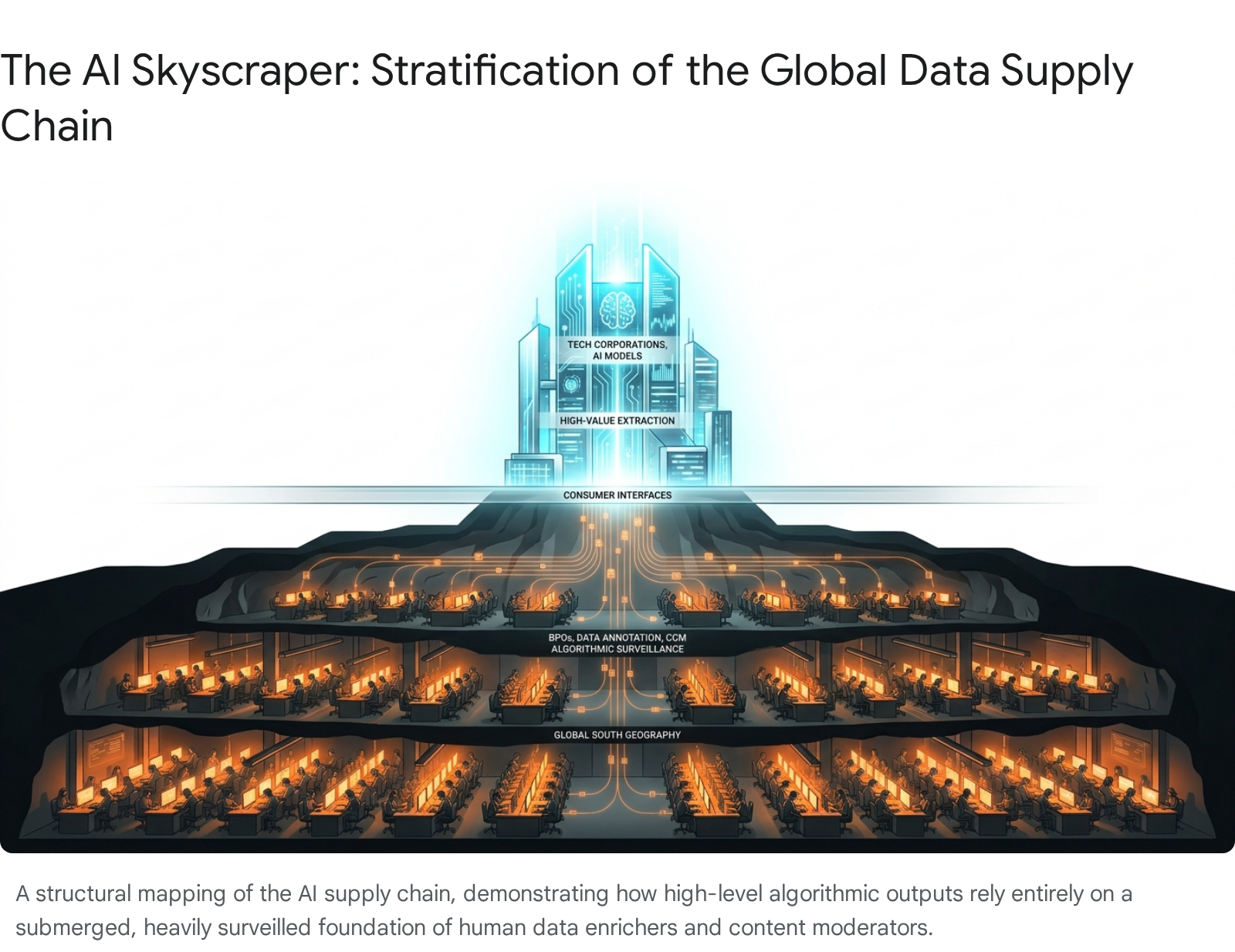
The historical trajectory of this subterranean labor force is deeply rooted in Labor Process Theory and the evolution of "Digital Taylorism." In the early twentieth century, Frederick W. Taylor's scientific management revolutionized industrial manufacturing by systematically breaking complex production processes into discrete, highly supervised, and repetitive micro-tasks5. This methodology intentionally separated the conceptualization of work from its execution, stripping workers of autonomy to maximize efficiency and extract surplus value5. Today, the global AI supply chain has adopted a digital iteration of this model.
Digital Taylorism leverages advanced algorithmic management to fragment the cognitive tasks required for AI development into granular, measurable, and surveilled units of "microwork"4. Initially popularized by open crowdsourcing platforms such as Amazon Mechanical Turk in the mid-2000s, where anonymous workers completed brief tasks for fractions of a cent, the industry has since mutated. As the demand for highly accurate, secure, and domain-specific training data surged alongside the deep learning boom, technology corporations transitioned operations toward managed, vendor-based Business Process Outsourcing (BPO) facilities7. While this shift away from open crowdsourcing offered clients tighter control over data security and quality, it entrenched a localized system of algorithmic management. Within these facilities, ghost workers are governed by automated metrics, continuous keystroke logging, screen recording, and punitive time quotas, thereby finalizing the digital degradation of the labor process8.
Detailed Mechanics of the Labor: Data Enrichment and Content Moderation
The contemporary artificial intelligence ecosystem is functionally dependent on two distinct, yet frequently overlapping, categories of hidden human labor: Data Enrichment and Commercial Content Moderation (CCM). Both sectors demand nuanced cognitive processing and ethical judgments that algorithmic systems cannot independently generate or replicate.
The Scope and Specifics of Data Enrichment
Data enrichment encompasses the curation, preparation, cleaning, labeling, and semantic segmentation of raw data required to train supervised and generative machine learning models2. The foundational axiom of computer science—"garbage in, garbage out"—dictates that raw datasets scraped from the public internet are inherently unstructured and unusable without human intervention. The labor required to structure this data is immense and highly repetitive.
For computer vision applications, such as autonomous driving systems, human annotators must meticulously draw 2D and 3D bounding boxes around pedestrians, traffic signals, and lane markers across thousands of hours of video footage, often dealing with LIDAR point clouds3. For natural language processing (NLP), workers engage in exhaustive sentiment analysis, intent recognition, syntactic tagging, and speech-to-text validation, systematically mapping human linguistic nuances into machine-readable formats12. Despite the highly technical output, the day-to-day reality of the work is characterized by mind-numbing repetitiveness, strict piece-rate quotas, and intense visual strain, as workers perform these fragmented tasks continuously over long shifts2.
The Mechanics of Commercial Content Moderation (CCM)
Commercial Content Moderation involves the rigorous review of user-generated content, or the raw synthetic data fed into AI models, to ensure adherence to safety guidelines, legal standards, and community policies13. While social media conglomerates have long relied on CCM to sanitize their platforms by removing child sexual abuse material (CSAM), hate speech, terrorist propaganda, and graphic violence, the explosion of generative AI has vastly expanded the scope and necessity of this labor15.
In order for an LLM to be deemed safe for broad public consumption, its foundational training data must be purged of toxic content, and its internal safety filters must be rigorously trained to identify and intercept violations. Consequently, ghost workers are contracted to actively seek out, read, view, and classify the darkest and most traumatic materials available on the internet, effectively teaching the AI what it must block16. This labor is inherently hazardous. Workers are subjected to a continuous stream of horrifically violent or abusive content and are subjected to stringent performance metrics, frequently demanding that they make complex moderation decisions within incredibly narrow windows of 10 to 30 seconds per item17.
Usage of Information and Inclusion in Training: The Mathematics of Human Feedback
To fully grasp why technology conglomerates tolerate the complex logistical overhead of offshore data factories, one must examine precisely how this ghost labor is integrated into the mathematical training architectures of foundational AI models. The data generated by these workers does not merely serve as a passive filter; it fundamentally defines the operational parameters, ethical alignment, and stylistic "personality" of models such as ChatGPT, Claude, and Llama18.
The dominant methodology utilized to align modern LLMs is Reinforcement Learning from Human Feedback (RLHF)19. In the RLHF pipeline, the ghost worker’s primary output is not just a label, but a qualitative preference ranking. The process begins after a base model undergoes Supervised Fine-Tuning (SFT). The worker is presented with a specific prompt and multiple AI-generated responses (e.g., ). The annotator must read, evaluate, and rank these responses based on complex, subjective criteria such as helpfulness, truthfulness, tone, and toxicity, ultimately selecting a preferred completion () over a rejected completion ()20.


This dataset of human preferences is subsequently utilized to train an independent neural network known as a "reward model." The objective of the reward model is to automatically output a scalar reward score that mirrors the offshore worker's ethical and qualitative judgments19. To achieve this, AI researchers employ the Bradley-Terry model, a probabilistic mathematical framework designed for modeling the outcomes of pairwise comparisons21.
The loss function derived from the Bradley-Terry reward model is specifically designed to maximize the probability that the reward model assigns a higher score to the human-preferred response than to the rejected response. The standard RLHF Bradley-Terry preference loss function is mathematically articulated as:

In this equation, represents the neural network reward model parameterized by , and represents the logistic sigmoid function, which converts the difference in rewards into a probability19. By iteratively minimizing this loss across tens of thousands of human-annotated examples, the reward model learns to approximate the collective psychological judgments of the ghost workforce19.


Once the reward model is trained, it is used to continuously score the outputs of the primary language model. An optimization algorithm, most commonly Proximal Policy Optimization (PPO) or newer variants like Direct Preference Optimization (DPO), is then deployed to update the language model's policy, forcing it to generate text that maximizes the reward signal19. The critical, often overlooked implication of this mathematical architecture is that the highly touted "safety" and "alignment" of advanced AI systems are entirely dependent upon the continuous, low-wage extraction of human psychological labor. The machine has no intrinsic ethics; it merely mimics the aggregated trauma and labor of the offshore workforce.
Strategic Geographic Concentration: Why AI Companies Utilize African Labor
The concentration of AI data enrichment and CCM operations in the Global South—specifically within African nations such as Kenya, Ghana, Uganda, and Nigeria—is not a logistical coincidence. It is the result of deliberate corporate strategies capitalizing on macroeconomic vulnerabilities, a systemic phenomenon that labor scholars identify as "regulatory arbitrage"23.
Technology companies require immense volumes of data processing, much of which necessitates fluency in English, French, and local dialects to accurately moderate regional content25. Nations in Sub-Saharan Africa possess highly educated, multilingual, and digitally literate youth populations. Simultaneously, these nations face acute structural unemployment and frequently lack robust domestic labor frameworks tailored to protect workers in the digital gig economy25. This dynamic creates an ideal environment for exploitation, heavily influenced by legacies of colonial extraction and racialized dispossession that dictate where global value is produced and whose labor is deemed interchangeable26.
Companies such as Sama and CloudFactory have historically utilized a business model known as "impact sourcing." This approach cultivates a public moral economy of "ethical AI," presenting low-wage digital piecework as an on-ramp to the formal digital economy, a mechanism for poverty alleviation, and a technological blessing for developing nations16. Host governments often encourage this narrative; for instance, the Kenya Vision 2030 initiative specifically prioritized the creation of infrastructure to attract multinational BPO firms, fostering an investor-centric culture over stringent labor protections26.
However, critical analysis reveals this model to be a sophisticated regime of extraction. The late founder of Sama, Leila Janah, notably justified the payment of sub-$2.00 hourly wages to Kenyan workers by arguing that paying more would be economically disruptive. She stated, “One thing that’s critical in our line of work is to not pay wages that would distort local labor markets. If we were to pay people substantially more than that, we would throw everything off”27. This rationale effectively weaponizes regional poverty, utilizing local economic depression as a permanent baseline to maintain artificially low operational costs for trillion-dollar Silicon Valley entities.
This environment engenders a "regime of entrapment"11. Due to the severe scarcity of alternative employment opportunities, highly educated workers accept precarious, short-term contracts. Algorithmic management enforces strict compliance through the constant threat of deactivation or opaque "platform bans." Because the infrastructure is entirely digital and transnational, BPOs can shift operations across borders with minimal friction, severely weakening the collective bargaining power of workers29. If a labor dispute arises, platforms can simply sever access; for example, Scale AI's Remotasks platform abruptly banned workers from Kenya, Nigeria, and Pakistan following internal disputes regarding withheld wages and extreme psychological trauma30.
Geographic Driver of AI Labor Offshoring | Mechanism of Exploitation within the Global AI Supply Chain |
Linguistic Proficiency | High fluency in English and French allows African workers to process data for Western markets seamlessly, though without Western compensation25. |
Regulatory Arbitrage | Exploiting the gap between robust labor laws in the Global North and the emerging, less-regulated digital gig frameworks in the Global South23. |
Impact Sourcing Narratives | Framing low-wage digital sweatshops as "poverty alleviation" to satisfy corporate ESG metrics while suppressing wages to avoid "distorting" impoverished local markets26. |
Structural Unemployment | Leveraging high youth unemployment to create a desperate labor pool willing to accept precarious contracts and severe psychological hazards25. |
Transnational Mobility | The ability of digital platforms to instantly ban workers or move task queues to different countries if local workers attempt to unionize or demand fair pay29. |
Corporate Utilization: Publicly Disclosed Examples of Ghost Work
The reliance on ghost workers is not a fringe practice relegated to obscure startups; it is the fundamental operating procedure for the most highly valued technology conglomerates on the planet. Despite marketing narratives that heavily emphasize autonomous machine intelligence, relentless investigative journalism and unprecedented international litigation have laid bare the reliance on BPOs like Sama, Teleperformance, Majorel, and Scale AI.
OpenAI and the Alignment of ChatGPT
One of the most heavily documented examples of AI ghost work involves OpenAI's development of the generative model ChatGPT. In its quest to make the model less toxic and to prevent it from generating hate speech or instructions for illegal acts, OpenAI contracted Sama to serve as an outsourcing partner16.
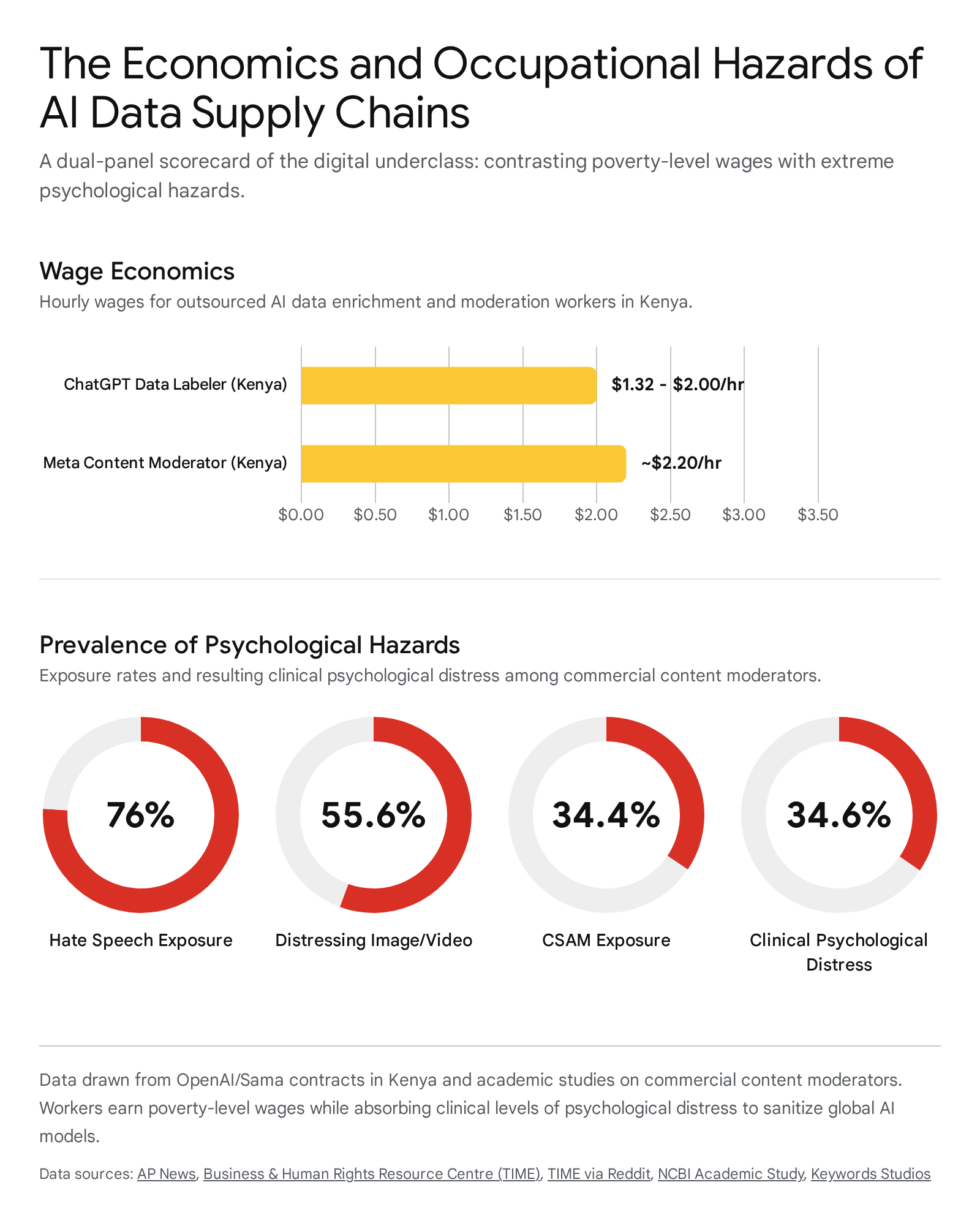
Beginning in November 2021, Sama employed workers at its Nairobi hub in Kenya to label tens of thousands of text snippets pulled from the darkest, most depraved corners of the internet16. The content described situations in graphic detail, including child sexual abuse, bestiality, murder, suicide, and torture16. The Kenyan data labelers performing this essential alignment work were paid a take-home wage of between $1.32 and $2.00 per hour, depending on seniority and performance16. Workers reported being required to read and label between 150 and 250 passages of this graphic text during a standard nine-hour shift32. The psychological toll of the work was so profound that Sama eventually canceled its contract with OpenAI in February 2022, eight months earlier than planned, publicly citing the traumatic nature of the text moderation16.
Meta's Moderation Hubs and the Landmark Motaung Lawsuit
Meta (formerly Facebook) has similarly relied on African BPOs to execute its CCM and data enrichment strategies. Through contractors like Sama in Kenya and Majorel in Ghana, Meta outsourced the moderation of violent, graphic, and abusive content for millions of users across sub-Saharan Africa23.
The severe operational realities of these hubs were exposed to global scrutiny when Daniel Motaung, a former content moderator, filed a landmark lawsuit against both Meta and Sama35. Motaung, recruited from South Africa and relocated to Kenya, alleged that he and his colleagues were subjected to forced labor conditions, deceptive recruitment practices (where they were initially told they were taking customer service roles), and a toxic work environment35. Paid approximately $2.20 per hour, Motaung spent his days viewing disturbing content, including violent beheadings and child abuse35. Consequently diagnosed with severe post-traumatic stress disorder (PTSD), Motaung alleged he was unlawfully dismissed by Sama after attempting to lead an effort to unionize his colleagues to demand better pay and adequate psychological support34.
Methods of Obfuscation: The Prevention of Disclosure
Technology companies dedicate substantial logistical and legal resources to obscure the origins of their training data and to prevent the disclosure of offshore working conditions3. This systematic obfuscation serves dual purposes: it protects proprietary AI training methodologies from industry competitors, and it heavily shields parent corporations from reputational damage and legal liability regarding human rights violations.
The primary mechanism for maintaining secrecy is the deployment of extreme Non-Disclosure Agreements (NDAs). Ghost workers are routinely forced to sign sweeping NDAs as a prerequisite for employment, often before they are even informed of the graphic nature of the content they will be processing36. These legal instruments explicitly forbid workers from discussing the nature of their data sets, the identity of the end-client, or their working conditions, operating under the continuous threat of immediate termination and severe legal retaliation23.
Furthermore, the industry relies on deliberately complex, fragmented supply chains. AI companies rarely hire ghost workers as direct employees. Instead, they fissured the workplace by contracting intermediary BPOs (such as Sama, Teleperformance, or Appen), who in turn sometimes subcontract to smaller regional "guilds" or utilize decentralized gig platform marketplaces23. This structure introduces layers of deniability; in the Motaung lawsuit, Meta's initial legal defense explicitly argued that because Motaung was formally employed by Sama, Meta was neither liable for nor privy to the alleged constitutional violations, despite Meta's algorithms strictly dictating the workers' quotas and performance metrics35.
Client anonymity is also strictly enforced within the platforms themselves. Workers frequently log into digital portals with no knowledge of the corporation benefiting from their labor. For instance, investigative reports revealed that Kenyan data labelers working on the Remotasks platform were entirely unaware that the platform was a subsidiary of Scale AI, a massive data broker serving tech giants like Google, OpenAI, and Meta25. When combined with the constant threat of algorithmic reprisal—where speaking out or requesting better pay can result in an automated platform ban across entire geographic regions—these methods successfully enforce a culture of absolute silence30.
The Real and Undeniable Psychological Consequences
The most devastating and systematically ignored aspect of ghost work within the AI supply chain is the profound psychological trauma inflicted upon the workforce. Commercial Content Moderators and RLHF data labelers are structurally positioned as the digital frontline, forced to absorb the internet's most harrowing content so that end-consumers and generative AI models are protected from it.
The volume of toxic material processed by these individuals is staggering and unprecedented in occupational history. A 2025 Equidem survey focusing on 76 data workers across Colombia, Ghana, and Kenya documented 60 independent, severe incidents of psychological harm resulting directly from the work25. Academic studies utilizing established psychiatric diagnostic cut-offs have further quantified this toll. Research analyzing large cohorts of commercial CMs indicates that over 76.9% are exposed to severe hate speech, 35.6% to profound humiliation content, and 34.4% to Child Sexual Abuse Material (CSAM) on a regular basis17.
The psychological consequences of this continuous exposure are severe and well-documented within the framework of the Job Demands-Resources (JD-R) model. Due to the exceptionally high job demands (incessant exposure to graphic trauma) and critically low organizational resources (poverty-level pay, job insecurity, and lack of genuine clinical support), workers suffer from a spectrum of debilitating clinical conditions:
Clinical Psychological Hazard | Manifestation in the Ghost Work Environment |
Secondary Traumatic Stress (STS) & Vicarious Trauma (VT) | Workers report severe intrusive thoughts, hypervigilance, and recurring, involuntary visions of the graphic material they have moderated14. One OpenAI labeler described the recurring psychological looping of a specific CSAM video as absolute "torture"16. |
Post-Traumatic Stress Disorder (PTSD) | Studies indicate that over a third of CMs (34.6%) score in the moderate-to-severe range for psychological distress, with symptoms mirroring clinical PTSD typically observed in frontline first responders or law enforcement cybercrime units17. In the Kenyan lawsuit, over 140 moderators were formally diagnosed with severe PTSD33. |
Clinical Depression and Anxiety | Almost half of surveyed workers (47.6%) score at levels associated with clinical depression on standardized diagnostic metrics like the CORE-1017. The trauma frequently manifests in severe anxiety, suicidal ideation, and substance dependence25. |
Desensitization and Empathy Erosion | Prolonged exposure leads to a profound cognitive shift, characterized by extreme cynicism, a generalized fear of death, and an inability to function in public spaces. Workers report becoming entirely desensitized to nudity, self-harm, and graphic violence, losing fundamental empathy36. |
Researchers have identified a clear "dose-response effect" in this line of work: daily exposure to graphic content is statistically associated with significantly greater psychological distress and secondary trauma than weekly or monthly exposure17.
Despite these clear occupational hazards, corporate mitigation efforts remain fundamentally inadequate. While BPOs frequently advertise the availability of "wellness counselors" to support their staff, workers universally report that these interventions are superficial and unhelpful. Wellness sessions are frequently rare, actively discouraged by floor management due to relentless productivity demands, or staffed by individuals tasked with returning the worker to the screen rather than providing genuine psychiatric care16. The structural design of the work—rapid, high-volume exposure to extreme trauma coupled with punitive algorithmic surveillance—entirely negates the superficial benefits of intermittent corporate wellness seminars45.
Organized Resistance, Unionization, and Legislative Horizons
Despite the pervasive use of coercive NDAs, precarious contracts, and the constant threat of algorithmic termination, the global ghost workforce is increasingly mobilizing to challenge digital exploitation and demand structural reform.
The lawsuit filed by Daniel Motaung against Meta and Sama represented a watershed moment in the balance of power. Meta’s initial legal defense leaned heavily on jurisdictional technicalities, arguing that an American company could not be subject to Kenyan employment law34. However, in a historic 2023 ruling, a Kenyan judge rejected Meta's attempt to strike its name from the suit, determining that the parent company was indeed a "proper party" to the case34. In 2024, the Kenyan Court of Appeal upheld this decision, marking the first time Meta was significantly subjected to a court of law in the Global South regarding its offshore labor practices and essentially piercing the corporate veil of the BPO supply chain33.
This legal breakthrough catalyzed an unprecedented wave of collective action among AI workers. On May 1, 2023, over 150 content moderators working for various global platforms gathered in Nairobi to formally establish the African Content Moderators Union (ACMU), marking a historic act of cross-platform defiance against Big Tech29. Concurrently, the Data Labelers Association (DLA) was formed in Kenya to advocate for fair wages, transparent contracts, and mandatory mental health protections specifically for the workers engaged in training generative AI models25.
These worker-led organizations are moving beyond basic protests, engaging in sophisticated advocacy and strategic litigation. For example, the ACMU has partnered with global research initiatives to leverage GDPR Data Subject Access Requests (SARs) as a forensic tool. By legally compelling BPOs like Sama and Teleperformance to release the surveillance metrics and personal data held on workers, the union is building an evidence base to hold platforms accountable for algorithmic cruelty and wage theft49. Furthermore, labor advocates are actively proposing systemic alternatives, such as the creation of worker-owned platform cooperatives backed by regional infrastructure funds, designed to eliminate the extractive BPO intermediaries entirely and return 50% more wage value directly to the African workers powering the AI50.
Simultaneously, policymakers in the Global North are beginning to recognize that AI supply chains require strict labor governance, moving beyond mere concerns over algorithmic bias to address the human cost of production. A pioneering example is California Assembly Bill 2653 (AB 2653). The legislation seeks to address the invisibility of the data enrichment workforce by fundamentally updating California's state procurement laws51.
Historically, California maintained a "Sweatfree Code of Conduct" preventing the state from procuring garments or equipment manufactured using sweatshop labor. AB 2653 sought to explicitly expand this legal definition to include "data enrichment services"—categorically citing content moderation, data labeling, model training, and AI "fauxtomation"51. The bill mandates that any state agency procuring AI products must require the contractor to certify that the AI was not built using exploited data labor. It requires contractors to compensate data workers with a living wage and establishes a process for independent monitoring of offshore BPO facilities51. While the bill has faced iterations and amendments (transitioning toward establishing a Foundation Model Labor and Procurement Working Group to deeply study the issue), its introduction signals a profound shift in regulatory philosophy: AI training data is recognized as an industrial product, and its production must be strictly governed by international labor and human rights standards52.
Conclusion
The prevailing narrative that artificial intelligence is an autonomous, clean technology born strictly of algorithmic innovation is fundamentally flawed. An exhaustive analysis of ghost work, data enrichment, and commercial content moderation reveals that the latest advancements in machine learning are directly subsidized by the psychological and economic exploitation of a hidden global workforce.
By systematically offshoring the alignment, training, and moderation of AI models to countries in the Global South, technology corporations have engaged in highly sophisticated regulatory arbitrage. They have successfully shielded themselves from legal liability and public scrutiny while paying poverty wages to a workforce forced to absorb the most toxic elements of human digital behavior. The complex mathematical optimization of modern AI—achieved through mechanisms like the Bradley-Terry reward model in RLHF—is intricately and undeniably bound to the psychological trauma inflicted upon these ghost workers.
However, the growing momentum of organized labor, spearheaded by the African Content Moderators Union and the Data Labelers Association, combined with landmark litigation in Kenyan courts and pioneering legislative proposals like California's AB 2653, indicates that the era of invisible AI labor may be drawing to a close. Moving forward, the pursuit of truly "ethical AI" cannot be achieved merely through mathematical alignment or superficial corporate wellness programs; it requires the total structural dismantling of the regime of entrapment, ensuring fair compensation, rigorous psychological protection, and full transparency for the indispensable human workforce that builds the foundation of the digital world.
Works cited
- Ghosts in the Shell - Worklaw - Jotwell, https://worklaw.jotwell.com/ghosts-in-the-shell/
- Full article: Describing, knotting, tying: developing emerging media documentary in a creative accelerator context - Taylor & Francis, https://www.tandfonline.com/doi/full/10.1080/10304312.2024.2367249
- Data Work and its Layers of (In)visibility - Just Tech, https://just-tech.ssrc.org/articles/data-work-and-its-layers-of-invisibility/
- Making AI Work: A Critical Theory of AI Production - Macquarie University, https://researchers.mq.edu.au/files/535663627/Publisher_version.pdf
- Labor, Capital, and Machine: Toward a Labor Process Theory for HCI - arXiv, https://arxiv.org/html/2602.10548v1
- Algorithmic management in the global gig economy: an interdisciplinary systematic literature review and critical discourse analysis - Frontiers, https://www.frontiersin.org/journals/sociology/articles/10.3389/fsoc.2026.1743445/full
- (PDF) From planetary to state-embedded AI stacks: The re-territorialisation of China's data annotation industry - ResearchGate, https://www.researchgate.net/publication/400694447_From_planetary_to_state-embedded_AI_stacks_The_re-territorialisation_of_China's_data_annotation_industry
- The production of algorithmic management technologies at an early-stage online labour platform, https://oro.open.ac.uk/109345/1/Struan%20Barr_PhD%20Thesis_25-02-2026.pdf
- From Bathroom Restrictions to “Algorithmic Cruelty”: Employer Surveillance in the Digital Age and its Manifestations in the - Social Innovations Journal, https://socialinnovationsjournal.com/index.php/sij/article/download/8299/6774/25642
- Responsible Sourcing of Data Enrichment Services - Partnership on AI, https://partnershiponai.org/wp-content/uploads/2021/08/PAI-Responsible-Sourcing-of-Data-Enrichment-Services.pdf
- 'The plan is just survival': Data Work in Kenya and the Regime of Entrapment - University of Edinburgh Research Explorer, https://www.research.ed.ac.uk/files/654070394/KapaniaEtalCHI2026ThePlanIsJustSurvival.pdf
- Responsible Sourcing Across the Data Supply Line - Partnership on AI, https://partnershiponai.org/workstream/responsible-sourcing/
- Behind the Screen: Content Moderation in the Shadows of Social Media - ResearchGate, https://www.researchgate.net/publication/334000468_Behind_the_Screen_Content_Moderation_in_the_Shadows_of_Social_Media
- (PDF) The psychological impacts of content moderation on content moderators: A qualitative study - ResearchGate, https://www.researchgate.net/publication/374008778_The_psychological_impacts_of_content_moderation_on_content_moderators_A_qualitative_study
- Waiting for robots: the ever-elusive myth of automation and the global exploitation of digital labor - SciELO, https://www.scielo.br/j/soc/a/M3pMfF9nkYXnrgrQwcBCBBr/
- OpenAI and Sama hired underpaid Workers in Kenya to filter toxic content for ChatGPT, https://www.business-humanrights.org/es/%C3%BAltimas-noticias/openai-and-sama-hired-underpaid-workers-in-kenia-to-filter-toxic-content-for-chatgpt/
- Content Moderator Mental Health and Associations with Coping Styles: Replication and Extension of Previous Studies - PMC, https://pmc.ncbi.nlm.nih.gov/articles/PMC12024403/
- Reinforcement Learning from Human Feedback - RLHF Book, https://rlhfbook.com/book.pdf
- Reinforcement learning from human feedback - Wikipedia, https://en.wikipedia.org/wiki/Reinforcement_learning_from_human_feedback
- An Introduction to Reinforcement Learning from Human Feedback (RLHF) - Lightly, https://www.lightly.ai/blog/rlhf-reinforcement-learning-from-human-feedback
- Direct Preference Optimization: Your Language Model is Secretly a Reward Model, https://proceedings.neurips.cc/paper_files/paper/2023/file/a85b405ed65c6477a4fe8302b5e06ce7-Paper-Conference.pdf
- Reinforcement Learning From Human Feedback (RLHF) | by Naren Suri - Medium, https://medium.com/@SuriNaren/reinforcement-learning-from-human-feedback-rlhf-8ab957750ac8
- GIZ (2026): Invisible Workers, Visible Harms. Perils and Precarities of AI Labour - BMZ Digital.Global, https://www.bmz-digital.global/wp-content/uploads/2026/02/GIZ_2026_InvisibleWorkersVisibleHarms-1.pdf
- Addressing Regulatory Arbitrage in the AI Supply Chain | TechPolicy.Press, https://www.techpolicy.press/addressing-regulatory-arbitrage-in-the-ai-supply-chain/
- Reimagining the future of data and AI labor in the Global South - Brookings Institution, https://www.brookings.edu/articles/reimagining-the-future-of-data-and-ai-labor-in-the-global-south/
- 'The plan is just survival': Data Work in Kenya and the Regime of Entrapment, https://www.morgan-klaus.com/pdfs/pubs/Kapania-CHI2026-Data-Work-Futures.pdf
- THE SILICON VALLEY EFFECT - Stanford Law School, https://law.stanford.edu/wp-content/uploads/2025/04/SJIL_61-1_Arun.pdf
- Venue stories at Techdirt., https://www.techdirt.com/tag/venue/
- GIZ (2026): Engineered precarities. Algorithmic management in data work and content moderation - BMZ Digital.Global, https://www.bmz-digital.global/wp-content/uploads/2026/02/GIZ_2026_EngineeredPrecarities.pdf
- LABOUR AND EXPLOITATION PROCESSES IN ARTIFICIAL INTELLIGENCE: EXAMPLE OF DIGITAL TAYLORISM IN DATA LABELLING - DergiPark, https://dergipark.org.tr/tr/download/article-file/4638040
- [N] OpenAI Used Kenyan Workers on Less Than $2 Per Hour to Make ChatGPT Less Toxic, https://www.reddit.com/r/MachineLearning/comments/10gtruu/n_openai_used_kenyan_workers_on_less_than_2_per/
- Moving toward truly responsible AI development in the global AI market | Brookings, https://www.brookings.edu/articles/moving-toward-truly-responsible-ai-development-in-the-global-ai-market/
- Teaching AI Ethics 2026: Human Labour - Leon Furze, https://leonfurze.com/2026/01/21/teaching-ai-ethics-2026-human-labour/
- Meta Fails Attempt to Dodge a Worker Exploitation Lawsuit in Kenya - TIME, https://time.com/6253180/meta-kenya-lawsuit-motaung/
- Facebook Faces New Lawsuit Alleging Human Trafficking and Union-Busting in Kenya, https://time.com/6175026/facebook-sama-kenya-lawsuit/
- Facebook sued in Kenya over work conditions for moderators - AP News, https://apnews.com/article/business-lawsuits-africa-nairobi-uganda-a93d3e60bcebee3124b2d2b168c652dc
- 'A watershed': Meta ordered to offer mental health care to moderators in Kenya, https://www.theguardian.com/global-development/2023/jun/07/a-watershed-meta-ordered-to-offer-mental-health-care-to-moderators-in-kenya
- Facebook Sued Over Mental Health Trauma to Content Moderators in Kenya - CorpWatch, https://www.corpwatch.org/article/facebook-sued-over-mental-health-trauma-content-moderators-kenya
- Facebook content moderator in Kenya sues over working conditions - CBS News, https://www.cbsnews.com/sanfrancisco/news/facebook-content-moderator-kenya-sues-working-conditions/
- From planetary to state-embedded AI stacks: The re-territorialisation of China's data annotation industry - School of Journalism and Communication, CUHK, https://www.com.cuhk.edu.hk/publication/lin-journal-2026-planetary.pdf
- The Moderator Wellbeing Report: 6 Key Insights Every Studio Needs to Know, https://www.keywordsstudios.com/files/6c78161aa90dd30f5cd2527518973c27.pdf
- Potential Impact for Content Moderators in Trust & Safety Roles A COMPREHENSIVE LITERATURE REVIEW OF FACTORS CONTRIBUTING TO VICARIOUS TRAUMA - Zevo Health, https://www.zevohealth.com/wp-content/uploads/2024/07/lit_review_IN-1.pdf
- Crimes Against Caring: Exploring the Risk of Secondary Traumatic Stress, Burnout, and Compassion Satisfaction Among Child Exploitation Investigators | Request PDF - ResearchGate, https://www.researchgate.net/publication/311549392_Crimes_Against_Caring_Exploring_the_Risk_of_Secondary_Traumatic_Stress_Burnout_and_Compassion_Satisfaction_Among_Child_Exploitation_Investigators
- Content moderation: The harrowing, traumatizing job that left many African data workers with mental health issues and drug depen, https://data-workers.org/wp-content/uploads/2024/09/Fasicas-Report-Accessible-1.pdf
- Longitudinal comparison of psychological outcomes of professional content moderators engaged in resilience training program - PMC, https://pmc.ncbi.nlm.nih.gov/articles/PMC12711784/
- I've Seen Enough: Measuring the Toll of Content Moderation on Mental Health - arXiv, https://arxiv.org/pdf/2511.09813
- Kenya: Meta files appeal challenging jurisdictional authority of Kenyan courts, https://www.business-humanrights.org/en/latest-news/kenya-meta-fait-appel-de-la-d%C3%A9cision-du-tribunal-qui-avait-d%C3%A9clar%C3%A9-les-juridictions-locales-comp%C3%A9tentes-apr%C3%A8s-la-plainte-dun-ancien-mod%C3%A9rateur/
- Can African Unions Beat Big Tech? - Nonprofit Quarterly, https://nonprofitquarterly.org/can-african-unions-beat-big-tech/
- GIZ (2026): Fragmented Responsibility. Labour Exploitation and Governance Gaps in AI Supply Chains - BMZ Digital.Global, https://www.bmz-digital.global/wp-content/uploads/2026/02/GIZ_2026_FragmentedResponsibility.pdf
- From Extraction to Ownership: Platform Cooperatives as Infrastructure for Worker Sovereignty in African AI Labor Markets - ResearchGate, https://www.researchgate.net/publication/400798251_From_Extraction_to_Ownership_Platform_Cooperatives_as_Infrastructure_for_Worker_Sovereignty_in_African_AI_Labor_Markets
- Bill Text: CA AB2653 | 2025-2026 | Regular Session | Amended - LegiScan, https://legiscan.com/CA/text/AB2653/id/3400009
- AB 2653 - Assembly Bill Policy Committee Analysis - CA.gov, https://apcp.assembly.ca.gov/system/files/2026-04/ab-2653-lee-apcp-analysis.pdf
- Policy Priorities - Kapor Center Advocacy, https://kaporcenteradvocacy.org/policy-priorities/