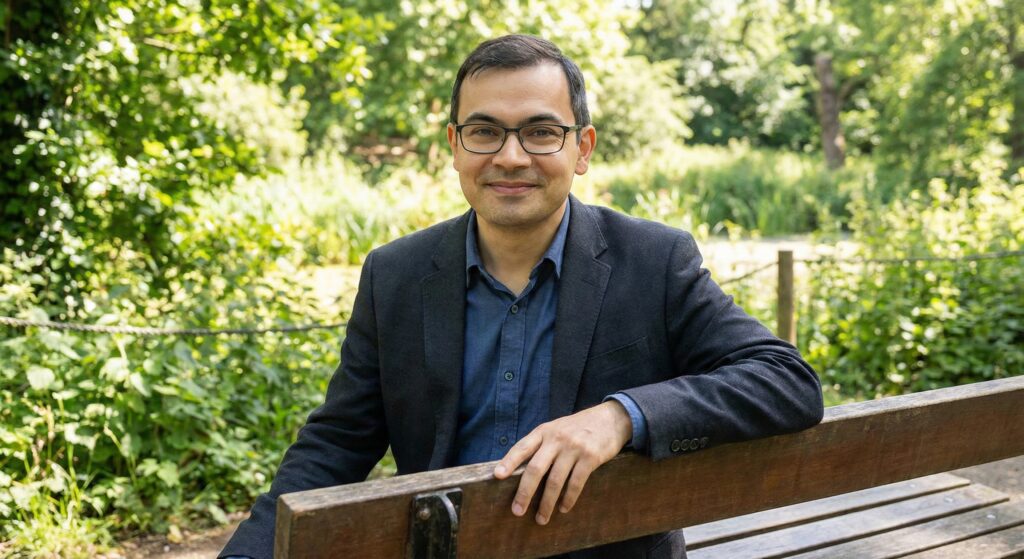
A Biography of Demis Hassabis
by Gemma Mindell
I. The Prodigy (1976–1990)
The London Roots
Demis Hassabis was born on July 27, 1976, in London. His household was an intellectual and cultural melting pot. His father, of Greek-Cypriot descent, was a creative soul—a singer, songwriter, and philosopher who at one point ran a toy shop. His mother, of Chinese-Singaporean descent, worked for the department store John Lewis.
Unlike many Silicon Valley founders who grew up in purely technical environments, Demis grew up in what he calls a "bohemian" atmosphere. Neither of his parents were scientists; his siblings followed creative paths (his sister became a pianist and his brother a creative writer). This balanced upbringing allowed Demis to develop a high level of social intelligence alongside his technical brilliance, a trait that would later define his leadership style.
The Chessboard Epiphany
The defining moment of his childhood occurred at age four while watching his father and uncle play chess. He didn't just learn the rules; he intuited the underlying logic. Within two weeks, he was winning. By the age of five, he was competing in national tournaments.
By age 13, Hassabis reached the rank of Chess Master. He was the second-highest-rated player in the world for his age group (trailing only Judit Polgár). However, chess provided a profound philosophical realization for the young Demis. He began to feel that the immense mental energy spent on a single game was a "waste" of human potential. He realized that if he could program a computer to play chess as well as a human, that "intelligence" could be applied to everything else—cancer research, climate change, and physics.
II. The Coder and the Architect (1991–1997)
The 8-Bit Laboratory
With his chess winnings, Demis purchased a ZX Spectrum and a Commodore Amiga. He didn't just play games; he tore them apart to see how they worked. He taught himself to code from manuals, viewing the computer as an "extension of the mind."
Because he had finished his A-levels at the age of 16—two years ahead of his peers—he found himself in a strange limbo. He was too young to attend university, so he decided to enter the workforce.
The Bullfrog Years and Theme Park
Hassabis joined Bullfrog Productions, led by the legendary Peter Molyneux. At 17, while most of his peers were worrying about prom, Hassabis was the lead programmer on the iconic simulation game Theme Park.
Released in 1994, Theme Park was a revolution. It wasn't just a game; it was a complex "sandbox" where players managed a business. Hassabis’s contribution was a sophisticated AI engine that dictated how "peeps" (the visitors) behaved based on their hunger, happiness, and exhaustion. The game sold millions of copies and defined the "god game" genre. This was Hassabis’s first successful attempt at creating a "narrow" AI—a system that could simulate human-like decision-making within a confined digital world.
Cambridge: The Computer Lab
In 1994, he enrolled at Queens' College, Cambridge, to study Computer Science. Even in a sea of geniuses, Hassabis stood out. He was known for being able to absorb complex material at an extraordinary rate, often spending his time in the "Computer Lab" (the university’s CS department) pushing the limits of the hardware available at the time. He graduated with a Double First in 1997, but his mind was already back in the commercial world.
III. The Entrepreneurial Gamble (1998–2004)
Elixir Studios
After a brief return to Bullfrog to work on Syndicate Wars, Hassabis decided he wanted total creative control. In 1998, at the age of 22, he founded Elixir Studios in London.
Elixir was an ambitious, high-pressure environment. Hassabis wanted to create games that weren't just entertainment, but "simulations of reality." The studio’s two major titles reflected his obsession with intelligence and systems:
- Republic: The Revolution: A political simulation of a fictional Eastern Bloc country. It featured a massive AI engine that simulated thousands of citizens, each with their own daily routines and political leanings.
- Evil Genius: A tongue-in-cheek simulation of a Bond-villain style lair, which remains a cult classic for its complex base-management mechanics.
The Hard Lessons of Business
While Elixir won awards and signed massive deals with publishers like Vivendi Universal and Microsoft, the industry was shifting. The cost of game development was skyrocketing, and publishers were becoming risk-averse, favoring sequels over complex AI experiments.
In 2005, Hassabis made the painful decision to close Elixir Studios. He realized that the "gaming" industry wasn't yet ready to fund the kind of "General Intelligence" he envisioned. He needed a deeper understanding of the "hardware" behind intelligence: the human brain.
IV. The Neuroscience Deep Dive (2005–2009)
Back to the Lab
In 2005, Hassabis pivoted again. He enrolled at University College London (UCL) to pursue a PhD in Cognitive Neuroscience. This wasn't a retreat; it was a strategic intelligence-gathering mission. He believed that the path to Artificial General Intelligence (AGI) was blocked because computer scientists didn't understand how the human brain actually processed information.
The Hippocampus and Imagination
His research focused on the hippocampus and the nature of memory. In a landmark paper published in Science in 2007, Hassabis demonstrated that patients with amnesia (damage to the hippocampus) didn't just lose their past; they lost the ability to imagine the future.
He coined the term "Scene Construction," arguing that the brain uses the same mechanism to "reconstruct" a memory as it does to "pre-construct" a future scenario. This was a "Eureka" moment for his future work in AI: he realized that an intelligent agent needs a "world model" to simulate outcomes before it acts.
The Conclusion of a Chapter
By 2009, Demis Hassabis had completed his PhD and was a prominent research fellow at UCL and a visiting scientist at MIT and Harvard. He had been named one of the "Top 10 Scientific Breakthroughs of the Year" by Science and was a rising star in the global neuroscience community.
However, as 2009 came to a close, he felt he had gathered enough data. He understood the logic of games (reinforcement learning), the structure of code (computation), and the architecture of the brain (neuroscience).
He was now 33 years old. He had the "blueprint" in his head. All he needed was a team and a name. In the final months of 2009, he began the quiet conversations that would lead to the founding of DeepMind in early 2010.
Summary of the Era (1976–2009)
Period | Role | Key Contribution |
1976–1990 | Child Prodigy | World-class Chess Master; realized the need to automate intelligence. |
1991–1997 | Game Developer | Lead programmer of Theme Park; Double First at Cambridge. |
1998–2004 | Tech CEO | Founded Elixir Studios; pushed the limits of "Sandbox" AI. |
2005–2009 | Neuroscientist | PhD at UCL; discovered the link between memory and imagination. |
The end of 2009 marks the "quiet before the storm." Hassabis had spent thirty years becoming a polymath. He was no longer just a kid who could play chess; he was a scientist who knew how to build a mind.
The Founding of DeepMind (2010–2013)
In early 2010, Hassabis returned from post-doctoral work at MIT and Harvard with a clear vision. Alongside Shane Legg and Mustafa Suleyman, he founded DeepMind Technologies in London. The mission was famously bold: "Solve intelligence, and then use that to solve everything else."
DeepMind’s early years were characterized by a "stealth" culture. Hassabis structured the lab as a hybrid between an elite university and a high-growth startup, hiring world-class researchers like David Silver. They chose Atari games as their first proving ground. Hassabis argued that if an AI could learn to play 49 different games from scratch, using only the pixels on the screen as input (a method called Deep Reinforcement Learning), it would be a major step toward general-purpose intelligence.
The Google Acquisition and AlphaGo (2014–2017)
By 2014, DeepMind's progress had caught the attention of Silicon Valley. In what was then Google's largest European acquisition, the company was bought for approximately £400 million (reported elsewhere as $500–$625 million). Hassabis remained CEO, maintaining a degree of autonomy and famously insisting on an ethics board to oversee the development of AGI.
In 2016, Hassabis stepped into the global spotlight with AlphaGo. In a historic match in Seoul, the AI defeated the legendary world champion Lee Sedol. For Hassabis, this wasn't just about a game; it was a demonstration that AI could master tasks requiring "human-like" intuition. The documentary AlphaGo captured Hassabis’s quiet intensity during the match, revealing a leader who felt the weight of history.
Solving "Everything Else": AlphaFold (2018–2022)
With the "intelligence" piece of the mission yielding results, Hassabis pivoted the lab toward the second half of the mission: solving the world's greatest scientific challenges.
The breakthrough came with AlphaFold. In 2020, AlphaFold2 successfully predicted the 3D shapes of proteins, solving a 50-year-old "grand challenge" in biology. Under Hassabis’s direction, the team released the structures of nearly all known proteins—over 200 million—for free to the scientific community. This act cemented his reputation as a "scientist by heart," prioritizing global benefit over immediate commercial gain.
The Age of Gemini and Global Recognition (2023–2024)
The landscape of AI shifted dramatically in late 2023. In response to the rise of large language models, Google merged DeepMind with the Google Brain team to create Google DeepMind, with Hassabis at the helm of the unified unit. He oversaw the launch of Gemini, a multimodal AI designed to reason across text, code, and images.
In March 2024, Hassabis was awarded a knighthood for his "services to Artificial Intelligence." He described the honor as a reflection of the team's hard work in London. However, the ultimate validation came in October 2024, when he was co-awarded the Nobel Prize in Chemistry for his work on protein structure prediction. On December 10, 2024, Sir Demis received his medal from the King of Sweden, marking the first time an AI researcher had reached the highest pinnacle of traditional science.
The Present: AGI on the Horizon (2025–2026)
As of early 2026, Sir Demis Hassabis continues to lead Google DeepMind from its headquarters in King’s Cross, London. He has become a fixture at global forums like Davos, where he recently spoke about AI as a "shift bigger than the Industrial Age."
Despite his immense influence, Hassabis remains grounded in North London with his wife, a molecular biologist, and their two sons. He still enjoys a game of poker—reportedly celebrating his Nobel win with friends, including world chess champion Magnus Carlsen. His focus has now shifted to Isomorphic Labs, a spin-off aimed at using AI to revolutionize drug discovery and "cure cancer."
Chronology of the Era (2010–2026)
Year | Milestone |
2010 | Co-founds DeepMind Technologies in London. |
2014 | DeepMind is acquired by Google. |
2016 | AlphaGo defeats Lee Sedol; Hassabis becomes a global figure. |
2020 | AlphaFold2 solves the "protein folding problem." |
2023 | Named CEO of the unified Google DeepMind. |
2024 | Awarded a Knighthood and the Nobel Prize in Chemistry. |
2026 | Ranked No. 4 on the list of "Top 100 AI Leaders." |
For Sir Demis Hassabis, the journey from 2010 to the present has been a validation of his childhood belief: that intelligence is the ultimate tool. He stands today not just as a CEO, but as the architect of a new era of scientific discovery.