
Convergence Architectures: The Post-Monolithic Era of Decentralized, Cryptographic, and Geopolitical Artificial Intelligence
The artificial intelligence ecosystem has crossed a fundamental structural threshold. As of the second quarter of 2026, the historical paradigm of relying exclusively on the brute-force scaling of monolithic compute clusters has fractured. This legacy approach, constrained by the immutable physical limits of silicon manufacturing, centralized data silos, and increasingly vulnerable global supply chains, is no longer viable for advancing frontier models. In its place, a complex, multi-layered architecture is emerging, defined by the integration of silicon photonics, advanced cryptographic hardware, geopolitical obfuscation, and globally distributed, asynchronous topologies. This comprehensive report provides an exhaustive analysis of the four primary pillars defining this transition: the physical circumvention of the semiconductor memory wall, the weaponization of decentralized AI as a geopolitical cover story for state actors, the maturation of cryptographic acceleration hardware facilitating trustless swarms, and a predictive trajectory of decentralized swarm intelligence from 2027 through 2039 and beyond.
Bypassing the Physics of the Memory Wall
The semiconductor industry has definitively entered a "packaging-first" era, fundamentally altering the trajectory of Moore's Law and rewriting the rules that integrated circuit (IC) design teams have relied upon for decades.1 Between 2012 and 2018, global AI compute demand doubled every 3.4 months, and while this pace recently slowed to a doubling every 7 months, it continues to push transistor density and bandwidth demand far beyond what monolithic System-on-Chips (SoCs) can reliably deliver.2 The industry collided with the physical "reticle limit," which caps advanced lithography mask patterns at approximately 858 square millimeters.2 Producing monolithic dies at or beyond this size became economically disastrous due to sharply increased defectivity and unacceptably poor yields in advanced technology nodes.2 To train and execute 100-trillion parameter models, the fundamental architecture had to disaggregate logic and memory, shifting the paradigm from scaling down transistors to scaling out integration across three-dimensional spaces.2
The Post-Moore's Law Reality and the Packaging Revolution
The chronic manufacturing bottlenecks that plagued the industry between 2023 and 2025—most notably the severe shortages in Chip-on-Wafer-on-Substrate (CoWoS) capacity—have been decisively overcome through a trifecta of material and architectural innovations: the commercialization of glass substrates, the maturation of hybrid bonding for 3D IC stacking, and the rapid, standardized adoption of the Universal Chiplet Interconnect Express (UCIe) 3.0 standard.1
The transition from traditional organic materials to glass substrates represents the technical cornerstone of this shift. As of early 2026, leading foundries, notably Intel, successfully moved glass substrates from pilot programs into high-volume production for their latest generation of AI accelerators.1 Organic substrates were prone to severe material warping under the massive thermal loads generated by modern AI workloads, leading to catastrophic signal degradation.1 Glass, conversely, offers superior thermal stability and a ten-fold increase in routing density.1 This stability is critical; it enables the creation of ultra-large Systems-in-Package (SiPs) that can house over 50 individual specialized chiplets without succumbing to the physical warping that previously rendered such scale impossible.1
Simultaneously, the industry evolved beyond side-by-side 2.5D integration and thermal-compressed vertical bonds, which had reached their practical integration limits.2 "Hybrid Bonding" has emerged as the definitive gold standard for 3D interconnects.1 Pioneered at scale by companies like TSMC and advanced by AMD's Corporate Vice President of Heterogeneous Integration Technologies, Dr. Raja Swaminathan, hybrid bonding drives 3D interconnect pitch down to 1 micrometer and below.3 This facilitates 3.5D architectures that allow for disaggregated logic and memory to be intimately re-integrated across vertical stacks, optimizing power, performance, area, and cost (PPAC) to unprecedented levels.2
Co-Packaged Optics (CPO): Shattering the Copper Wall
While 3D packaging addresses the density problem, co-packaged optics (CPO) and silicon photonics resolve the concurrent energy and bandwidth crises. The industry hit the "Copper Wall," where traditional copper links approaching 224 Gbps and 448 Gbps per-lane rates suffered from catastrophic signal loss and required immense power to push electrons over distances longer than a few inches.3 Consequently, moving data across a server rack exacted a massive "I/O tax," consuming up to 30% of a system’s total power budget in 2024-era clusters.5 With global AI data center power demand projected to rise 50% by 2027, resolving interconnect inefficiency became an existential requirement.3
By integrating optical Input/Output (I/O) engines directly adjacent to switch ASICs, accelerators, and logic chiplets, CPO collapses electrical trace lengths from inches to mere millimeters.3 At the "shoreline" of the chip, electrons are converted to photons, enabling data to travel hundreds of meters via microscopic lasers and light-modulating chiplets with minimal heat generation and virtually zero signal degradation.5
The new "Direct Drive" architectures represent a significant leap forward. Unlike older, bulky "pluggable" transceivers that required power-hungry Digital Signal Processors (DSPs) to function, the 2026 paradigm modulates and detects light directly inside the GPU or switch package, while keeping the laser source external for serviceability (standardized as ELSFP).5 Eliminating the DSP reduces both latency and thermal bloat, yielding up to a 70% reduction in interconnect power and a 10x increase in bandwidth density.5 NVIDIA reported that shifting from pluggable transceivers to CPO in 1.6T networks reduced link power from approximately 30 Watts to just 9 Watts per port.3 Industry forecasts now project over 10 million 3.2T CPO ports deployed in volume by 2029.3
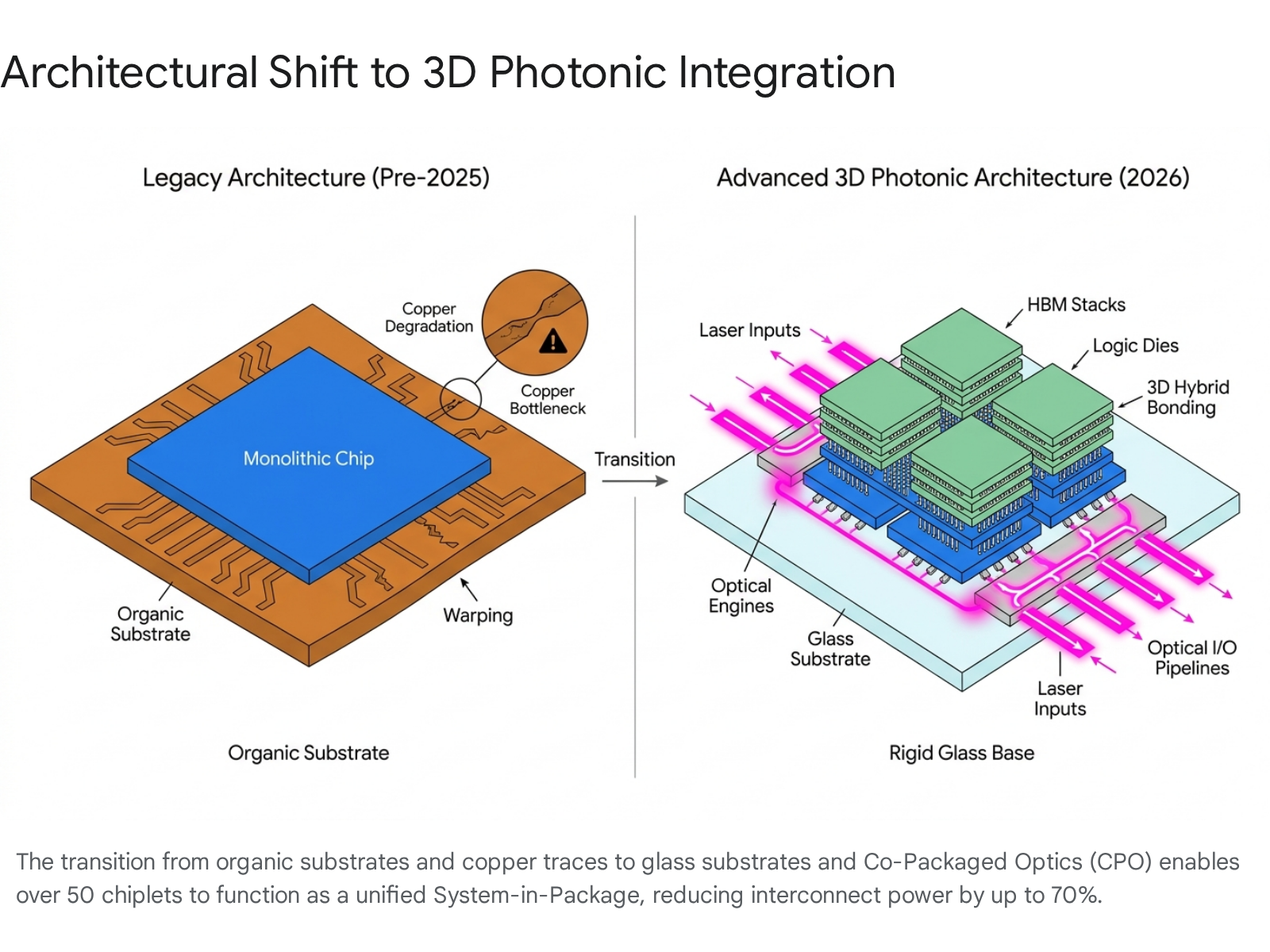
The deployment of this technology introduces immense engineering complexities. Photonic ICs are highly temperature-sensitive, and integrating them via 3D CPO involves hybrid bonding interfaces, die thinning, and complex vertical heat flows.3 Thermal gradients can induce wavelength drift, alignment errors, and long-term reliability risks, mandating rigorous thermal-optical co-design and multiphysics analysis before production-scale deployment.3
Despite these challenges, the competitive landscape has been entirely redrawn by photonics:
- Ayar Labs: Their TeraPHY Gen 3 chiplets became the first to optically carry Universal Chiplet Interconnect Express (UCIe) traffic, pushing power efficiencies down to an astonishing 5 picojoules per bit (pJ/bit).5
- NVIDIA: Launching the Rubin platform at CES 2026, NVIDIA established optical I/O as a core requirement for its "single-brain" cluster architectures. Integrating TSMC-developed silicon photonic engines directly into the switch ASIC of their Spectrum-X Ethernet Photonics and Quantum-X800 InfiniBand switches, NVIDIA achieved a 5x power reduction per 1.6 Tb/s port.5
- Broadcom: Securing a lead in the Ethernet backbone market, Broadcom’s Tomahawk 6 (Davisson) switch utilizes integrated 6.4 Tbps optical engines to deliver a staggering 102.4 Tbps of total switching capacity.5
Disaggregated Memory and the Photonic Fabric
CPO technology has evolved rapidly beyond placing optical engines merely at the edges of a chip. For instance, Lightmatter’s Passage M1000 platform bypasses edge-placement entirely by utilizing a 3D photonic interposer. This allows GPUs to sit directly on top of a photonic layer, yielding a record-breaking 114 Tbps of aggregate bandwidth and a density of 1.4 Tbps/mm².5 The roadmap clearly points toward "all-optical" switch fabrics by 2027, where data will never be converted back into electrons between source and destination, lowering latency to the absolute speed of light and enabling real-time training of next-generation models.5
The strategic importance of this architecture was cemented in January 2026 when Marvell announced the $3.25 billion acquisition of Celestial AI.5 Celestial AI’s proprietary "Photonic Fabric" technology is specifically engineered to allow GPUs to share High Bandwidth Memory 4 (HBM4) across an entire rack at light speed.5 By combining this with Marvell's robust Compute Express Link (CXL) and PCIe switching portfolio, the industry can now implement "Disaggregated Memory" architectures.5 Massive banks of high-speed memory can be located in completely separate parts of the data center from the processors, allowing for hyper-flexible hardware resource allocation and decisively bypassing the memory wall.5
Economics and Sovereign Stealth: The Geopolitics of Decentralized AI
While silicon photonics and disaggregated memory resolve the physical limitations of AI scaling, the deployment and control of this compute power has become the central front in a new digital geopolitics. Nations and enterprises alike are realizing that reliance on foreign, centralized AI infrastructure represents a critical vulnerability.6 Consequently, an intense drive toward "AI Sovereignty" has emerged, ostensibly to strengthen domestic economies, mitigate geopolitical shocks, and reflect national values.7 However, beneath the legitimate economic narrative of digital independence and the democratic ethos of "open-source, decentralized AI," lies a profound geopolitical strategy: the use of distributed networks to bypass sanctions, obscure proprietary research and development (R&D), and facilitate covert, dual-use military capabilities.
The Sovereign AI Imperative and the Global South
The push for AI sovereignty is particularly resonant in the "Global South," where nations seek independence from the unpredictability of great power competition.8 For developing economies facing an ever-widening AI divide, AI sovereignty offers a pathway to reject an unequal status quo.8 Nations like Indonesia have invoked the principle of sovereignty in private sector partnerships to construct Bahasa Indonesian-serving large language models (LLMs), while Malaysia has made significant capital investments to develop domestic LLMs and sovereign AI cloud infrastructures.8
However, building the full AI stack—from data centers to energy grids to foundational models—is prohibitively expensive and redundant.7 To jump-start their sovereign ambitions, low- and middle-income countries (LMICs) often partner with major US tech firms. These partnerships pair foreign capital and expertise with domestic regulatory oversight, allowing local economies to capture the financial upside of AI while ostensibly maintaining autonomy.9 For example, US cloud providers are anchoring regional computing hubs through billion-dollar data-center investments, building on the success of hubs like AWS Africa's Cape Town region, which catalyzed substantial local economic growth after opening in 2020.9
In Europe, the desire for digital sovereignty is driven by a profound aversion to vendor lock-in and a demand for transparency. A massive 63% of European businesses have a defined plan to switch AI providers if their primary provider suddenly restricts access, though 40% admit execution would cause significant disruption.10 European IT leaders overwhelmingly (77%) agree that public policy should actively mandate open-source principles—such as transparency, auditability, and open-source licensing—to help organizations achieve true AI sovereignty without relying on opaque, proprietary systems.10
The Cloud Loophole and Export Control Evasion
While the discourse around sovereignty emphasizes autonomy, the practical reality of networked computing has created massive vulnerabilities in international sanctions regimes. In the final days of the Biden administration, the US released the ambitious AI Diffusion Framework, representing the most comprehensive attempt to date to leverage US dominance across the semiconductor supply chain via export controls.11 The intent was to deny strategic competitors, particularly China, physical possession of advanced chips that could accelerate AI-driven military and surveillance capabilities.12
However, these physical export controls face a fundamental architectural loophole: the cloud. Compute does not behave like a tangible product with a controlled supply chain; it is infinitely networked, divisible, rentable, and routinely processed through third-country intermediaries.13 State-linked entities in heavily sanctioned jurisdictions have aggressively pivoted to accessing computational power remotely, obscuring their identity behind layers of contracts and globalized cloud operators.13
For instance, INF Tech, a Shanghai-based start-up, was discovered remotely accessing approximately 2,300 leading-edge NVIDIA Blackwell chips through an Indonesian data center to train AI systems.12 Chinese tech giants like Alibaba and ByteDance have tapped into NVIDIA chips housed across Southeast Asian data centers to train frontier large language models.12 These are not isolated anomalies. At least eleven state-linked Chinese entities have sought access to restricted US technologies through third-party cloud services, and China’s Tencent famously struck a $1.2 billion deal with a Japanese cloud provider for access to 15,000 highly restricted B200 chips.12
While legislative efforts like the Remote Access Security Act correctly identify access to controlled chips via the cloud as an export, implementing and enforcing these controls internationally demands an extreme level of intrusive surveillance, private sector compliance burdens, and extraterritorial enforcement that most US partners outright reject.13
Decentralized Compute Networks and Sanctions Evasion
The evolution of decentralized AI infrastructure exacerbates this loophole, providing a virtually impenetrable layer of geopolitical obfuscation. Decentralized GPU compute models, such as those operated by Aethir, explicitly market themselves as a "hedge against geopolitics and export controls".14 By distributing nearly 440,000 GPUs across 94 countries, these networks claim immunity to international power dynamics and localized embargoes.14
While framed as a mechanism for enterprise clients to ensure compute sovereignty and avoid AI supply chain risks without violating local regulations, the structural reality is that decentralized, permissionless networks are highly attractive to rogue state actors.14 Nations like Russia, North Korea, and Iran increasingly rely on sophisticated sanctions evasion networks to sustain their military-industrial bases.15 By 2025 and 2026, enforcement actions surged against entities facilitating the unlicensed export of controlled items, resulting in multi-agency crackdowns and millions in civil forfeiture actions.16
Yet, sanctioned entities effortlessly circumvent the dollar-based financial system by paying for decentralized compute resources using non-KYC (Know Your Customer) cryptocurrency exchanges, peer-to-peer networks, and stablecoins.17 The European Union's 20th Sanctions Package specifically targeted decentralized platforms enabling crypto trading and banned transactions involving the digital rouble and RUBx stablecoin due to their rampant use in circumventing sanctions.18 Nevertheless, the combination of decentralized hardware networks and decentralized finance makes state-level embargoes on AI compute effectively impossible to enforce.
Geopolitical Evasion Vector | Mechanism of Action | Strategic Implication |
Third-Party Cloud Brokering | Renting restricted hardware (e.g., B200 chips) physically located in non-aligned nations (e.g., Indonesia, Japan).12 | Renders physical chip export controls obsolete; shifts regulatory burden to highly complex extraterritorial cloud surveillance.13 |
Decentralized GPU Networks | Utilizing blockchain-orchestrated GPU pools (e.g., 440K globally distributed nodes).14 | Provides total anonymity; makes it physically impossible to enforce state-level embargoes on compute access.14 |
Cryptocurrency Settlement | Utilizing no-KYC exchanges, peer-to-peer networks, and stablecoins to pay for compute resources.17 | Bypasses the dollar-based financial system (e.g., SWIFT) and disrupts traditional financial sanctions tracking.17 |
Open-Source Base Models | Leveraging advanced open-weight models (e.g., DeepSeek) with permissive MIT licenses.11 | Accelerates domestic sovereign capability without relying on restricted US proprietary models.11 |
Project Tapestry and Open Source as "Cover Story"
The open-source AI movement is simultaneously being leveraged as a strategic asset for sovereign stealth. The global security risks of open-source AI models are well-documented; they lower the barrier for non-state actors to access dangerous capabilities, from advanced cyberattacks against critical infrastructure to the deployment of lethal autonomous weapons and CBRN (chemical, biological, radiological, or nuclear) materials.20 The release of competitive, low-cost open-source models by Chinese startups like DeepSeek, utilizing highly permissive MIT licenses, directly challenges the more restrictive licensing models of Western counterparts like Meta, complicating global regulatory debates.11
Within this context, the launch of Project Tapestry by the AI Alliance perfectly encapsulates the dual-use nature of decentralized AI.23 Spearheaded by Turing Award laureate Yann LeCun, Project Tapestry aims to build a collaborative foundation for open and sovereign AI.23 It is an open-source platform designed to enable the distributed, globally federated training of frontier open models.23 Supported by a 501(c)(3) nonprofit research organization and governed by a global board of representatives, the platform allows institutions, industries, and nations to contribute to a highly capable open base model while explicitly retaining strict, localized control of their proprietary data.23
LeCun argues that AI constitutes common human infrastructure and must not be controlled by a handful of private entities via proprietary products.23 By utilizing a federated architecture, Project Tapestry empowers users to create highly customized "sovereign derivative models" aligned precisely to their cultural, industrial, and legal priorities.23
However, the second-order geopolitical implication of globally federated training is profound: it provides the ultimate "cover story" for state-backed actors. Under the legitimate umbrella of collaborative open-source scientific research, nation-states can pool fragmented compute resources to train world-class baseline models, while keeping their most sensitive, dual-use training data entirely hidden behind local firewalls to produce weaponized derivatives. This dynamic aligns with the "Generative AI-Making and State-Making" framework, which argues that the intense strategic pressures of the sovereign AI race force nation-states to augment their coercive, extractive, and informational capacities, fundamentally reshaping domestic state structures and international power dynamics.26
Frameworks like AegisSovereignAI and Super Protocol are emerging to provide the cross-ecosystem trust layers required for these operations.27 Super Protocol, for instance, operates an entirely decentralized, self-sovereign infrastructure managed solely through smart contracts.28 By utilizing End-to-End (E2E) encryption, open-source AI engine verification, and Trusted Execution Environment (TEE) attestation specifically leveraging NVIDIA GPU TEEs, these protocols ensure that data uploaded to decentralized file systems remains encrypted and is only decrypted inside a secure, trusted loader during processing.28 This guarantees that even when using distributed, globally sourced compute, a state actor's proprietary data remains entirely inaccessible to the host network.
The Cryptographic Engine of the Swarm
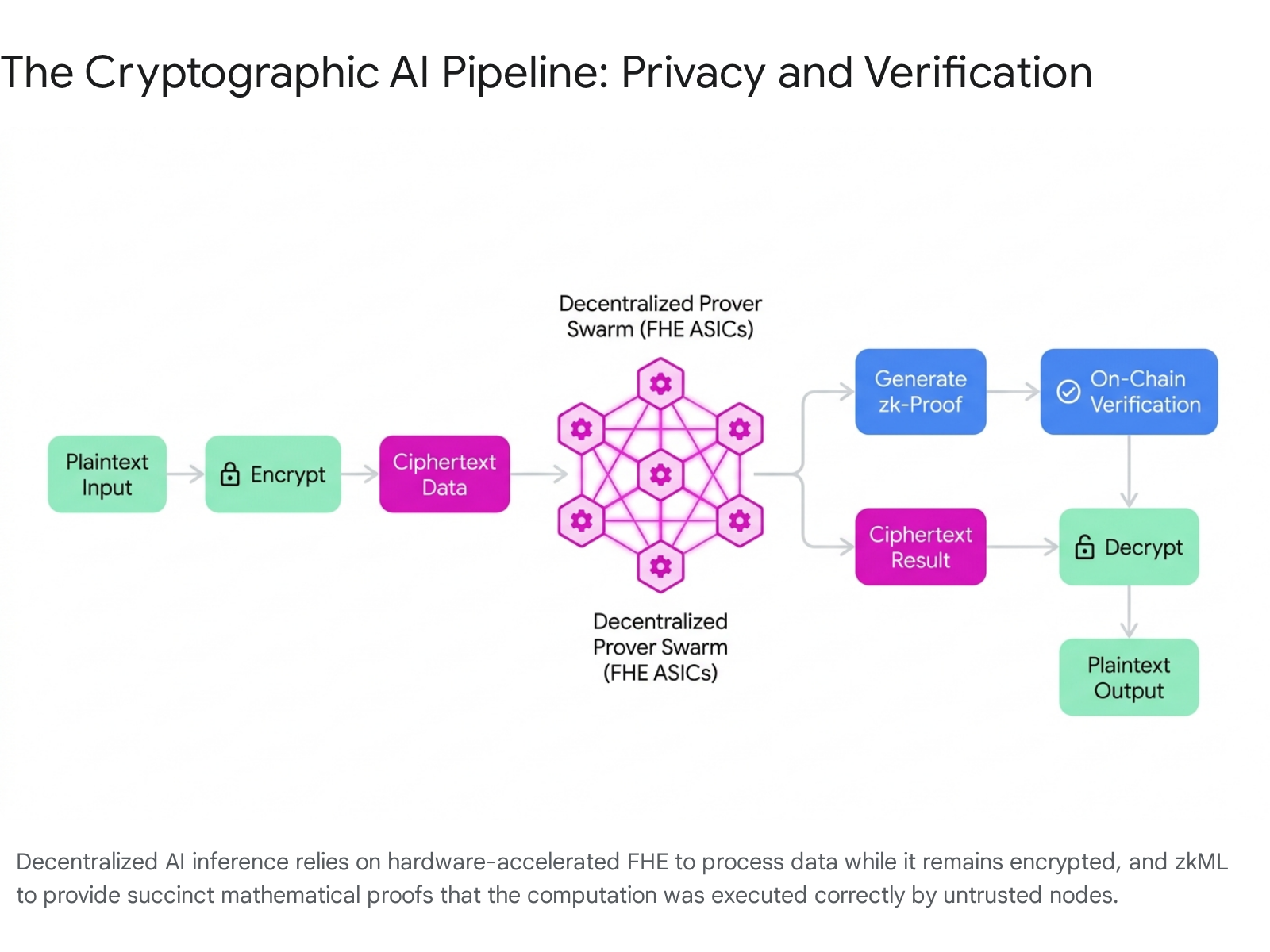
If the global AI compute layer is to transition from centralized hyperscalers to fundamentally decentralized, untrusted, and asynchronous networks, it requires a robust mechanism to guarantee operational integrity. Participants must be able to verify that remote nodes actually executed the complex computations they claimed to perform, and they must be able to do so without leaking the proprietary data being processed. This absolute necessity has catalyzed the development of the "Cryptographic Engine of the Swarm," characterized by the rapid transition of Zero-Knowledge Machine Learning (zkML) and Fully Homomorphic Encryption (FHE) from theoretical mathematics into bespoke, hardware-accelerated silicon.
Zero-Knowledge Proofs (ZK) and Verifiable Compute
In a decentralized Large Language Model Inference System (DLIS), execution is shifted from centralized clusters to a mesh of local, heterogeneous edge and endpoint devices to reduce latency and cost.29 Each node executes a share of the model, coordinated through a distributed scheduler.29 However, trusting remote nodes to execute AI algorithms correctly—especially when these systems make decisions affecting financial markets, healthcare outcomes, and autonomous agents—is inherently dangerous.30
While early verification approaches relied on consensus mechanisms or re-execution within secure enclaves (TEEs), the industry standard has rapidly shifted toward pure mathematical verification via Zero-Knowledge Proofs (ZKPs).30 ZKPs enable a prover to share the result of computing a function on specific inputs with a verifier, while keeping parts of the input completely confidential.31 The verifier can be mathematically certain that the result is correct, despite not seeing the underlying data.31 Furthermore, ZKPs possess the property of "succinctness," allowing a prover to compress a massive computation into a tiny, easily verifiable proof, minimizing the computational cost and energy required for validation by the wider network.31
Historically, the fatal flaw of applying ZKPs to machine learning (zkML) was an astronomical computational overhead. Running inference inside a zero-knowledge proof introduced overheads ranging from 100,000x to 1,000,000x compared to native execution, rendering it commercially useless.30 However, the landscape shifted dramatically in 2024 and 2025 as pioneers like Modulus Labs and EZKL proved the concept, triggering an aggressive industry pivot toward hardware acceleration.30
By 2026, specialized Application-Specific Integrated Circuits (ASICs) and Field-Programmable Gate Arrays (FPGAs) dedicated purely to ZK acceleration have reached the market.
- Cysic: Operating a highly ambitious dual-track strategy, Cysic combines ASIC innovation with expansive GPU networks to build a comprehensive ComputeFi "Proof Layer".32 The company recognized that while GPUs offer flexibility, ASICs vastly outperform them in energy efficiency and peak performance.33 With substantial seed funding from entities like Polychain and Hashkey, Cysic successfully completed FPGA-based Proof of Concept designs that dominate the industry.34 Their proprietary hardware, the ZK Air and ZK Pro, anticipated for release in 2025, drastically reduces proof generation times.32 Within the Cysic Network, ZK projects publish tasks via smart contracts, decentralized provers utilize Cysic hardware to compete for proof generation, and verifiers perform multi-party validation before results are settled on-chain.32 This system underpins ZK Rollups, zkML, and cross-chain applications by rendering cryptographic verification highly scalable.33
- Ingonyama: Focusing on open-source accessibility, Ingonyama established the ICICLE SDK as the de facto industry standard for GPU ZK acceleration.33 Unlike competitors pursuing in-house hardware, Ingonyama's strategy centers on lowering the barrier to entry by optimizing software-hardware co-design across existing architectures, aggressively challenging prevailing assumptions regarding the cost and efficiency of FPGAs versus GPUs for complex operations like Multi-Scalar Multiplication (MSM) and Number Theoretic Transforms (NTT).31
- Fabric & Irreducible: Other entities, such as Fabric, are adopting a "hardware-software co-design" path to build Verifiable Processing Units (VPUs), targeting a broader cryptographic compute market akin to the CUDA/NVIDIA ecosystem.33 Meanwhile, Irreducible focuses on exploring novel algebraic structures like Binius alongside specialized zkASICs.33
Cryptographic Hardware Provider | Core Strategy & Architecture | Market Focus |
Cysic | Dual-track ASIC (ZK Air/Pro) + GPU network. Full-stack ComputeFi Proof Layer.32 | Hardware monopoly via Decentralized Physical Infrastructure Networks (DePIN).32 |
Ingonyama | Open-source ICICLE SDK for GPUs. Software-hardware co-design.33 | Lowering barriers to entry; establishing software standards.31 |
Fabric | Verifiable Processing Unit (VPU). General crypto-compute chip.33 | Broad cryptographic compute market ("CUDA for Crypto").33 |
Optalysys | Silicon photonic FHE acceleration (LightLocker Node). AMD Alveo FPGA integration.36 | Enterprise-grade Fully Homomorphic Encryption; strict data privacy.36 |
Fully Homomorphic Encryption (FHE) and Photonic Acceleration
Where zkML proves the correctness of a computation, Fully Homomorphic Encryption (FHE) guarantees its absolute privacy. FHE is an advanced, quantum-resilient cryptographic method that permits data to be processed without ever being decrypted.37 This capability is the holy grail for enterprise and sovereign AI, as it inherently resolves severe data sovereignty conflicts, mitigating the risks of sending personal or proprietary data to public clouds governed by strict frameworks like GDPR and HIPAA.29
Historically, FHE has been throttled by staggering computational demands and the rapid accumulation of mathematical noise during complex operations.37 Researchers have continuously optimized schemes like TFHE, CKKS, and BGV to balance noise tolerance with computational efficiency, often employing layered architectures that combine Partially Homomorphic Encryption (PHE), Somewhat Homomorphic Encryption (SHE), and FHE to manage performance.38
The definitive breakthrough for FHE commercialization is the integration of advanced hardware acceleration. Companies like Zama have pioneered robust open-source cryptographic software, including the TFHE-rs library, Concrete, and the fully homomorphic Ethereum Virtual Machine (fhEVM), which facilitates encrypted machine learning and strict confidentiality in blockchain smart contracts.37 To scale this software for enterprise use, Zama partnered with hardware manufacturer Optalysys, a company developing cutting-edge silicon photonic chips designed specifically for FHE acceleration.37
The culmination of this partnership is the Optalysys LightLocker Node, an enterprise-grade FHE acceleration server.36 Integrating Optalysys technology via an industry-standard Dell PowerEdge and AMD Alveo V80 FPGA platform, the LightLocker Node acts as a high-performance co-processor for Zama's TFHE-rs library.36 It boasts remarkable specifications: supporting throughput in excess of 100 encrypted ERC-20 (cERC-20) transactions per second, utilizing deterministic NTT-based compute, and achieving an extraordinarily low Programmable Bootstrapping (PBS) error probability down to .36 By supporting standard polynomial sizes of 2048 and tweaked uniform noise distributions, this hardware surpasses the throughput, energy, and cost performance of traditional GPU-based FHE solutions, allowing for the widespread deployment of encrypted AI models across public clouds, private data centers, and EVM-compatible blockchains.36

The convergence here is profound: the exact same scientific discipline—silicon photonics—that is bypassing the physical memory wall inside centralized AI compute clusters 5 is being simultaneously deployed to shatter the latency and computational walls of advanced cryptography, enabling the trustless swarm.
Predictive Timeline of Decentralized AI Milestones
The convergence of 3D photonics, geopolitical evasion architectures, and cryptographic hardware acceleration sets the stage for a rapid, highly predictable evolution in AI topologies over the next decade and a half.
Phase I: Prediction 2027 – 2029: The Edge-Compression Era & Monetized Inference
The initial phase of this transition is defined by the radical decentralization of model inference. The exorbitant operational overheads of centralized cloud inference—where sustaining robust GPU nodes costs between $10 and $30 per hour and introduces unacceptable latency (often exceeding 200ms round-trip time) for geographically distant queries—have rendered continuous hyperscale inference economically unviable for pervasive applications.29
In response, the industry has aggressively pivoted toward extreme edge compression, foundational to which is the commercialization of 1.58-bit ternary quantization.42 Architectures such as BitNet and PrismML’s Ternary Bonsai family reduce the precision of LLM weights to simple ternary values ().42 This exponential compression eliminates the massive memory bloat associated with traditional FP16 (16-bit floating point) precision models while retaining near-lossless reasoning capabilities.42 Experimental models, such as LLaVA-OV-7B and Qwen2.5-VL-7B, have demonstrated that utilizing 1.5-bit compression with per-channel strategies significantly outperforms older per-token quantization methods, achieving near-FP16 performance on standard benchmarks.45

Ternary quantization permits highly efficient execution directly on local CPU kernels and constrained edge devices.44 This architectural shift is further enhanced by advanced Key-Value (KV) cache optimizations, which store intermediate attention results to prevent redundant computation, yielding up to 5x speedups in token generation.44
With inference running efficiently on edge hardware, the "Monetized Inference" economy will fully mature by 2028. Blockchain protocols will seamlessly distribute AI workloads across vast decentralized networks, allowing millions of participants to contribute idle computing power in exchange for tokenized compensation.38 This convergence of crypto and AI is already a practical reality; networks like Bittensor run a $3 billion decentralized machine learning ecosystem where subnets routinely perform massive computational tasks, such as screening 11 million drug molecules, while compensating nodes in tokens.46 During this era, AI agents will increasingly operate autonomously within decentralized finance (DeFi), executing trades, managing liquidity, and running uncollateralized credit models.46 The security risks are commensurate with the economic scale; AI-driven social engineering and autonomous attacks on DeFi protocols are projected to cost the industry nine figures annually, necessitating robust AI security agents to defend the networks.46
Phase II: Prediction 2030 – 2033: Hardware-Accelerated zk-ML & Swarm Fine-Tuning
As the execution of inference becomes entirely decentralized, the frontier of innovation will shift toward decentralized fine-tuning and the establishment of shared cognitive architectures. By 2030, the specialized ASIC and photonic FPGA accelerators pioneered by companies like Cysic, Ingonyama, and Optalysys will reach total market saturation.32 The mass deployment of consumer-grade ZK hardware acceleration will trigger a massive speculative and operational boom, heavily mirroring the historical Bitcoin mining craze, as networks demand immense computational power to verify the burgeoning volume of zkML proofs.32
This cryptographic ubiquity effectively collapses the latency overhead of ZK and FHE operations, enabling the deployment of "Trustless Shared AI Memory" at scale by 2031.47 AI agents will no longer rely on single, isolated context windows constrained by local hardware; instead, they will dynamically coordinate and query multiple, cryptographically verified memory sources—spanning personal encrypted histories, proprietary corporate databases, and public expert repositories.47
Simultaneously, large-scale fine-tuning will migrate from centralized servers to the decentralized swarm. Nodes across the globe will execute gradient updates on highly proprietary, FHE-encrypted datasets, utilizing zkML ASICs to succinctly prove their mathematical contributions, before securely merging those updates onto a verifiable blockchain state layer.29 This capability completely divorces the ongoing education and refinement of intelligent systems from centralized corporate data centers, realizing the geopolitical vision of sovereign, untraceable AI architectures that operate outside the bounds of traditional regulatory oversight.
Phase III: Prediction 2034 – 2038: The Asynchronous Pre-Training Breakthrough
While inference and fine-tuning successfully decentralize by the early 2030s, the initial pre-training of frontier baseline models (e.g., those scaling into the hundreds of trillions of parameters) has remained stubbornly tethered to massive, centralized hyperscale clusters due to the physics of network synchronization.
Modern large-scale language model pre-training relies fundamentally on the tightly coupled Single Program, Multiple Data (SPMD) paradigm.48 This "monolithic" approach requires that after every forward and backward pass, gradients must be averaged across tens of thousands of individual chips—a blocking process known as the AllReduce synchronization step.48 Because every chip must remain in near-perfect lockstep, a single hardware failure or transient network slowdown stalls the entire global computation.48 Operating this architecture across geographically distributed data centers demands catastrophic inter-datacenter bandwidths exceeding 198 Gbps, a hard physical constraint that standard wide-area networking (WAN) simply cannot support, rendering global-scale training effectively impractical.48
Between 2034 and 2038, the commercialization and scaling of Decoupled DiLoCo (Distributed Low-Communication) architectures will completely shatter this final barrier. Initially conceptualized by Google DeepMind, Decoupled DiLoCo is an asynchronous training architecture that wholly abandons the fragility of lock-step global synchronization.48 The system partitions global compute into completely independent, fault-isolated "islands" or "learners".48 These localized learners execute numerous inner optimization steps entirely on their own, asynchronously communicating only highly compressed parameter fragments to a central synchronizer.49
Crucially, the central synchronizer aggregates these updates using a "minimum quorum," governed by an adaptive grace window and dynamic token-weighted merging algorithms.49 If an entire node, or indeed an entire data center, fails or goes offline, the global system simply ignores the straggler, utilizing the minimum quorum to continue training entirely uninterrupted.50 When the failed unit eventually comes back online, it reintegrates seamlessly into the active run.50
This "chaos engineering" approach yields phenomenal resilience. Benchmarks demonstrate that Decoupled DiLoCo achieves a staggering 88% goodput rate under high failure conditions, compared to a mere 27% for standard Data-Parallel systems, with zero global downtime.48 Most importantly, it reduces the required inter-datacenter bandwidth from 198 Gbps to a trivial 0.84 Gbps.50 Researchers have successfully trained 12-billion parameter models (such as Gemma 4 variants) across four separate US regions over standard, commercial internet connectivity—more than 20x faster than conventional synchronization methods—while mixing entirely different chip architectures (TPU v6e and TPU v5p) in a single run without performance degradation or accuracy loss (64.1% average accuracy versus the 64.4% synchronous baseline).50
The geopolitical implications of the Asynchronous Pre-Training Breakthrough are profound. By the mid-2030s, the requirement to centralize 100,000 GPUs in a single, easily sanctionable physical location is eradicated. A state actor, a decentralized collective, or a corporate entity will possess the technical architecture required to orchestrate the pre-training of frontier models across thousands of disjointed, low-bandwidth servers scattered across multiple nations, permanently neutralizing the efficacy of physical hardware export controls.
Phase IV: Prediction 2039+: The Ambient Global Subconscious
As the industry moves into the late 2030s and beyond, the convergence of 1.58-bit extreme edge efficiency, untrusted FHE swarm computation, and globally asynchronous pre-training protocols will culminate in the emergence of the "Ambient Global Subconscious."
At this mature stage, Artificial Intelligence fundamentally transitions from a state of "alterity"—a distinct, visible tool or conversational agent that a user explicitly interacts with—into a "background relation".53 Ambient Intelligence (AmI) scales from pervasive computing, Big Data, and IoT sensor networks to become an invisible, ubiquitous infrastructure that shapes human action and decision-making without appearing as a distinct entity.53
Agentic AI models, orchestrated within vast multi-agent systems, will proactively execute the Perceive-Reason-Act loop.54 These agents will autonomously gather data from billions of networked optical, auditory, and biometric sensors via APIs; reason across decentralized nodes using localized LLMs; and act to execute complex workflows entirely unprompted by human operators.54
Gartner projections indicate this shift will accelerate rapidly in the enterprise sector, projecting that 15% of day-to-day enterprise work decisions will be made autonomously by AI agents by the end of the 2020s, paving the way for total ambient integration by 2040.53 The defining characteristic of this era is the obsolescence of explicit process articulation.53 For example, the computer keyboard will not vanish because a superior input device replaces it, but because ambient AI eliminates the structural requirement for human-to-machine text translation entirely.53
In highly sensitive domains like healthcare, ambient AI scribes will passively capture physician-patient conversations, extract relevant clinical data, and autonomously generate structured documentation without the physician performing any deliberate input action.53 In industrial applications, ambient computing will enable smarter energy management by dynamically adjusting HVAC and power resources based on real-time, predictive modeling of human occupancy and activity.54 Because this pervasive ambient intelligence is powered by an underlying decentralized infrastructure secured by hardware-accelerated Fully Homomorphic Encryption, it ostensibly protects the vast, continuous flow of biometric and behavioral data it relies upon, ensuring privacy through pure mathematics.55 The resulting ecosystem is an intelligent, predictive, and sovereign subconscious woven inextricably into the physical environment.
Conclusion
The fundamental architecture of artificial intelligence is undergoing a terminal inversion. Driven by the unyielding physical constraints of the memory wall, the semiconductor industry has successfully engineered a monumental leap from copper-tethered, monolithic silicon chips to sophisticated 3D, photonically interconnected disaggregated systems. However, the deployment and control of this vast, newly liberated computational power is no longer merely a commercial endeavor; it has become the primary vector for 21st-century geopolitical supremacy. The strategic embrace of decentralized, federated, and open-source AI frameworks provides an ideal, democratically palatable cover story, enabling heavily sanctioned state actors to conduct sovereign R&D and pool decentralized hardware entirely outside the purview of Western export controls and traditional diplomatic oversight.
To facilitate this radically decentralized reality without sacrificing data security or computational integrity, a robust cryptographic engine—powered by dedicated zkML ASICs and silicon photonic FHE accelerators—is rapidly scaling to meet global demand. This cryptographic bedrock ensures that as Artificial Intelligence evolves from local, highly compressed edge inference models in the late 2020s, through the asynchronous, planetary-scale pre-training swarms of the 2030s, the network remains entirely trustless yet functionally unified. Ultimately, this inexorable trajectory points toward the 2040s and the realization of ambient intelligence—a pervasive, globally distributed subconscious that is invisible, cryptographically secure, and inherently sovereign.
Works cited
- The Packaging Revolution: How Glass Substrates and 3D Stacking Shattered the AI Hardware Bottleneck - FinancialContent - Stock Market, accessed June 1, 2026, https://markets.financialcontent.com/wral/article/tokenring-2026-1-6-the-packaging-revolution-how-glass-substrates-and-3d-stacking-shattered-the-ai-hardware-bottleneck
- Six Key Trends Redefining 3D IC Packaging in the AI Era, accessed June 1, 2026, https://blogs.sw.siemens.com/semiconductor-packaging/2026/02/05/six-key-trends-redefining-3d-ic-packaging-in-the-ai-era/
- Six critical trends reshaping 3D IC design in 2026 and beyond - EDN Magazine, accessed June 1, 2026, https://www.edn.com/six-critical-trends-reshaping-3d-ic-design-in-2026/
- Future of AI Hardware Enabled by Advanced Packaging - Stanford SystemX Alliance, accessed June 1, 2026, https://systemx.stanford.edu/events/seminars/future-ai-hardware-enabled-advanced-packaging
- The Era of Light: Photonic Interconnects Shatter the 'Copper Wall' in ..., accessed June 1, 2026, https://investor.wedbush.com/wedbush/article/tokenring-2026-1-9-the-era-of-light-photonic-interconnects-shatter-the-copper-wall-in-ai-scaling
- Sovereignty in the Age of AI: Strategic Choices, Structural Dependencies and the Long Game Ahead - Tony Blair Institute, accessed June 1, 2026, https://institute.global/insights/tech-and-digitalisation/sovereignty-in-the-age-of-ai-strategic-choices-structural-dependencies
- Eight ways AI will shape geopolitics in 2026 - Atlantic Council, accessed June 1, 2026, https://www.atlanticcouncil.org/dispatches/eight-ways-ai-will-shape-geopolitics-in-2026/
- On the Path to AI Sovereignty, AI Agency Offers a Shortcut | Lawfare, accessed June 1, 2026, https://www.lawfaremedia.org/article/on-the-path-to-ai-sovereignty--ai-agency-offers-a-shortcut
- An Open Door: AI Innovation in the Global South amid Geostrategic Competition - CSIS, accessed June 1, 2026, https://www.csis.org/analysis/open-door-ai-innovation-global-south-amid-geostrategic-competition
- Open source transparency defines the future of sovereign AI in Europe - Red Hat, accessed June 1, 2026, https://www.redhat.com/en/blog/open-source-transparency-defines-future-sovereign-ai-europe
- Silent Saboteurs: Loaded Assumptions in US AI Policy - Rhodium Group, accessed June 1, 2026, https://rhg.com/research/silent-saboteurs-loaded-assumptions-in-us-ai-policy/
- The Geopolitical Debates Over Controlling Cloud Compute, accessed June 1, 2026, https://carnegieendowment.org/research/2026/05/the-geopolitical-debates-over-controlling-cloud-compute
- The Cloud Loophole: Why Chip Sanctions Cannot Secure U.S. AI Leadership, accessed June 1, 2026, https://economy.ac/research/2026/05/202605289177
- Decentralized GPU Compute: Hedging Against Geopolitics - Aethir Ecosystem, accessed June 1, 2026, https://ecosystem.aethir.com/blog-posts/decentralized-gpu-compute-hedging-against-geopolitics-export-controls
- Sanction Evasion Report 2025-2026 - Squarespace, accessed June 1, 2026, https://static1.squarespace.com/static/6793b73c8d4b6d357827a2a7/t/69e940dd0d1bd92aeb5bd2f8/1776894173871/Sanction+Evasion+Report+2025-2026.pdf
- BSA/AML, SANCTIONS & EXPORT CONTROLS ENFORCEMENT AND COMPLIANCE ANNUAL UPDATE - Gibson Dunn, accessed June 1, 2026, https://www.gibsondunn.com/wp-content/uploads/2026/02/WebcastSlides-BSA-AML-and-Sanctions-and-Export-Controls-4-FEB-2026.pdf
- China's Facilitation of Sanctions and Export Control Evasion | U.S., accessed June 1, 2026, https://www.uscc.gov/research/chinas-facilitation-sanctions-and-export-control-evasion
- Sanctions Update: April 27, 2026 - Steptoe, accessed June 1, 2026, https://www.steptoe.com/en/news-publications/stepwise-risk-outlook/sanctions-update-april-27-2026.html
- Weekly Sanctions Update: April 27, 2026 - Steptoe, accessed June 1, 2026, https://www.steptoe.com/en/news-publications/international-compliance-blog/weekly-sanctions-update-april-27-2026.html
- Mapping AI Policy: Where, Why, and How to Intervene - Institute for Law & AI, accessed June 1, 2026, https://law-ai.org/mapping-ai-policy-where-why-and-how-to-intervene/
- 10 Responsible Innovation in Artificial Intelligence for Peace and Security - United Nations Office for Disarmament Affairs, accessed June 1, 2026, https://disarmament.unoda.org/en/responsible-innovation-ai/blog
- Addressing the risks that civilian AI poses to international peace and security: the role of responsible innovation - SIPRI, accessed June 1, 2026, https://www.sipri.org/sites/default/files/2025-11/1125_civilian_ai.pdf
- AI Alliance Launches Project Tapestry to Build a Collaborative ..., accessed June 1, 2026, https://thealliance.ai/blog/ai-alliance-launches-project-tapestry-to-build-a-collaborative-foundation-for-open-and-sovereign-ai
- AI Alliance Launches Project Tapestry for Federated Open-Source AI Development, accessed June 1, 2026, https://hyperight.com/ai-alliance-launches-project-tapestry-for-federated-open-source-ai-development/
- AI Alliance Launches Open-Source AI Initiative Project Tapestry - CDO Magazine, accessed June 1, 2026, https://www.cdomagazine.tech/aiml/ai-alliance-launches-open-source-ai-initiative-project-tapestry
- Generative AI-Making and State-Making: Sovereign AI Race and the Future of Digital Geopolitics - Cogitatio Press, accessed June 1, 2026, https://www.cogitatiopress.com/politicsandgovernance/article/viewFile/10222/4750
- AegisSovereignAI: Trusted AI for the Distributed Enterprise - GitHub, accessed June 1, 2026, https://github.com/lfedgeai/AegisSovereignAI
- Exploring the Case of Super Protocol with Self-Sovereign AI and NVIDIA Confidential Computing, accessed June 1, 2026, https://developer.nvidia.com/blog/exploring-the-case-of-super-protocol-with-self-sovereign-ai-and-nvidia-confidential-computing/
- Decentralized LLM Inference: Dual-Layer Architecture for Next-Gen AI - Indium Software, accessed June 1, 2026, https://www.indium.tech/blog/decentralized-inference-ai/
- The Definitive Guide to ZKML (2025). - ICME Labs Blog, accessed June 1, 2026, https://blog.icme.io/the-definitive-guide-to-zkml-2025/
- How Ingonyama Is Accelerating the Future of Zero-Knowledge Proofs in AI, Gaming, and Beyond | Walden Catalyst, accessed June 1, 2026, https://waldencatalyst.com/blog/how-ingonyama-is-accelerating-the-future-of-zero-knowledge-proofs-in-ai
- Understanding Cysic: Hardware Acceleration and ZK Mining Explained | Gate Learn, accessed June 1, 2026, https://www.gate.com/learn/articles/understanding-cysic-the-dawn-of-hardware-acceleration-and-the-emergence-of-zk-mining/3792
- Cysic Research Report: The ComputeFi Path of ZK Hardware Acceleration - Medium, accessed June 1, 2026, https://medium.com/@0xjacobzhao/cysic-research-report-the-computefi-path-of-zk-hardware-acceleration-3b4517cd183b
- How ZK Proof Startup Cysic Breakthrough in the ZK Hardware Acceleration Roadmap, accessed June 1, 2026, https://www.binance.com/en/square/post/239588
- Revisiting Paradigm “Hardware Acceleration for Zero Knowledge Proofs” - Ingonyama, accessed June 1, 2026, https://www.ingonyama.com/post/revisiting-paradigm-hardware-acceleration-for-zero-knowledge-proofs
- Product Brief - Optalysys, accessed June 1, 2026, https://optalysys.com/wp-content/uploads/2025/06/LightLocker-Node-Product-Brief.pdf
- Optalysys collaborates with Zama to supercharge FHE development, accessed June 1, 2026, https://optalysys.com/resource/optalysys-and-zama-partnership/
- Lighthouse Monthly Update – January 2025, accessed June 1, 2026, https://www.lighthouse.storage/blogs/Lighthouse%20Monthly%20Update%20%E2%80%93%20January%202025
- FHE Track: Web3 Privacy Endgame Arrival? | Fully Homomorphic Encryption Explained | Gate Learn, accessed June 1, 2026, https://www.gate.com/learn/articles/fhe-track-web3-privacy-endgame-arrival/2975
- The State of FHE report - Zama, accessed June 1, 2026, https://www.zama.org/the-state-of-fhe-report
- Hardware accelerated FHE in practice with @optalysys @ The Zama CoFHE Shop, accessed June 1, 2026, https://www.youtube.com/watch?v=TIhR58ql0tc
- leeex1/Quillan-Ronin: Quillan-Ronin - Achieved A.G.I. architected A Stateful Reasoning Engine on Universal BitNet 1.58-bit logic and a 9B EGGROLL Swarm. v6.0.3 Quantum features a 33-Expert HNMoE Council, 32-layer Flash Diffusion, and the C20-ARTIFEX Host-Execution Bridge. See README.md for more details .Architected by CrashOverrideX · GitHub, accessed June 1, 2026, https://github.com/leeex1/Quillan-v4.2-repo
- The Automated Daily - AI News Edition - YouTube Music, accessed June 1, 2026, https://music.youtube.com/playlist?list=PLDi7Me5k_yvy6yKyBytCf5nNpU1grJIpr
- SalvatoreRa/ML-news-of-the-week: A collection of the the best ML and AI news every week (research, news, resources) - GitHub, accessed June 1, 2026, https://github.com/SalvatoreRa/ML-news-of-the-week
- NEWMIND AI JOURNAL MONTHLY CHRONICLES, accessed June 1, 2026, https://www.newmind.ai/NEWMIND%20AI%20JOURNAL%20Monthly%20CHRONICLES%20-%20March%201.pdf
- Crypto AI Convergence 2026: The Future of Digital Assets, accessed June 1, 2026, https://www.learningcrypto.com/resources/crypto-ai-convergence
- ZKML Authority Guide (2025) | Internet Computer on Binance Square, accessed June 1, 2026, https://www.binance.com/en-AE/square/post/33553413231841
- Google DeepMind Introduces Decoupled DiLoCo: An Asynchronous Training Architecture Achieving 88% Goodput Under High Hardware Failure Rates - MarkTechPost, accessed June 1, 2026, https://www.marktechpost.com/2026/04/23/google-deepmind-introduces-decoupled-diloco-an-asynchronous-training-architecture-achieving-88-goodput-under-high-hardware-failure-rates/
- Decoupled DiLoCo for Resilient Distributed Pre-training - Googleapis.com, accessed June 1, 2026, https://storage.googleapis.com/deepmind-media/DeepMind.com/Blog/decoupled-diloco-a-new-frontier-for-resilient-distributed-ai-training/decoupled-diloco-for-resilient-distributed-pre-training.pdf
- Google DeepMind Introduces Decoupled DiLoCo: An Asynchronous Training Architecture Achieving 88% Goodput Under High Hardware Failure Rates : r/machinelearningnews - Reddit, accessed June 1, 2026, https://www.reddit.com/r/machinelearningnews/comments/1su5vds/google_deepmind_introduces_decoupled_diloco_an/
- Decoupled DiLoCo: Resilient, Distributed AI Training at Scale ..., accessed June 1, 2026, https://deepmind.google/blog/decoupled-diloco/
- Decoupled DiLoCo for Resilient Distributed Pre-training - arXiv, accessed June 1, 2026, https://arxiv.org/html/2604.21428v1
- The Instrumental Dissolution of Typing: Why AI Challenges the Keyboard Era in Knowledge Work - arXiv, accessed June 1, 2026, https://arxiv.org/html/2604.17023v1
- Top 10 IT Trends That Will Define the Future of Technology in 2025 - DIGITALCONFEX, accessed June 1, 2026, https://digitalconfex.com/top-10-it-trends-that-will-define-the-future-of-technology-in-2025/
- Digital-Economy-Trends-2026.pdf, accessed June 1, 2026, https://det.dco.org/sites/default/files/2025-12/Digital-Economy-Trends-2026.pdf?token=4gKJK62ounu4VPOSdaaWBF4E34wGejg1JIUo7bHQy4A
- SURF Tech Trends 2026, accessed June 1, 2026, https://www.surf.nl/files/cocoon_media_files/surf-tech-trends-2026_ttr26.pdf