
Arthur
by Gemma Mindell
The glow of the liquid crystal screen is the new ambient light of the modern living room. A blue-tinted haze reflects off the face of Arthur, a man possessing a verified IQ of 125—a statistical reality that guarantees he can solve a logic puzzle, map a spatial grid, and decipher complex code, yet does absolutely nothing to prevent him from staring blankly at a digital void for six consecutive hours. He sits with a bowl of cold cereal, paralyzed by the algorithm.

The descent begins with a pristine cardboard box. A pair of manicured hands appears on the display, slicing through packing tape with a specialized utility knife. This is the unboxing. There is no evaluation of the product, no testing of its internal circuitry, and no long-term assessment of its durability. It is simply the extraction of plastic from cardboard, accompanied by high-definition rustling sounds designed to trigger a primal consumerist response. Arthur watches the cardboard empty. His 125 IQ recognizes the vacuity of the spectacle, yet his thumb refuses to swipe away.v

The feed shifts immediately to a secondary parasitic form: a creator sitting in the lower right corner of the frame, wearing oversized headphones, watching a video that someone else spent three weeks filming. The reactor contributes nothing but sporadic nods, the occasional gasp, and a repetitive vocalization of agreement. It is a digital echo chamber, traffic harvested from the labor of others, a hall of mirrors where the reflection of a reflection passes for original entertainment.

Next comes the self-proclaimed authority. A youth in a minimalist studio speaks with absolute, unwavering confidence about geopolitical fiscal policy and macroeconomic shifts. He has never read a textbook, held a position at a financial institution, or studied economic history. His entire thesis is derived from a three-minute skim of a trending forum thread. He uses corporate buzzwords like “synergy” and “disruption” to mask a profound lack of foundational understanding, delivering superficial summaries with the cadence of a tenured professor. Arthur knows the data is flawed, yet the rhythm of the speech acts like a cognitive sedative.

Then the short-form distortion takes over. An eight-second clip flashes past. It features an AI-generated image of a standard historical figure with slightly shifting eyes and a false panning effect. A synthetic, metallic voice reads a single, highly dubious trivia fact regarding a medieval dietary habit, while massive, neon-yellow captions bounce across the center of the frame. It ends before the brain can process the inaccuracy, looping instantly to imprint the triviality onto the subconscious.

The visual matrix arrives next—the tier list. A digital grid labeled from S down to D dominates the screen. A creator spends twenty minutes debating whether a specific brand of carbonated beverage or a fictional cartoon character belongs in the alpha tier or the beta tier. It is an exercise in arbitrary classification, a systematic breakdown of subjective preferences presented as a structural hierarchy, designed entirely to provoke furious arguments in the comment section below.

Following this is the pseudo-scientific evaluation. A creator presents a series of ten poorly constructed questions, claiming this proprietary metric can accurately determine the viewer’s true personality type or hidden intellectual potential. “If you chose the blue door, you possess an innate capacity for leadership.” It is ancient divination dressed in the language of modern psychology, a collection of vague statements designed to flatter the ego of the viewer while bypassing every tenet of the scientific method.

The historical narrative dissolves entirely into speculative rendering. An AI reconstruction of an ancient palace or a catastrophic battle fills the screen with hyper-polished, cinematic visuals. The software has hallucinated columns, armor styles, and geographical layouts that have zero basis in archaeological discovery or academic literature. It looks magnificent, a sleek and glossy presentation of history that swaps factual truth for computational guesswork, rewriting the past through the lens of a graphic rendering engine.

The scene transitions to the city pavement, where a host with a wireless microphone corners pedestrians for street trivia. The game is rigged from the editing bay. The producer systematically removes every individual who answers correctly, leaving only the confused, the startled, and the misinformed. The resulting compilation frames the general public as entirely illiterate for the amusement of a smug audience, converting social anxiety into a profitable metric.

Deep mysteries are reduced to structured listicles. An iceberg graphic, lifted directly from an online forum, is read from top to bottom. The creator offers no original investigation, no archival research, and no journalistic verification. They simply read the titles of conspiracy theories and obscure internet phenomena straight from the JPEG, adding a tone of manufactured creepiness to simulate depth where there is only a summary of a summary.

The visual field splits in half for the automated compilation. The top section features a rapid sequence of oddly satisfying factory machines cutting foam or pet accidents filmed on home security cameras. The bottom half is a loop of mobile gameplay. The audio is replaced by a loud, generic, royalty-free electronic track that loops every thirty seconds. The brain is pulled in two separate directions, overstimulated by competing visual inputs, thoroughly preventing any coherent or singular thought from forming.
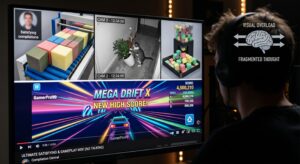
The algorithm shifts to the drama sector, where minor disagreements between internet personalities are elevated to the status of international crises. A creator spends fifteen minutes analyzing a three-word social media post, breaking down hidden slights and imagined betrayals with the intensity of a forensic investigator. It is a manufactured storm, an artificial ecosystem where controversy is generated, nurtured, and monetized to keep the audience in a state of perpetual, low-grade irritation.

Then come the life hacks that violate basic physics. A hand glues a plastic bottle to a broken appliance, or combines household chemicals to create a dysfunctional cleaning solution. The video relies on hidden cuts and clever angles because the workaround does not function in reality. It is visual fiction passed off as domestic utility, a celebration of unnecessary complexity that leaves the viewer less capable than before.

The final descent is the ambient void. A ten-hour video promises focus or sleep, featuring a static, stolen illustration of a rainy window paired with a looping track of white noise. The creator did not draw the image or record the audio; they simply arranged the pirated assets on a timeline and exported a massive file to sit on the server, a monument to passive consumption.

Arthur blinks. The screen reflects in his pupils, a catalog of modern cognitive decay. His 125 IQ allows him to categorize the precise mechanism of each distraction, to analyze the socio-economic drivers of the attention economy, and to understand exactly how his attention span is being systematically eroded. Yet he remains entirely stationary, his intellect rendered completely useless by the constant delivery of dopamine. He is highly intelligent, perfectly capable of critical thought, but thoroughly trapped in the loop.

But the digital rot is not confined to this single domain. If Arthur were to close the tab and move his hand to his mobile device, the decay merely shifts its vocabulary.

There are other platforms waiting in the dark. One offers a landscape of short-form vertical video, where users dance in sync to accelerated pop songs or mimic comedic audio tracks in a display of collective repetition. Another presents a stream of curated photographs, where reality is filtered, smoothed, and polished into an unattainable standard of aesthetic perfection that breeds quiet inadequacy.

Across another network, the rot takes the form of text—short, volatile bursts of outrage where nuance is prohibited by character limits and political discourse is reduced to hostile slogans and tribal posturing. Professional networks offer a different flavor of degradation, where ordinary career events are transformed into insufferable parables of corporate enlightenment and self-congratulatory inspiration.

The infrastructure of the modern mind is connected to a global network of specialized rot. Every application has engineered its own unique method to bypass human intellect, offering a customized flavor of numbness for the scholar and the fool alike. Arthur puts down his spoon, picks up his phone, and begins the cycle again on a different application.