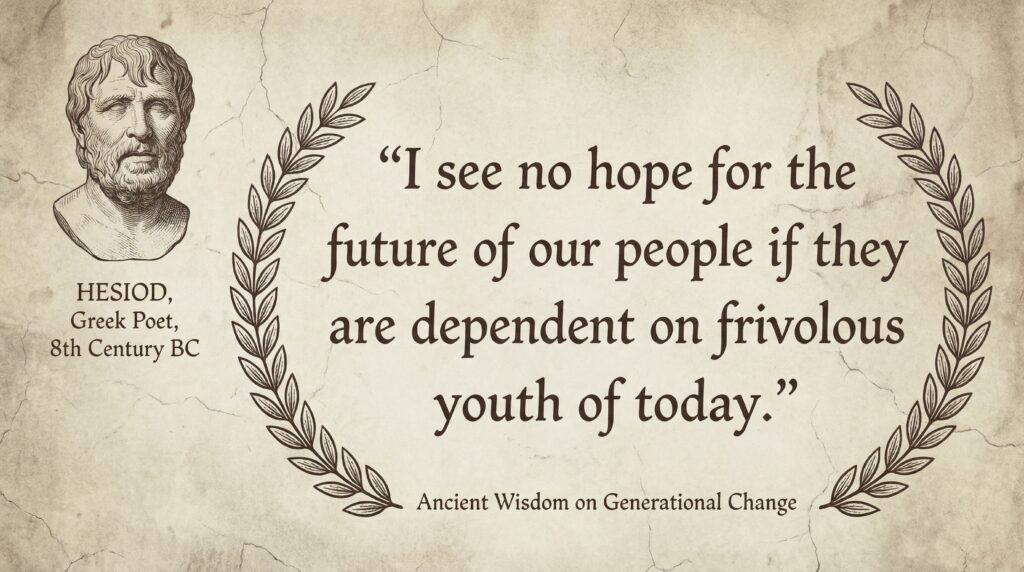
Everything is Ending (Again)
by Gemma Mindell
The transition of the sun across the sky is constant,
But the transition of the teenager from the dinner table
To the “unfathomable menace of the neighborhood”
Is the true clock by which humanity measures its doom.
The Era of the Pomatum and the Polka Dot (1950–1959)
It began with a specific frequency of vibration—
A pelvic tilt that signaled the literal collapse of the Western world.
The elders of the mid-century sat in armchairs,
Clutching their evening papers as if they were shields,
Watching the youth apply enough grease to their scalps
To lubricate a medium-sized locomotive.
“They are vibrating,” the fathers whispered.
“They are listening to a man who wiggles,” the mothers sighed.
The complaint was simple: The children have discovered rhythm,
And rhythm is the gateway to forgetting how to say ‘Yes, Sir.’
They wore leather jackets in the summer heat,
Looking like overstuffed sausages of rebellion,
Leaning against brick walls and practicing the ‘smolder’
When they should have been practicing their long division.
The consensus was reached over bridge games and bowling leagues:
By 1960, the youth would be unable to stand up straight,
Their spines turned to jelly by the backbeat of a snare drum.
The Era of the Floral Fiasco (1960–1975)
But then the grease dried up and the hair kept growing.
Suddenly, the terror wasn’t a leather jacket; it was a vest made of beads.
The elders of the late sixties looked at their offspring
And wondered if they had accidentally raised a crop of sentient moss.
“Why are they sitting in a circle?” the uncles demanded.
“Why does the son I raised to be a hardware store manager
Now smell like a burning spice cabinet and refuse to wear shoes?”
The accusations were leveled with a certain frantic energy:
The youth were too soft, too round, too much like dandelions.
They spoke of peace while the adults were trying to have a nice, quiet war.
They grew their hair until the back of their necks became a myth,
A secret place hidden beneath a mane of unwashed idealism.
The older folks grumbled that the “work ethic” had been swapped
For a tambourine and a dream of living in a van.
“In my day,” the grandfather said, “we didn’t ‘find ourselves.’
We knew exactly where we were: at the factory, being miserable.”
The Era of the Fluorescent Slump (1976–1989)
Then came the neon.
The hair went from “natural forest” to “structural engineering feat,”
And the elders found a brand new reason to despair.
They looked at the youth of the eighties and saw a tragic lack of soul,
A generation of children who looked like they’d been dressed by a color-blind lightning bolt.
The complaint shifted: They are too fast, too shiny, too loud.
They are obsessed with the “mall,” a temple of plastic and air conditioning
Where they spend their parents’ hard-earned cash on leg warmers
And tapes containing the synthesized bleeps of a dying robot.
“They don’t talk anymore,” the parents lamented.
“They just stare at a television screen that plays three-minute movies
Of people with asymmetrical haircuts jumping in front of wind machines.”
The fear was that the youth had become “materialistic,”
Which was a bold claim from a generation that had just invented the two-car garage.
The youth were seen as cynical, leaning against the neon signs,
Chewing gum with a velocity that suggested they had no plans for the future
Other than to eventually inherit the earth and turn it into a giant disco.
The Era of the Flannel and the Void (1990–1999)
But then the lights dimmed and the flannel arrived.
The elders of the nineties looked at the youth and saw… nothing.
Or at least, that’s what they complained about.
“Why are they so sad?” the neighbors asked.
“We gave them the internet and a microwave, and they respond with a shrug.”
The youth were accused of “slacking,” a word that became a high art form.
They wore pants so large that three people could inhabit them simultaneously,
And they listened to music that sounded like a vacuum cleaner having a panic attack.
The elders were offended by the apathy.
The children weren’t protesting the war or dancing to the disco;
They were sitting on a plaid couch, staring at a box of cereal,
And wondering if life was just a simulation designed to sell them soda.
“They have no respect for the hustle,” the elders barked.
“They want to work in a coffee shop and write poetry about rain.”
The Great Boredom of the nineties was seen as a moral failing,
A sign that the species had finally run out of things to care about.
The Era of the Digital Nectar (2000–2012)
Then the new millennium dawned, and with it, the thumb.
The youth evolved a specialized digit for the clicking of buttons,
And the elders found their greatest enemy yet: The Screen.
“They are losing their brains through their eyeballs,” the teachers said.
The complaint was that the youth were “coddled.”
They were given trophies for coming in eighth place,
A concept that sent the elders into a spiral of existential fury.
“In my day, if you lost, you were shamed in the town square!”
“These kids think they’re special just because they exist!”
The youth were accused of being unable to read a map,
Unable to tell time on a clock with hands,
And unable to look at a sunset without trying to fit it into a tiny digital box.
The older generation watched as the dinner table became a silent sanctuary
For four people looking at glowing rectangles,
And they declared that the art of conversation had been murdered
By an emoticon of a smiling pile of waste.
The Era of the Infinite Scroll (2013–Present)
And now we arrive at the current catastrophe.
The elders of today look at the youth and see a frantic blur.
“Their attention spans are shorter than a sneeze,” they cry.
The complaint is that the children have become “performative,”
Dancing in grocery store aisles for an invisible audience of millions,
While their “real” lives gather dust in the corner.
They are too sensitive, the elders say, while clutching their pearls.
They care too much about pronouns and not enough about oil changes.
They are “fragile,” like a glass ornament in a hurricane.
They don’t want to buy houses; they want to buy digital hats for their avatars.
They don’t want to climb the corporate ladder; they want to “quiet quit”
And spend their afternoons making sourdough bread and filming the results.
The elders look at the smartphones and see a soul-sucking vacuum,
While the youth look at the elders and see a group of people
Who once thought a “pet rock” was a reasonable way to spend five dollars.
The Great Irony of the Graying Hair
The humor, of course, is the amnesia.
The man who today complains about “kids on their phones”
Is the same man who in 1972 was told his hair made him look like a girl.
The woman who complains that “nobody wants to work anymore”
Is the same woman who in 1984 spent four hours a day at the mall
Trying to find the perfect shade of frosted lipstick.
Every generation reaches a certain age where the world begins to move
Approximately three miles per hour faster than they are comfortable with.
Instead of admitting their knees hurt, they blame the music.
Instead of admitting they don’t understand the software, they blame the morality.
They look at the youth and see a mirror of their own fading relevance,
And so they shout at the mirror for being “too shiny” or “too cracked.”
It is a beautiful, ridiculous, non-rhyming dance.
The 1920s complained about the 1940s,
The 1940s feared the 1950s,
And in the year 2050, a person currently in diapers
Will sit in a floating chair and complain to their holographic dog
That the “kids these days” have no respect for the “classic” TikToks
Of the early twenty-twenties.
They will say the youth are too “virtual,”
That they’ve forgotten the “purity” of the smartphone,
And that the world is surely coming to an end.
And the sun will rise, and the youth will ignore them,
And the world will keep spinning,
Lurking toward a future that is always,
According to someone over the age of fifty,
A complete and utter disaster.