
The Phenomenology of Crisis Apparitions and Immortal Guides: A Comparative Analysis of 20th and 21st-Century Manifestation Accounts
The human encounter with the anomalous—particularly in moments of profound ecological catastrophe, psychological trauma, or spiritual crisis—frequently generates complex narratives of divine intervention. Across vastly different cultural, theological, and geographic landscapes, accounts persist of transcendent entities breaching the boundaries of the material world to offer protection, initiate the seeker, or alter the course of predetermined events. These manifestations, often categorized as crisis apparitions or soteriological interventions, challenge strictly materialist paradigms and reveal the intricate mechanisms by which human consciousness processes the miraculous.
This comprehensive report provides an exhaustive, comparative analysis of six seminal manifestation accounts from the 20th and 21st centuries. By examining the apparitions of Guan Yin during the 1959 Taiwan flood, the localized phenomena of the Joplin "Butterfly People," the immortal manifestations of Mahavatar Babaji and Al-Khidr, the post-mortem interventions of Neem Karoli Baba, and the controversial bilocation and subtle-body claims surrounding Sathya Sai Baba, a nuanced ontological and psychological framework emerges. These accounts are not merely isolated anomalies; they represent an archetypal matrix of stimulus and response, where the extremity of human need precipitates the materialization of the divine.
Collective Trauma, Environmental Symbology, and the Archetype of Compassion: Guan Yin and the 1959 Taiwan Flood
The intersection of meteorological disaster and religious folklore provides a fertile ground for the study of collective memory, cultural coping mechanisms, and the domestication of divine figures. Taiwan’s geographical reality as a mountainous island surrounded by ocean, characterized by fast-flowing rivers prone to severe flooding, has historically fostered a unique cultural relationship with water1. Early Han Chinese settlers, who originally hailed from continental farming traditions, viewed water with profound trepidation1. In traditional Chinese cosmology, which incorporates the five agents and the balance of yin and yang, the Taiwanese have historically been characterized as a "fire people"1. Fire represents the south and strong, bright yang energy, which aligns with bold, expressive Taiwanese folk practices like burning ghost money, lighting beehive fireworks, and launching sky lanterns1. Conversely, water corresponds to the north, embodying softer, darker yin qualities1. Water is thus approached with caution, requiring elaborate talismans, amulets, and solemn riverside ceremonies to appease animistic spirits and ward off evil1.
This deep-seated ecological anxiety is echoed in the indigenous Formosan flood myths of Taiwan, such as those of the Amis, Atayal, and Tsou peoples. These ubiquitous ancient motifs frequently detail humanity surviving apocalyptic deluges by escaping to high peaks like Jade Mountain, only to be saved by the intervention of animals—such as a giant crab cutting apart a mythical eel or serpent that had blocked the rivers2. It is within this historical and mythological context of water-induced existential threat that the catastrophes of the 19th and 20th centuries must be understood.
The Historical Context: The Floods of 1898 and 1959
To comprehend the psychological impact of the 1959 disaster, it must be measured against the cultural memory of the Great Flood of 1898. On August 6, 1898, an "iron typhoon" unleashed endless rain that swallowed entire fields, shifted riverbeds 300 meters, and forced massive terrain alterations, leaving survivors with so little resources that they resorted to creating a new culinary staple—the bawan (a translucent dough filled with pork and bamboo shoots)—to survive and appease spirits during Ghost Month4.
However, the devastation of August 7, 1959, far eclipsed this historical memory. Indirectly triggered by Typhoon Ellen, which diverted Tropical Storm 81 toward Taiwan, the 1959 flood saw rainfall in the central and southern regions of the island reach their annual averages in a single day4. The destruction was absolute.
Metric | The Great Flood of 1898 | The Flood of August 7, 1959 |
Meteorological Cause | "Iron Typhoon" | Typhoon Ellen / Tropical Storm 81 |
Casualties | Unrecorded/Localized | > 1,000 dead or missing |
Houses Completely Destroyed | 6,165 | 27,466 |
Houses Partially Ruined | 5,045 | 18,303 |
Area Affected | Regional (Hsihu Township) | 1,365 square meters (30,000 households) |
Notable Topographical Impact | River shifted 300 meters; new sandbanks formed | Complete annihilation of Pitzu Village; 3 meters of standing water in Changhua City |
Data reflecting the comparative devastation of Taiwan's historical floods4.
In Chiayi County, the Chianan Irrigation Canal's levee collapse annihilated entire settlements, such as Pitzu Village, leaving nothing but flat sandbeds and drowning all livestock save for a few poultry4. In Changhua City, the Dadu River burst its left bank along a 1,102-meter stretch, submerging the city under three meters of water4.
The Wu River Apparition and the Symbology of the Dragon
Amidst this apocalyptic landscape, as hundreds of thousands fled their homes, a powerful narrative emerged among the residents and military personnel. Witnesses claimed to see an apparition of the Buddhist bodhisattva Guan Yin—the Goddess of Mercy and Compassion—manifesting in the strange, colorful storm clouds over the Wu River in Changhua5. She was described as dressed in flowing white robes, standing majestically upon the back of a dragon5. Shortly after this alleged manifestation, the torrential rains subsided, and the floodwaters began to recede5.
The theological implications of this vision are deeply embedded in East Asian cosmology and Mahayana Buddhism. Guan Yin (Avalokiteśvara) translates to "[The One Who] Perceives the Sounds of the World," explicitly characterizing her as a savior who listens to the cries of the suffering6. While originally depicted as a male bodhisattva in Indian Buddhism, the figure became localized in China and East Asia as a female or androgynous entity by the 12th century, largely influenced by the legend of Princess Miao Shan, who chose execution over a forced marriage and transformed into the immortal Guan Yin6.
In Buddhist iconography, the mounts of the bodhisattvas represent their core virtues—Manjushri rides a lion representing fearlessness, while Samantabhadra rides an elephant symbolizing diligence5. Guan Yin's dragon, however, possesses a highly functional aspect. In Chinese mythology, dragons are high-order beings tasked with the governance of water, rainfall, typhoons, and floods5. The manifestation of Guan Yin upon the dragon represents a subjugation and rebalancing of chaotic elemental forces9. The dragon serves as the active, executing force (the yang), while Guan Yin provides the divine will and command (the yin)5. This aligns perfectly with the Daoist principles outlined by Laozi in the Dao De Jing, where Dao is the formless law (the will) and De is the path of action (the execution)5.
The Photographic Myth and the Yōga Art Movement
The endurance of the 1959 Guan Yin apparition in Taiwanese cultural memory was uniquely cemented by a visual artifact. Between 1960 and 1980, a popular image of Guan Yin riding a dragon through a tempest was widely distributed and venerated in Buddhist, Taoist, and folk temples across Taiwan4. Devotees circulated the image with the belief that it was a genuine photograph captured by a U.S. reconnaissance jet pilot who had flown over the storm clouds, purportedly developing the film to discover the silhouette of the bodhisattva5.
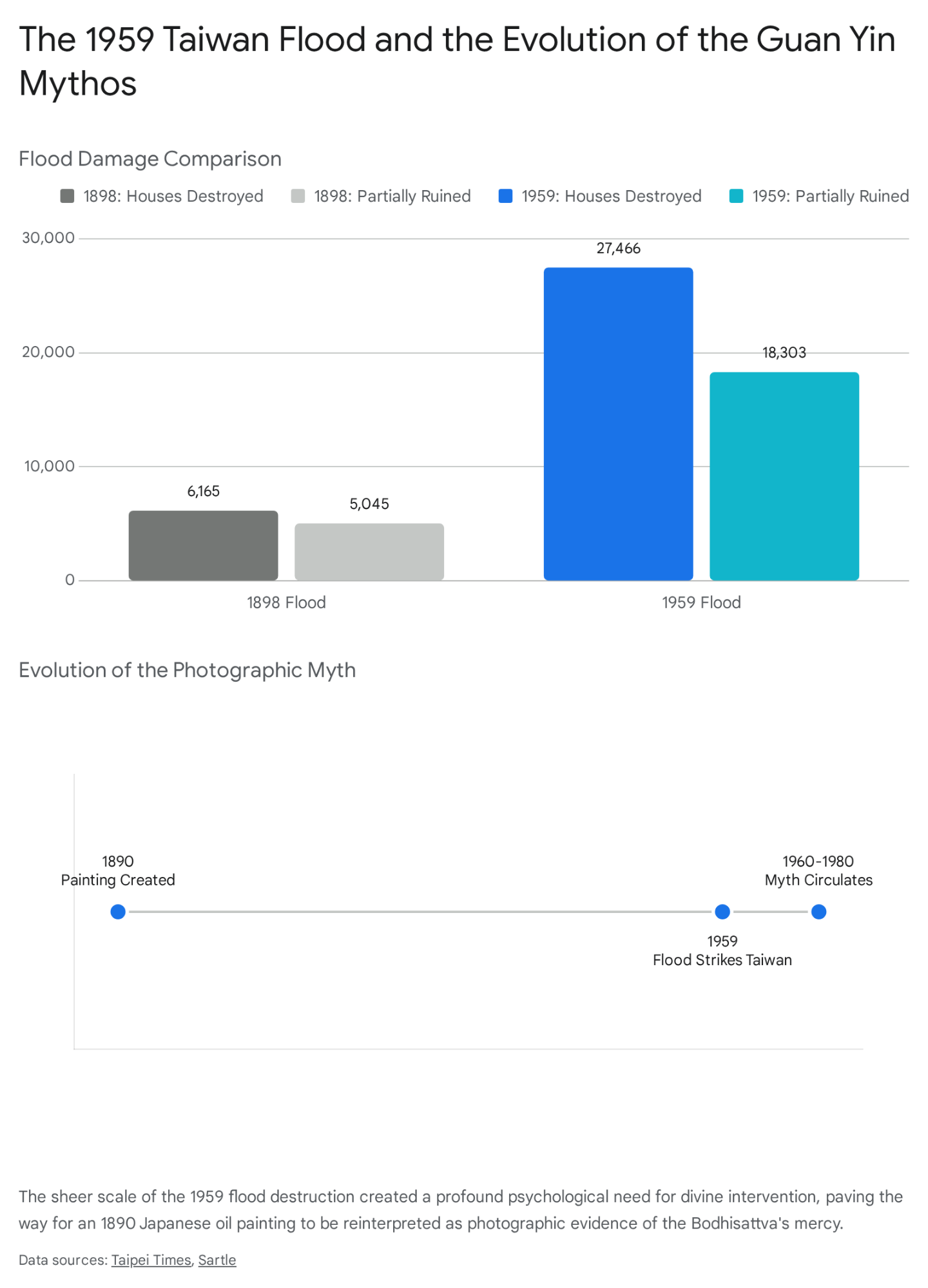
Historical and art-historical investigations eventually debunked the photograph. The image was proven to be a reproduction of an 1890 oil painting titled Kannon Bodhisattva Riding the Dragon by the Japanese artist Harada Naojirō4. The painting itself is a historical anomaly. Harada had recently returned to Japan from studying in Germany and was a proponent of the yōga (Western-style painting) movement, which sought to reinvent Japanese art using European stylistic realism11. By applying the realistic representation of European oil painting to a traditional Mahayana Buddhist subject, Harada created a depiction so lifelike that it offended the sensibilities of the 19th-century Japanese public11. The public rejected the rendering of their symbolic, gender-fluid deity as a human, prompting academic backlash from figures like Professor Toyama Shōichi of Tokyo Imperial University, who argued that art should strictly represent the Japanese nation subliminally11.
The supreme irony of this art historical lineage is profound. The very Western realism that made Harada's painting controversial in 1890s Japan is precisely what allowed it to be seamlessly co-opted as "photographic proof" of a miracle by a traumatized Taiwanese populace seventy years later. The painting's realistic rendering of the turbulent sea, the stormy sky, and the composed Bodhisattva holding a willow branch and water cup mapped perfectly onto the collective memory of the Wu River manifestation8.
This phenomenon is best understood through the traditional Chinese cosmological concept of ganying (stimulus and response)13. Ganying posits a correlative resonance permeating the cosmos; human suffering acts as a powerful energetic stimulus, to which the divine necessarily responds, akin to a sympathetic vibration13. The immense scale of the 1959 disaster acted as the ultimate collective stimulus, generating a psychological and spiritual vacuum that demanded a response. The Harada painting filled this vacuum, serving as a tangible artifact of ganying, crystallizing the traumatic memory of the flood into an enduring narrative of salvation that successfully bridged ancient mythology with modern disaster.
The Enduring Guardian: The Butterfly People of the Joplin Tornado
While the Taiwanese flood narrative was codified through established religious iconography, the human propensity to perceive localized, protective entities during extreme environmental trauma was similarly observed in the modern American Midwest. On May 22, 2011, the city of Joplin, Missouri, was struck by a devastating EF5 tornado. The sheer physical force of the vortex killed 161 individuals, injured over 1,150, and destroyed approximately one-third of the city's homes and infrastructure, amounting to $2.8 billion in economic losses15.
In the immediate aftermath of this catastrophic event, a unique collective narrative emerged, predominantly among the city's child survivors. Numerous children reported seeing "butterfly people"—winged, angelic beings that manifested directly within the violent vortex of the tornado15. According to these testimonies, the entities appeared specifically to shield the children from the deadly flying debris and the crushing atmospheric pressure, acting as supernatural physical barriers against the devastation15. This anomaly gained such widespread cultural traction that local filmmaker Gregory Fish, alongside digital creator Steve Head, produced an award-winning documentary, The Butterfly People, to catalog the first-person accounts and investigate the psychological dimensions of these protective guardian figures15.
From a psychological and neurological perspective, the Joplin phenomenon closely parallels what researcher John Geiger termed the "Third Man Factor"19. The concept, famously referenced in T.S. Eliot's The Waste Land (though Eliot misremembered explorer Ernest Shackleton's account, citing a "third" rather than a "fourth" companion), describes a well-documented survival mechanism19. Individuals in states of extreme isolation, sensory deprivation, or acute, life-threatening stress frequently experience the undeniable presence of an unseen companion20. The brain, when pushed to the absolute limits of endurance and facing imminent annihilation, appears to generate an externalized, comforting presence as an adaptive cognitive mechanism to prevent panic, maintain hope, and preserve physiological resilience20. The anomalous experience functions as a highly specific idiom of stress, tailored to the cultural vocabulary of the survivor—in this case, the Christian Midwestern conception of guardian angels, translated through a child's psychological lens into "butterfly people."
Trauma, Narrative, and Post-Traumatic Growth
The apparition of the Butterfly People cannot be decoupled from the broader psychological recovery of the Joplin community. Extensive clinical research conducted on the survivors revealed complex intersections between trauma and recovery. Studies analyzing the mental health of disaster survivors consistently show that direct exposure leads to elevated rates of Post-Traumatic Stress Disorder (PTSD) and clinical depression17.
Clinical Metric (Joplin Adult Cohort) | 6 Months Post-Disaster | 2.5 Years Post-Disaster |
Probable PTSD Prevalence | 12.63% | 26.74% |
Current Depression Prevalence | 20.82% | 13.33% |
Child Difficulties (Parent Reported) | N/A | Higher frequency in ages 4-10 |
Data reflecting the longitudinal psychological impact of the 2011 Joplin tornado17.
However, amidst these rising PTSD rates, researchers at the Disaster and Community Crisis Center at the University of Missouri discovered a profound secondary effect: Post-Traumatic Growth (PTG)16.
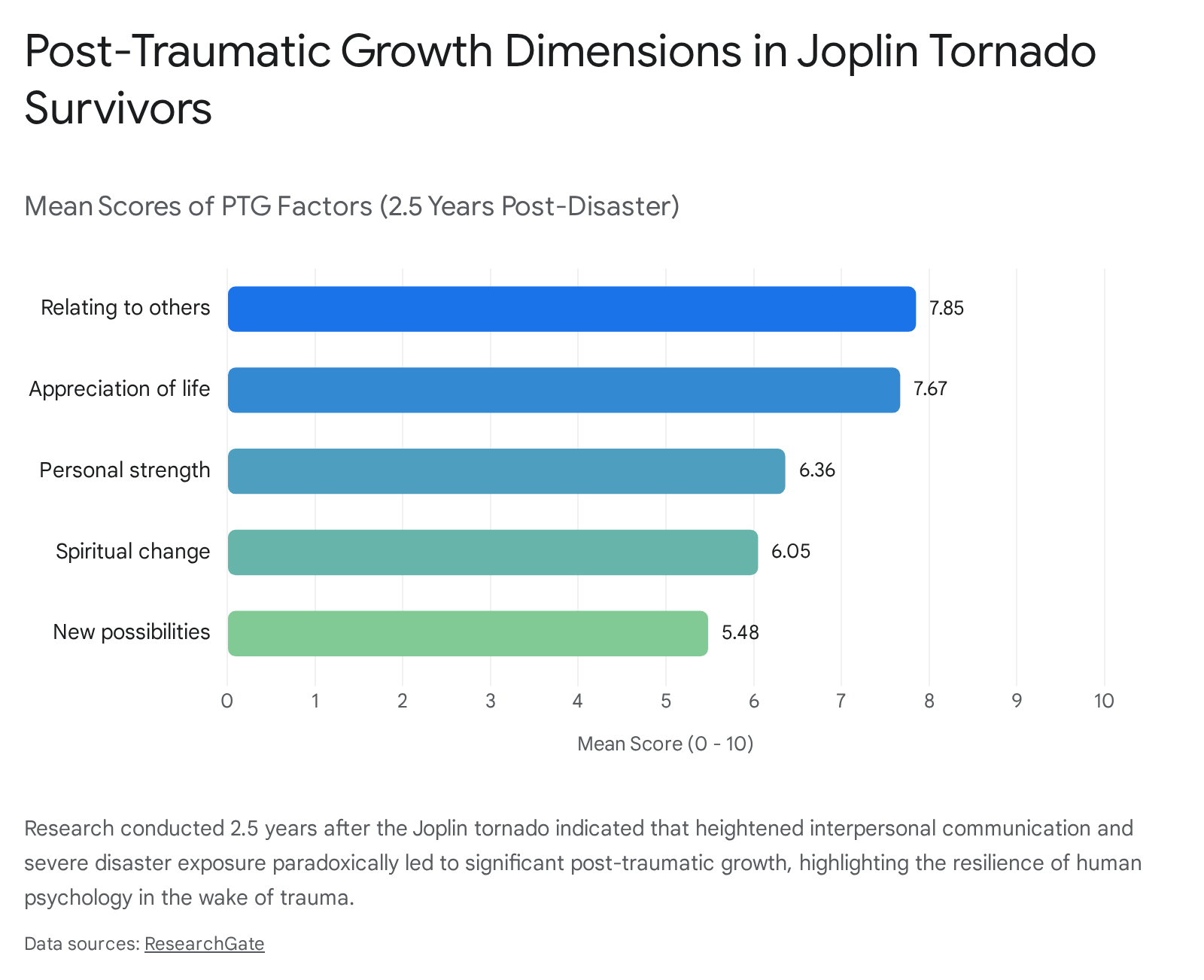
In an online survey of 438 adult survivors conducted two and a half years after the event, researchers found that higher levels of tornado exposure and trauma symptoms paradoxically correlated with higher levels of PTG16. The dimensions of growth included a greater appreciation of life, enhanced personal strength, spiritual change, and most prominently, improved relations with others16. Furthermore, cognitive processing and narrative meaning-making were identified as vital tools for adjustment; studies on 8- to 12-year-old Joplin survivors demonstrated that children who were able to form coherent recollections, identify positive emotion terms, and find emotional resolutions in their trauma narratives exhibited better mental health outcomes23.
The Butterfly People narrative served as a critical psychological scaffolding for this cognitive processing. By openly sharing these stories—and ultimately memorializing them in community projects like civic murals in downtown Joplin—the community engaged in high levels of interpersonal communication16. The shared mythos of protective entities transformed a senseless, chaotic natural disaster into a structured, survivable narrative where innocence was guarded by divine intervention, thereby facilitating collective psychological healing, enhancing social cohesion, and enabling long-term post-traumatic growth.
The Immortal Ascetics: Mahavatar Babaji and Al-Khidr as Esoteric Initiators
While crisis apparitions like Guan Yin and the Butterfly People are deeply tied to specific, localized environmental disasters and communal trauma, another distinct class of manifestations involves immortal, perpetually embodied guides. These entities appear across vast temporal landscapes not merely to rescue, but to initiate seekers and subtly alter the trajectory of spiritual history. Two of the most prominent figures in this category are the Hindu yogi Mahavatar Babaji and the Islamic Sufi figure Al-Khidr.
The Hidden Pillar of the Himalayas: Mahavatar Babaji
In the 20th century, the elusive figure of Mahavatar Babaji was brought to global prominence primarily through Paramahansa Yogananda’s seminal 1946 work, Autobiography of a Yogi25. Unlike traditional gurus who establish public ashrams, accrue wealth, and administer vast organizations, Babaji is described as a deathless avatar who has retained his physical form for centuries, perhaps millennia, residing in the remote, inaccessible northern Himalayan crags near Badrinarayan25.
Babaji’s manifestations are characterized by their extreme rarity, suddenness, their physical tangibility, and their highly specific strategic purposes. He does not appear to the masses; he reveals himself only to a select few to impart esoteric knowledge or to initiate paradigm-shifting spiritual movements. It was Babaji who physically manifested in the 19th century to bestow the lost scientific meditation technique of Kriya Yoga upon his disciple Lahiri Mahasaya25. During this initiation, Babaji explicitly stated the historical continuity of the practice, noting that it was the same science transmitted by Krishna to Arjuna millennia ago, and later utilized by Patanjali, Christ, St. John, and St. Paul25.
Furthermore, Babaji acts as a divine architect behind the scenes, assisting prophets in carrying out their special dispensations without claiming public credit26. A critical manifestation occurred shortly before Yogananda departed for America in 1920 to spread Kriya Yoga to the West. Babaji appeared physically in Yogananda’s Calcutta home at a moment of deep anxiety regarding the monumental mission. Babaji provided direct verbal assurance: “Follow the behest of your guru and go to America. Fear not; you shall be protected. You are the one I have chosen to spread the message of Kriya Yoga in the West”25. In this framework, the immortal master functions not merely as a teacher, but as the underlying structural support of global spiritual evolution, manifesting physically only to precisely calibrate the trajectory of human history before vanishing back into seclusion.
The Verdant Rescuer: Al-Khidr in the Sufi Tradition
A striking parallel to Mahavatar Babaji exists within Islamic mysticism in the form of Al-Khidr (The Green One, or The Verdant One). Originating as a Qur'anic figure in Surah al-Kahf (Quran 18:65–82), Khidr is described as a righteous servant possessing profound mystic knowledge (ilm ladunni)27. Across the centuries, he has evolved into a patron saint of travelers, the guardian of the seas, and the hidden initiator of Sufi mystics who lack a physical human master (an initiation process known as the Uwaisi transmission)27.
The fundamental archetype of Al-Khidr is one of paradoxical mercy and the limitation of human perception. In the Qur'anic narrative, he acts as a teacher to the prophet Musa (Moses), carrying out actions that appear destructive or malicious to the uninitiated observer27. Khidr damages a boat, kills a young boy, and repairs a decrepit wall for hostile villagers without asking for recompense27. Musa continuously questions these acts, violating his oath of patience. It is only upon explanation that the underlying divine justice is revealed: the boat was damaged to save it from being seized by a tyrannical king; the youth would have grown to oppress his righteous parents; the wall contained a hidden treasure for vulnerable orphans, and fixing it preserved their inheritance27. Khidr embodies the reality that divine intervention often arrives disguised as tragedy or chaos.
Throughout Islamic tradition, Khidr is believed to retain the appearance of a handsome young adult with a long, white beard27. Various traditions place him at pivotal historical moments: meeting the prophet Elijah every year to spend the month of Ramadan in Jerusalem, attending the funeral of the Prophet Muhammad where he was recognized only by Ali, and even being identified as Xerxes or a figure who drank from the River of Life to achieve immortality27.
Throughout the 20th century, reports of physical encounters with Al-Khidr persisted among Sufi communities. A fascinating intersection of this archetype occurred with the 20th-century Sufi saint Muhammad Raheem Bawa Muhaiyaddeen. Believed to be over 160 years old at the time of his death in Philadelphia in 1986, Bawa Muhaiyaddeen was discovered roaming the jungles of Sri Lanka in 194229. Encounters with him shared the hallucinatory, sudden quality of encounters with Khidr. In one documented account, two brothers from Jaffna on a pilgrimage spotted Bawa appearing from behind a tree in the jungle; their initial contacts were purely visual, escalating to spoken communication in an obscure Tamil dialect they struggled to understand29. Bawa performed miraculous feats, such as violently exorcising demonic possessions with a cane and burying the trapped evil spirits in jars on the nearby beach29.
Bawa Muhaiyaddeen himself taught a complex cosmological framework regarding the incarnation of the soul (ruh). He explained that souls originally existed as magnetic rays dispersed by God; the nature of a life was determined by where the ray fell—upon earth, fire, water, air, or ether (maya)32. Those that fell into the realm of wisdom became human souls, while those that returned to God became the 124,000 prophets and qutubs32. The soul arrives in the human infant in distinct stages, with the essence of the elements (anma) entering on the third day, the pure spirit (avi) in the second month, and the pure soul by the third month32. In this deeply esoteric worldview, the physical body is highly malleable and subject to profound spiritual forces, providing a theological basis for how figures like Al-Khidr or Mahavatar Babaji might manipulate matter to manifest in the physical realm, bypass biological decay, and appear simultaneously in distant locations to guide the faithful.
Trait / Entity | Mahavatar Babaji | Al-Khidr (The Green One) |
Tradition | Hindu (Kriya Yoga) | Islamic (Sufism) |
Primary Role | Hidden architect of spiritual evolution; initiator of prophets. | Guardian, esoteric initiator (Uwaisi), deliverer of paradoxical mercy. |
Physical Appearance | Ageless, youthfully radiant yogi. | Handsome young adult with a long white beard. |
Key Associations | Himalayan crags (Badrinarayan), Yogananda, Lahiri Mahasaya. | Water, the sea, Moses (Musa), Elijah, Bawa Muhaiyaddeen. |
Method of Intervention | Sudden physical manifestation to impart specific techniques (Kriya Yoga). | Testing patience, performing outwardly destructive acts to reveal deeper divine justice. |
Comparative taxonomy of the immortal esoteric initiators25.
The Post-Mortem Intercessor: Neem Karoli Baba's Ongoing Manifestations
While Babaji and Al-Khidr are characterized by their immortal physical retention, other modern phenomena revolve around the persistent, localized manifestations of a guru following biological death. The case of Neem Karoli Baba (affectionately known as Maharaj-ji), a highly venerated Hindu saint who achieved mahasamadhi (conscious exit from the body) on September 11, 1973, provides a rich tapestry of post-mortem interventions33.
Devotees of Neem Karoli Baba maintain that his physical passing did not conclude his interaction with the material plane. Echoing the assertion of Yogiraj Devraha Baba that "Baba's death was not a reality," followers globally report ongoing physical apparitions, vivid dreams, and inexplicable rescue interventions34. These manifestations are highly functional, often occurring during moments of dire physical threat or administrative crisis.
For instance, Devkamta Dixit, a trustee of the Vrindavan Ashram, was visited at his home by a mysterious sadhu who commanded him to attend a crucial meeting for the "work of his guru." Dixit complied, realizing later that his presence was vital for key decisions, while the sadhu vanished without a trace—an event universally interpreted by devotees as Maharaj-ji manifesting to ensure the continuity of his institutional legacy34. In another instance, a devotee was promised a rare Narmada River Shivling and conch by Maharaj-ji prior to his death. Long after 1973, a young sadhu arrived at the devotee's door delivering the exact promised items, stating they were sent by Maharaj-ji, thus fulfilling a divine contract from beyond the grave34.
Physical Interventions and the Grace of Hanuman
During his lifetime, Neem Karoli Baba's interventions often bent the laws of physics and probability, frequently utilizing the concept of "Hanuman's grace" to deflect tragedy. In a striking account from March 1972 involving a journey to Chitrakut, Maharaj-ji repeatedly warned his accompanying devotees that their hired taxi was unsuitable and would not complete the journey36. Despite altering their route upon his command, the taxi was involved in a horrific head-on collision with a heavily loaded truck36. The engine was smashed, and the vehicles were locked together in a mangle of steel, yet miraculously, no passenger suffered any physical injury36.
The theological mechanics of this intervention were subsequently explained by Maharaj-ji himself. Rather than claiming the miracle as his own, he exhibited intense emotion, stating that the monkey deity Hanuman had saved their lives, thereby sparing Maharaj-ji the unbearable punishment of having to face the devotees' mothers if their children had perished36. He localized this grace further upon reaching the Hanuman murti (statue) at Hanumandhara. After pacing and talking to the devotees, he whispered in a disciple's ear that "Hanumanji was always at peace," even after burning the demon city of Lanka36. This illustrates a core feature of his phenomenal presence: the ability to foresee impending trauma, allow the physical mechanics of the accident to unfold, yet completely neutralize the kinetic damage to human life, all while maintaining absolute inner tranquility amidst external chaos.
K.C. Tewari and the Transmission of Presence
The ongoing manifestation of Neem Karoli Baba is also intimately connected to the esoteric capacities of his closest disciples, most notably K.C. Tewari (Krishna Chandra Tewari). A humble headmaster of a boys' school in Nainital, Tewari was secretly a high yogi capable of entering samadhi (profound states of spiritual trance, akin to a spiritual coma) at a moment's notice37. Two days before leaving his body, Maharaj-ji explicitly instructed Tewari to care for his growing contingent of Western disciples (which included figures like Ram Dass, Krishna Das, and Jai Uttal)35.
Tewari embodied the localized presence of the departed guru, serving as a conduit for the divine vibration. The relationship between Maharaj-ji and Tewari highlighted the complete submission of human will to the divine command. Tewari, orphaned young, had taken a fierce vow of celibacy41. However, upon visiting a deceased devotee's home, Maharaj-ji decided Tewari should marry the daughter who had served them gracefully, calling her "Joan of Arc"42. After a three-day battle of wills, Tewari agreed on the impossible condition that Maharaj-ji take full responsibility for the marriage in writing; shockingly, Maharaj-ji signed a contract in gold ink guaranteeing full responsibility for all issues of the marriage42.
By embedding such highly advanced, "brilliantly disguised" yogis within the ordinary world, the architectural footprint of the guru's presence is maintained across generations. Tewari’s ability to vanish into the background like a ninja, yet channel unconditional love, allowed the leela (divine play) of spontaneous manifestation and spiritual support to continue unabated long after the biological death of the master37.
The Paradox of Bilocation and the Succession of the Subtle Body: Sathya Sai Baba
The phenomenon of physical manifestation reaches its most contentious and institutionally destabilizing form in the accounts surrounding Sathya Sai Baba (1926–2011). Throughout his life, Sathya Sai Baba amassed an enormous global following, estimated at up to 50 million devotees, drawing the attention of global political figures and managing a charitable empire valued at up to $2.8 billion (or £5.5 billion)43. The foundation of this following was built on continuous reports of miracles, physical materializations (such as vibhuti or sacred ash, gold rings, and watches), and bilocation43.
Disciples frequently reported encounters wherein the guru would physically materialize in distant locations—often thousands of miles from his primary ashram in Prasanthi Nilayam—to perform medical healings, avert accidents, or offer blessings, while simultaneously remaining visible to crowds in India43. While skeptics like Basava Premanand of the Indian Rationalist Association dedicated their lives to debunking these miracles as mere sleight of hand, and media investigations highlighted controversies surrounding his vast wealth and allegations of abuse, the subjective reality of these apparitions for the devotees remained an absolute truth44.
However, following his physical death from a severe lung infection and chest congestion on Easter Sunday, April 24, 2011, the mechanisms of his manifestation became the epicenter of a profound theological and institutional schism45. Because Sathya Sai Baba had not designated a formal successor prior to his death, a massive power vacuum opened45. In this void, a former student from the Muddenahalli campus, Madhusudan Rao Naidu, emerged with a radical claim: he asserted that Sathya Sai Baba had not truly departed but was existing in a Sukshma Sharira (subtle, non-physical body) localized at Muddenahalli47.
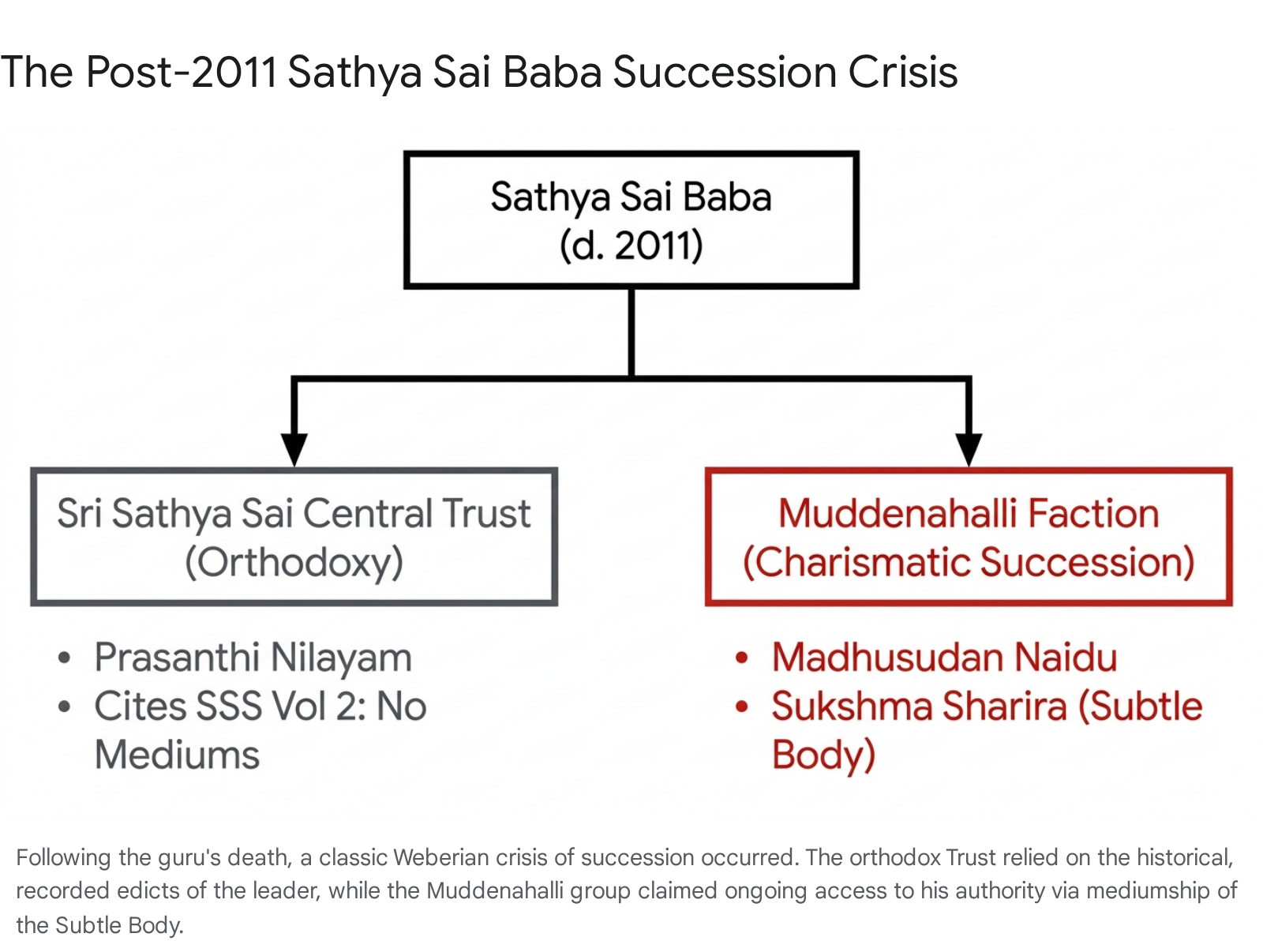
Madhusudan claimed the exclusive ability to see and hear this subtle form, acting as an intermediary or medium to transmit the deceased avatar's ongoing instructions47. This claim was bolstered by the support of B.N. Narasimhamurthy, a former hostel warden and senior biographer47. Operating under the guise of direct orders from the Sukshma Sharira, the Muddenahalli group rapidly mobilized, raising international funds and engaging in massive infrastructure projects. Within five years, they built ten new values-based educational campuses in Karnataka serving over 4,000 students, and constructed two mega super-specialty child heart care hospitals in Raipur (Chhattisgarh) and Palwal (Haryana), saving thousands of children with congenital heart diseases through free surgeries49.
Despite these philanthropic achievements, the Sri Sathya Sai Central Trust, representing the orthodox administration at Prasanthi Nilayam, vehemently denounced Madhusudan Naidu as a fraud and an impostor whose sacrilegious actions offended the sentiments of devotees worldwide47. The Trust wielded Sathya Sai Baba's own recorded discourses as the ultimate weapon against the splinter group. They cited speeches where Sathya Sai explicitly stated, "I do not use others as My media; I have no need to," and vehemently warned against charlatans pretending to be his mouthpiece or claiming he possessed them as vehicles of expression47. The orthodoxy released public documents explicitly cautioning devotees against engaging with the Muddenahalli caucus, rejecting the notion that the guru could be localized in Madhusudan's body or chair48.
This scenario perfectly encapsulates the sociological crisis of routinization of charisma (as formulated by Max Weber). When a charismatic leader whose authority is predicated on continuous miracles and supernatural manifestations passes away, the movement inevitably faces a structural rupture. The orthodox institution (the Central Trust) attempts to codify and freeze the charisma in past texts and strict guidelines, transforming living magic into administrative procedure48. Conversely, the splinter group (Muddenahalli) recognizes that the vitality and financial momentum of the movement depend on the continuance of anomalous manifestations, thus inventing a theological loophole (the Sukshma Sharira) to maintain the flow of living revelation, despite the blatant contradictions with the founder's explicit historical teachings47.
Conclusion
The accounts of crisis apparitions and immortal manifestations analyzed in this report reveal a deeply ingrained structural architecture within human consciousness and spiritual tradition. Whether interpreting the 1959 manifestation of Guan Yin or the 2011 sightings of the Joplin Butterfly People, it becomes evident that extreme environmental trauma triggers a potent psychological and cultural mechanism—be it classical ganying (stimulus and response) or the neurological Third Man Factor—that externalizes localized defense mechanisms into culturally specific divine forms. These apparitions function critically to stabilize the human psyche, preventing collapse by enforcing a narrative of ultimate safety, and ultimately paving the way for quantifiable post-traumatic growth and communal resilience.
Conversely, the manifestations of immortal guides like Mahavatar Babaji and Al-Khidr, as well as the post-mortem interventions of Neem Karoli Baba, serve a distinct theological function. They act as the hidden connective tissue of esoteric lineages, manifesting physically at precise inflection points to ensure the transmission of knowledge, avert physical disaster through divine grace, and maintain the overarching architecture of spiritual history across generations through disguised adepts like K.C. Tewari.
However, as demonstrated by the Sathya Sai Baba succession crisis, the human reliance on continuous miraculous manifestation can profoundly destabilize religious institutions once the physical locus of that charisma perishes. Movements are forced to navigate the treacherous waters between the frozen, text-based orthodoxy of the past and the controversial, unverifiable apparitions claimed by charismatic successors in the present. Ultimately, these phenomena underscore the enduring human conviction that the material world is highly permeable, not a closed system, but one constantly subject to the intercessory presence of the transcendent.
Works cited
- Water in Taiwan's Folk Rituals and Culture - 台灣光華雜誌, https://www.taiwan-panorama.com/en/Articles/Details?Guid=e5f7fbee-7a3e-419c-97b2-55e63c7aaab0&CatId=10&postname=Water%20in%20Taiwan%E2%80%99s%20Folk%20Rituals%20and%20Culture
- Taiwanese indigenous myths (translated in English) - Prairial, https://publications-prairial.fr/iris/index.php?id=1909&file=1
- The Great Flood - Island Folklore: Taiwanese Tales & Traditions, https://islandfolklore.com/the-great-flood/
- Taiwan in Time: Deadly waters and their legends - Taipei Times, https://www.taipeitimes.com/News/feat/archives/2018/08/05/2003697993
- Guan Yin, and Her Dragon - Lotus on Water, https://lotusonwater.blogspot.com/2016/02/guan-yin-and-her-dragon.html
- Guanyin - Wikipedia, https://en.wikipedia.org/wiki/Guanyin
- The Story of Guan Yin: Compassion, Symbolism, and Reverence - Golden Lotus Mala, https://www.goldenlotusmala.com/blogs/meditation/story-of-guan-yin
- Harada Naojirō, Guanyin Riding a Dragon, 1890 : r/oilpaintings - Reddit, https://www.reddit.com/r/oilpaintings/comments/1mz1c8o/harada_naojir%C5%8D_guanyin_riding_a_dragon_1890/
- Why does Guan Yin ride a dragon? - Buddhism Stack Exchange, https://buddhism.stackexchange.com/questions/20090/why-does-guan-yin-ride-a-dragon
- Guanyin Riding the Dragon by Harada Naojirō | Buy Fine Art Prints Online - Dark Gloomy Art, https://www.darkgloomyart.com/products/guanyin-riding-the-dragon-harada-naojiro-1890-fine-art-print
- Kannon Bodhisattva Riding the Dragon [Harada Naojirō] | Sartle - Rogue Art History, https://www.sartle.com/artwork/kannon-bodhisattva-riding-the-dragon-harada-naojiro
- Kannon Bodhisattva Riding the Dragon - 東京国立近代美術館, https://www.momat.go.jp/en/collection/oki096
- Article Title: GANYING AND THE MOUNTAIN: DEVOTEES' EXPERIENCES, VISIONS AND IMAGINATIONS AT - Academia.edu, https://www.academia.edu/36446872/Article_Title_GANYING_AND_THE_MOUNTAIN_DEVOTEES_EXPERIENCES_VISIONS_AND_IMAGINATIONS_AT
- Ganying - Wikipedia, https://en.wikipedia.org/wiki/Ganying
- 'Butterfly People' explores phenomenon 12 years after deadly Joplin tornado, https://www.lawrencecountyrecord.com/content/%E2%80%98butterfly-people%E2%80%99-explores-phenomenon-12-years-after-deadly-joplin-tornado
- (PDF) Post-Traumatic Growth 2.5 Years after the 2011 Joplin, Missouri Tornado, https://www.researchgate.net/publication/311276075_Post-Traumatic_Growth_25_Years_after_the_2011_Joplin_Missouri_Tornado
- 2011 Joplin, Missouri tornado experience, mental health reactions, and service utilization - USM Digital Commons, https://digitalcommons.usm.maine.edu/swo/33/
- Personal growth often coexists with post-traumatic stress following natural disasters, https://www.sciencedaily.com/releases/2018/01/180110123833.htm
- "Who is that on the other side of you?": The mysterious phenomenon known as Third Man Factor : r/UnresolvedMysteries - Reddit, https://www.reddit.com/r/UnresolvedMysteries/comments/1nk9bjk/who_is_that_on_the_other_side_of_you_the/
- Episode 380: The Third Man Factor - Sinisterhood, https://www.sinisterhood.com/shownotes/ep380-third-man-factor
- Case Study of Recognition Patterns in Haunted People Syndrome - PMC, https://pmc.ncbi.nlm.nih.gov/articles/PMC9216229/
- 2011 Joplin, Missouri Tornado Experience, Mental Health Reactions, and Service Utilization: Cross-Sectional Assessments at Approximately 6 Months and 2.5 Years Post-Event - PMC, https://pmc.ncbi.nlm.nih.gov/articles/PMC4639320/
- Recalling a Devastating Tornado: Qualities of Child Recollections and Associations with Mental Health Symptoms - PMC, https://pmc.ncbi.nlm.nih.gov/articles/PMC7163809/
- Joplin Mural Tells Story of Storm Devastation - YouTube, https://www.youtube.com/watch?v=2lEFwXbFxac
- Mahavatar Babaji - Self-Realization Fellowship, https://yogananda.org/mahavatar-babaji
- MAHAVATAR BABAJI: “Though ever-living, he is ever-hiding…” ~ Yogananda, AY, https://yoganandasite.wordpress.com/2018/07/15/mahavatar-babaji-though-ever-living-he-is-ever-hiding-yogananda-ay/
- Khidr - Wikipedia, https://en.wikipedia.org/wiki/Khidr
- Khidr - Sufi Path of Love, https://sufipathoflove.com/wp-content/uploads/2019/04/khidr-wiki.pdf
- TIL a Sufi Muslim Saint,Bawa Muhaiyaddeen (believed to be an Indian and over 160+ years old on his death bed) was found roaming in Srilanka's jungles in 1942, performed exorcisms, cured people with herbs and travelled to USA, where he is buried in Philadelphia : r/islam - Reddit, https://www.reddit.com/r/islam/comments/3bcts8/til_a_sufi_muslim_saintbawa_muhaiyaddeen_believed/
- Bawa Muhaiyaddeen: Sufi Legacy and Teachings | PDF | Religious Behaviour And Experience | Religion And Belief - Scribd, https://www.scribd.com/document/151124747/Bawa-Muhaiyaddeen
- Masjids, Ashrams and Mazars: Transnational Sufism and the Bawa Muhaiyaddeen Fellowship - SciSpace, https://scispace.com/pdf/masjids-ashrams-and-mazars-transnational-sufism-and-the-bawa-42ws2vb059.pdf
- A Sufi View of Rebirth: Bawa Muhaiyaddeen - A Buddhist Library, https://www.abuddhistlibrary.com/Buddhism/H%20-%20World%20Religions%20and%20Poetry/World%20Religions/Islam/Teachers/Bawa%20Muhaiyaddeen/A%20Sufi%20View%20of%20Rebirth/A%20Sufi%20View%20of%20Rebirth%20Bawa%20Muhaiyaddeen.htm
- Neem karoli baba miracles after death! - Maharaj ji Seva Trust, https://maharajjisevatrust.com/f/neem-karoli-baba-miracles-after-death
- Neem Karoli Baba: Miracles After Death & Legacy - NKB Divine Meditation Foundation, https://nkbmeditation.org/blog/neem-karoli-baba-miracles-after-death-and-his-spiritual-legacy
- Miracle_of_Love_v1.pdf - maharajji.love, https://maharajji.love/files/downloads/pdf_downloads/Miracle_of_Love_v1.pdf
- car crash in chitrakut - maharajji.love, https://maharajji.love/car-crash-in-chitrakut/
- The Documentary Brilliant Disguise Shares A Powerful Spiritual Story - LA Yoga Magazine, https://layoga.com/entertainment/film-inspiration/the-documentary-brilliant-disguise-shares-a-powerful-spiritual-story/
- Brilliant Disguise: The Samadhi of KC Tewari - Laemmle.com, https://www.laemmle.com/film/brilliant-disguise-samadhi-kc-tewari
- Brilliant Disguise Film Page - Ram Dass, https://www.ramdass.org/brilliantdisguise/
- The Bhav of K.C. Tewari – In Love with Neem Karoli Baba - YouTube, https://www.youtube.com/watch?v=YvTOPJ_ENno
- Neem Karoli Baba (Maharaji) Stories: Baba Knows Best - Ram Dass, https://www.ramdass.org/baba-stories-maharaji-knows-best/
- K.C. Tewari - maharajji.love, https://maharajji.love/kc-tewari/
- My Baba and I: Encounters with Sai Baba | PDF - Scribd, https://www.scribd.com/document/885787977/My-Baba-and-I
- BBC - "The Secret Swami" Sathya Sai Baba (2004) : r/india - Reddit, https://www.reddit.com/r/india/comments/2x7muw/bbc_the_secret_swami_sathya_sai_baba_2004/
- My concerns about Sathya Sai Baba - Enlightened-Spirituality.org, https://www.enlightened-spirituality.org/Sathya_Sai_Baba_my_concerns.html
- Basava Premanand, the godman buster who challenged Sathya Sai Baba of Puttaparthi - ThePrint, https://theprint.in/theprint-profile/basava-premanand-godman-buster-challenged-sathya-sai-baba-puttaparthi/300571/
- Is Madhusudan Naidu a representative of Sri Sathya Sai Baba? Evidence suggests that he is an impostor. - Antaryamin's Blog, https://antaryamin.wordpress.com/2025/03/19/is-madhusudan-naidu-a-representative-of-sri-satya-sai-baba/
- All top 3 Sathya Sai institutions in India and the world condemn Madhusudan Naidu spiritual fraud · Change.org, https://www.change.org/p/sathya-sai-devotee-fraternity-worldwide-we-condemn-spiritual-fraud-madhusudan-rao-naidu/u/23898581
- The mystery of Sookshma Sathya Sai, Muddenahalli... - YouTube, https://www.youtube.com/watch?v=K4ks5o0Vh8I
- The Stange Case of Madhusudan of Muddenahalli – Faith – Video - Children Of Light, https://sathyasaimemories.wordpress.com/2016/08/05/the-stange-case-of-mudhusudan-of-muddenahalli-faith/
- Sathya Sai Teachings vs. Muddenahalli Claims | PDF | Mediumship - Scribd, https://www.scribd.com/document/409430180/sssio-document-shining-the-light-on-truth-1