
SHIFT BRIEFING
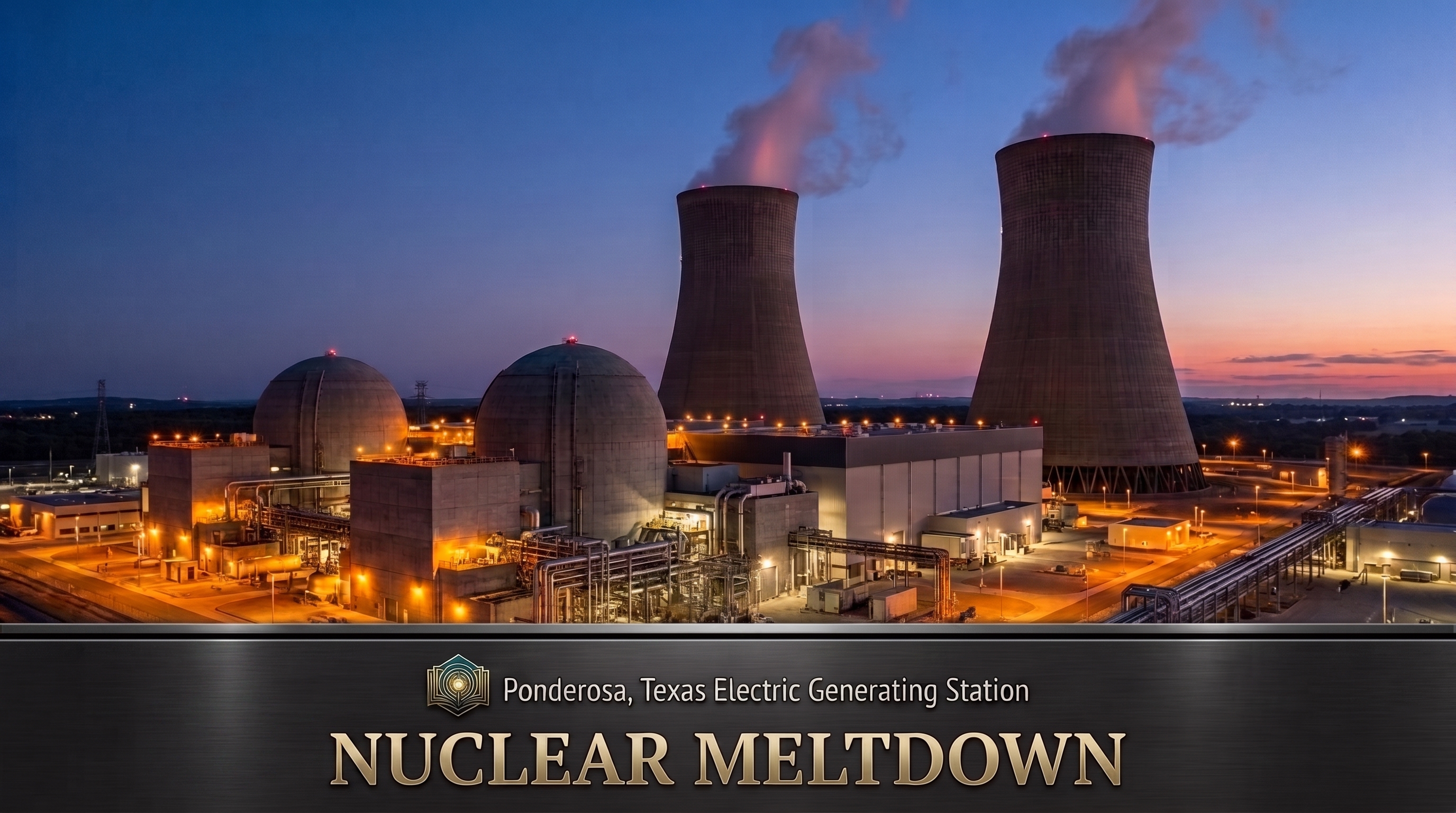
Welcome to the Ponderosa Electric Generating Station.
You have completed one week of classroom training and one week of on-the-job training. You are now assuming duty as the primary operator.
- Watch the gauges across the top of the schematic. Readings that start drifting often warn of trouble before the alarm sounds.
- Click any piece of equipment, or its gauge card, to open its controller. During an event, moving the affected setpoint against the drift speeds recovery and earns credit.
- Critical emergencies must be answered within 60 seconds. Minor notices expire after 90 seconds and count as missed.
- The Plant S.O.P. lists the correct response for every event.
- You cannot hand off the shift while an event is active.
NOTICE: Shifts terminating prior to 10 minutes or failure to respond to critical events will result in disciplinary evaluation.
SHIFT DEBRIEFING
STANDARD OPERATING PROCEDURES
1. PRIMARY MONITORED SYSTEMS (CONTROLLERS)
- RPV (Reactor Pressure Vessel): Houses the nuclear reactor core and primary coolant. Maintains criticality and thermal output. Parameters: Temp (°C), Level (%), Pressure (PSI).
- SG1 & SG2 (Steam Generators 1 & 2): Primary-to-secondary heat exchangers. Boils secondary feedwater into steam using primary thermal energy. Parameters: Temp (°C), Level (%), Pressure (PSI).
- PZR (Pressurizer): Regulates primary loop pressure to maintain liquid state of coolant via internal heaters and spray valves. Parameters: Temp (°C), Level (%), Pressure (PSI).
- TURBINE (HP & LP): High and Low Pressure turbines convert steam thermal expansion into rotational mechanical energy. Parameters: Rotor Speed (RPM), Shaft Vibration (mm/s), Inlet Pressure (PSI).
- GENERATOR: Coupled to the turbine shaft, converts mechanical rotation into electrical power output to the grid. Parameters: Real Power (MW), Grid Frequency (Hz), Terminal Voltage (kV).
- CONDENSER: Shell-and-tube heat exchanger operating under vacuum to condense exhaust steam back into liquid water. Parameters: Shell Vacuum (inHg), Hotwell Level (%), Cooling Water Temp (°C).
- COOLING TOWER: Rejects latent heat from the condenser cooling water loop to the atmosphere. Parameters: Basin Temp (°C), Level (%), Pump Pressure (PSI).
- VCT (Volume Control Tank): Surge volume reservoir for the Chemical and Volume Control System, regulating primary coolant inventory. Parameters: Temp (°C), Level (%), Pressure (PSI).
2. SECONDARY SCHEMATIC COMPONENTS
- Flow Check Valve: A passive valve that uses a internal mechanism to permit fluid to flow in one direction but automatically closes to prevent any reverse flow.
- Manual Isolation Valve: A standard hand-operated valve used for full stopping or starting of fluid flow in a process line, useful for maintenance or routing changes.
- Steam Main Header Assembly: A manifold system that combines the high-pressure steam flow from both Steam Generators (SG1 and SG2) and routes it toward the high-pressure turbine.
- Fluid Purification Filter: An element designed to trap and remove solid particulates from the process fluid, likely part of the coolant water chemistry control system.
- Instrumentation Tap Header: A section of piping with multiple connection points (taps) to allow various sensors (such as for temperature, pressure, or flow monitoring) to connect to the process line.
- Actuated Control Valve: A valve operated by an external signal (often pneumatic or electric) that can precisely throttle flow, allowing automated control of system parameters like flow rate or pressure.
- Pressure Relief Valve (PRV): A safety component designed to open automatically when system pressure exceeds a predetermined setpoint, venting excess fluid to prevent catastrophic overpressurization.
- Small Process Heat Exchanger: A specialized, smaller-scale component used for auxiliary heating or cooling of process fluids, distinct from the large system steam generators and condensers.
- Jet Pump / Ejector: A device with no moving parts that utilizes high-velocity fluid flow from a motive nozzle to create a vacuum and entrain/pump a secondary fluid.
- Valve Solenoid / Position Sensor: An electromechanical module mounted on an actuator to control the valve position or to send an electronic signal regarding the valve's current open/closed status.
3. EMERGENCY TROUBLESHOOTING RESOLUTIONS
- TURBINE_TRIP: Verify automatic reactor scram. Monitor SG levels and PZR pressure. Ensure auxiliary feedwater is routing to SG1 and SG2 to establish a stable heat sink. Evaluate bypass valve positions.
- CONTAINMENT_SPIKE: Initiate containment isolation sequence. Ensure all primary perimeter boundary valves are secured. Dispatch hazmat inspection crew. Seal containment doors. Verify dosimeter readings (e.g., 6240 mrem requires immediate evacuation). Do not vent atmosphere.
- LOCA (Loss of Coolant Accident): Identify primary pressure drop. Verify actuation of Emergency Core Cooling Systems (ECCS). Monitor VCT level decrease. Secure primary coolant pumps if cavitation risk exists.
- LOOP (Loss of Offsite Power): Acknowledge severe weather or grid failure. Verify automatic start of Emergency Diesel Generators. Confirm load shedding protocols. Monitor natural circulation in the primary loop if RCPs fail.
- SOLID_PLANT: Verify PRV/PORV operations. Reduce thermal output on RPV controller. Increase letdown flow to VCT and activate pressurizer spray valves to collapse steam bubble.
- PERIMETER_BREACH: Coordinate with National Guard or site security. Secure main gate. Acknowledge external siren. Place control room in lockdown mode.
- SEVERE_WEATHER: Monitor High-Voltage switchyard. Prepare for LOOP (Loss of Offsite Power). Verify diesel generator standby status.
- NRC_AUDIT / MEDIA_INTEREST: Acknowledge control room hotline. Ensure dosimeter badges are within 110 mrem nominal limits. Do not release unauthorized statements. Maintain strict operational logs.
- SHIFT_VIOLATION: Activate PA system to wake personnel or alert to hazard. Confiscate unauthorized food or materials at checkpoints. Re-establish control room discipline.
4. SHIFT RULES & RESPONSE DEADLINES
- Minimum Shift: 10 minutes. Ending earlier is recorded as abandoning the post.
- Critical Emergencies: Respond within 60 seconds or the station is considered abandoned.
- Minor Notices: Respond within 90 seconds or the notice is logged as missed.
- Turnover: The shift cannot be ended while an event is active.
- Setpoints: Must stay inside the alarm limits. Alarm limits and controller tuning are under engineering lock. Committing an out-of-range setpoint scrams the reactor.
- Tuning Assist: During an event, moving the affected equipment's setpoint against the drift speeds recovery and is credited in the debriefing.
- Grading: A = 90% or more correct, B = 75%+, C = 50%+, D = below 50%. F = scram or abandoned post. A "+" is earned with tuning assists on at least half of the events that affect the gauges.
● REC
VESSEL TARGET
LIVE CONTROL
TEMPERATURE CONTROLLER
🔒 ALARMS & TUNING · ENGINEERING LOCK
VOLUME CONTROLLER
🔒 ALARMS & TUNING · ENGINEERING LOCK
PRESSURE CONTROLLER
🔒 ALARMS & TUNING · ENGINEERING LOCK

Ponderosa, Texas Electric Generating Station
Rev. 1.2.0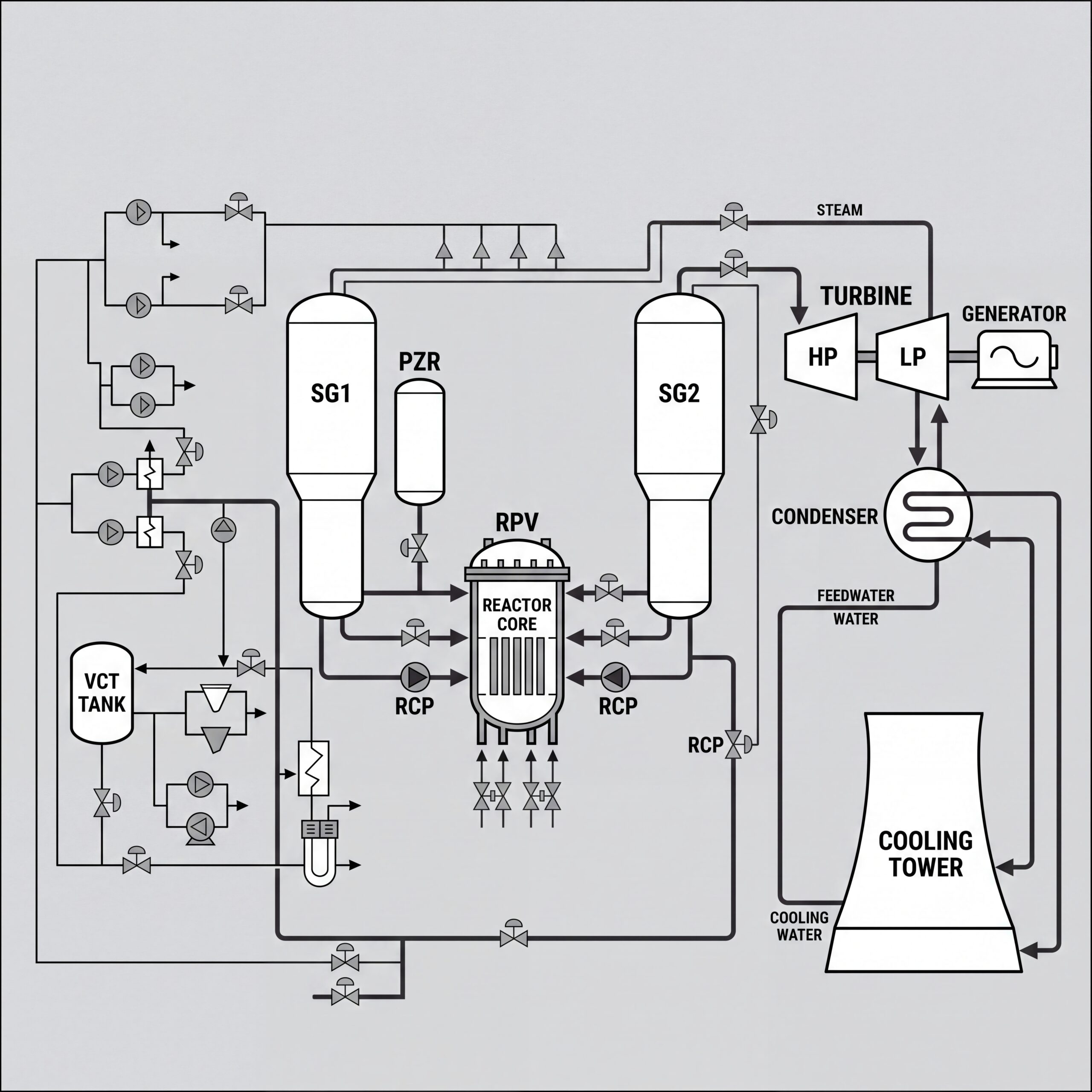
▶ CLICK ANY EQUIPMENT TO OPEN ITS CONTROLLER
SHIFT CLOCK00:00
10-MIN MINIMUM10:00 LEFT
STATUSOFF SHIFT
Resolve the active event before turnover.
ACTION REQUIRED:
RESPONSE DEADLINE0:00
System Event Log: