
Scenario-Based Companionship: An Exhaustive Sociological and Economic Analysis of Dazi Culture in Contemporary China
Introduction: The Emergence and Lexicography of the Lightweight Social Model
Among China’s Generation Z (individuals born between 1995 and 2010) and Millennials, a profound, structural transformation in interpersonal relationship dynamics is currently underway. This transformation is characterized by the explosive growth and institutionalization of "Dazi" (搭子) culture, a phenomenon that has fundamentally reconfigured the socio-emotional landscape of urban youth.1 Originating from the regional vocabulary of the Shanghai dialect, the term originally referred specifically to "card-playing buddies".2 However, in the contemporary sociological and pop-cultural lexicon, "Dazi" has developed a vastly broader meaning, translating roughly to "activity partner," "scenario-based buddy," or "precise companion".2
This phenomenon represents a highly compartmentalized, utility-driven approach to human connection. Rather than seeking holistic, multifaceted friendships, individuals increasingly seek out precise companions for highly specific activities. The contemporary taxonomy of Dazi is virtually limitless, encompassing the ubiquitous "meal dazi" (饭搭子) and "travel dazi" (旅游搭子), to more niche configurations such as the "gym dazi," the "study dazi," the "exhibition-visiting dazi," and even the "gossip dazi".2
The core appeal of the Dazi relationship structure lies in its strict, pre-negotiated boundaries and its deliberate lack of emotional commitment. These partnerships are defined by their functional temporality; the relationship begins at the onset of the designated activity and terminates immediately upon its conclusion.3 By engaging in this model, participants explicitly circumvent the traditional expectations of deep friendship. There is no implicit obligation to provide emotional labor, no requirement to reply to text messages with urgency outside of the shared context, no expectation to remember birthdays, and a strict refusal to navigate the other person's personal crises or psychological burdens.3
This calculated minimization of social friction is a direct response to what Chinese youth increasingly cite as the "emotional tax" of traditional friendships [User Query]. In the hyper-competitive, fast-paced, and highly demanding environment of contemporary Chinese megacities—often characterized by intense academic pressure and the grueling "996" work culture—coordinating schedules, managing emotional compromises, and sustaining the continuous maintenance required for deep intimacy is increasingly viewed as an exhausting endeavor.4 Consequently, Dazi culture provides a pragmatic mechanism for immediate companionship, allowing individuals to stave off the psychological toll of urban loneliness while fiercely protecting their mental health, individual boundaries, and scarce free time.3
This exhaustive report provides a comprehensive analysis of Dazi culture, examining its deep sociological underpinnings, the psychological drivers among Generation Z, the sophisticated algorithmic infrastructure that facilitates it, its quantifiable demographic impact, and its rapid evolution into a highly monetized, multi-billion RMB companion gig economy.
Sociological Theoretical Frameworks: Liquid Modernity and Relational Liquidity
To understand the proliferation of Dazi culture, it is imperative to move beyond superficial analyses of digital trends and examine the macroeconomic and sociological shifts that have defined modern China. The transition toward lightweight social models is a rational adaptation to a fundamentally altered structural reality.
Zygmunt Bauman and the Era of Liquid Modernity
The phenomenon of Dazi socializing aligns seamlessly with, and provides a profound empirical validation for, Zygmunt Bauman’s sociological theory of "Liquid Modernity".5 Bauman's philosophical framework postulates that human society has transitioned from a "solid" phase of modernity—characterized by rigid, enduring institutions, lifelong employment, geographic immobility, and unbreakable community bonds—into a "liquid" phase.6 In this liquid modern world, all social structures, cultural practices, and interpersonal relationships dissolve into fluid, precarious, and transient states.5
For previous generations in China, social life was deeply rooted in solid structures, most notably the danwei (unit system) and the hukou (household registration system), which inextricably linked an individual's employment, housing, healthcare, and social network to a specific geographic and institutional locus.4 Friendships and acquaintances were geographically bound and virtually permanent. However, rapid urbanization, economic globalization, and mass rural-to-urban migration have dismantled these solid structures.1 Generation Z navigates a reality where career trajectories are fragmented, residential mobility is absolute, and the future is characterized by intense uncertainty.
In this context, Bauman argues that human identity transforms from a stable "fact" into a continuous "task," and interpersonal relationships are increasingly evaluated based on their immediate utility rather than their permanence.6 Dazi culture is the pure manifestation of liquid relationality. The relationships are explicitly instrumental and low-commitment, allowing participants to dissolve the partnership at any moment without social repercussion, precisely because modern urban life is characterized by intense time fragmentation and geographic mobility.3 As Bauman observed, in contemporary reality, the transient supersedes the permanent, desire overtakes deep-seated need, and utility often precedes intrinsic relational value.6 The traditional deep friendship, which requires substantial time investment, historical context, and emotional compromise, is perceived as structurally "heavy," whereas Dazi is functionally "light".8
The Application of Social Penetration and Weak Tie Theories
Academic analyses of Dazi culture frequently invoke classic sociological frameworks, notably Social Penetration Theory and the Theory of Weak Ties, to explain the mechanics of these interactions.9
Developed by Irwin Altman and Dalmas Taylor, Social Penetration Theory posits that interpersonal relationships develop incrementally, moving from superficial layers of interaction to deeper, more intimate layers through a process of reciprocal self-disclosure.9 Traditional friendships are defined by their successful penetration into the core identity of the participants. Dazi culture, however, operates as a deliberate subversion of this process. Participants establish pre-negotiated boundaries that explicitly forbid deeper social penetration.3 The relationship is designed to remain permanently at the outermost, superficial layer—sharing a meal, playing a game, or hiking a trail—while actively prohibiting the disclosure of personal vulnerabilities or emotional entanglements.3
Simultaneously, Dazi culture functions as an extreme optimization of Mark Granovetter's "Strength of Weak Ties" theory.9 Granovetter demonstrated that weak ties (acquaintances) are often more valuable than strong ties (close friends) for acquiring novel information or accessing new resources, because strong ties operate within closed, redundant networks. By constantly matching with new, algorithmically vetted strangers for specific activities, Chinese youth are continuously generating vast networks of hyper-specific weak ties.2 This allows them to maximize their exposure to novel experiences, shared costs, and diverse viewpoints without paying the heavy maintenance costs required to convert those weak ties into strong ones.12
The Transition: From Social Atomization to a Molecularized Society
While critics often interpret the rise of Dazi culture as a symptom of societal alienation, contemporary Chinese sociologists frame it as a highly functional adaptation—a necessary structural bridge between absolute isolation and the overwhelming demands of intense intimacy. The rapid urbanization process, coupled with the dissolution of traditional kinship networks and the downsizing of the family unit, has led to a state that sociologists term "social atomization" (社会原子化).4
Atomized individuals—particularly the estimated 240 million single individuals currently residing in China—exist in a state of extreme privatization.13 They frequently lack intermediate social organizations, suffer from pervasive spiritual tension, and experience profound urban loneliness.13 While the internet and early social media platforms compressed physical distance, they often failed to achieve true "de-atomization," instead creating a paradox of being "connected but lonely" through chaotic, superficial online "circle-grouping" (圈群化).13
Dazi culture provides an innovative exit strategy from this atomization crisis, facilitating a sociological shift toward what is theorized as a "molecularized society" (分子化社会).13 In this highly structured framework, isolated "atoms" (individuals) utilize digital platforms to form temporary, highly specific, and bounded connections based on mutual interests (趣缘) or specific events (事缘), thereby creating functional "molecules".13
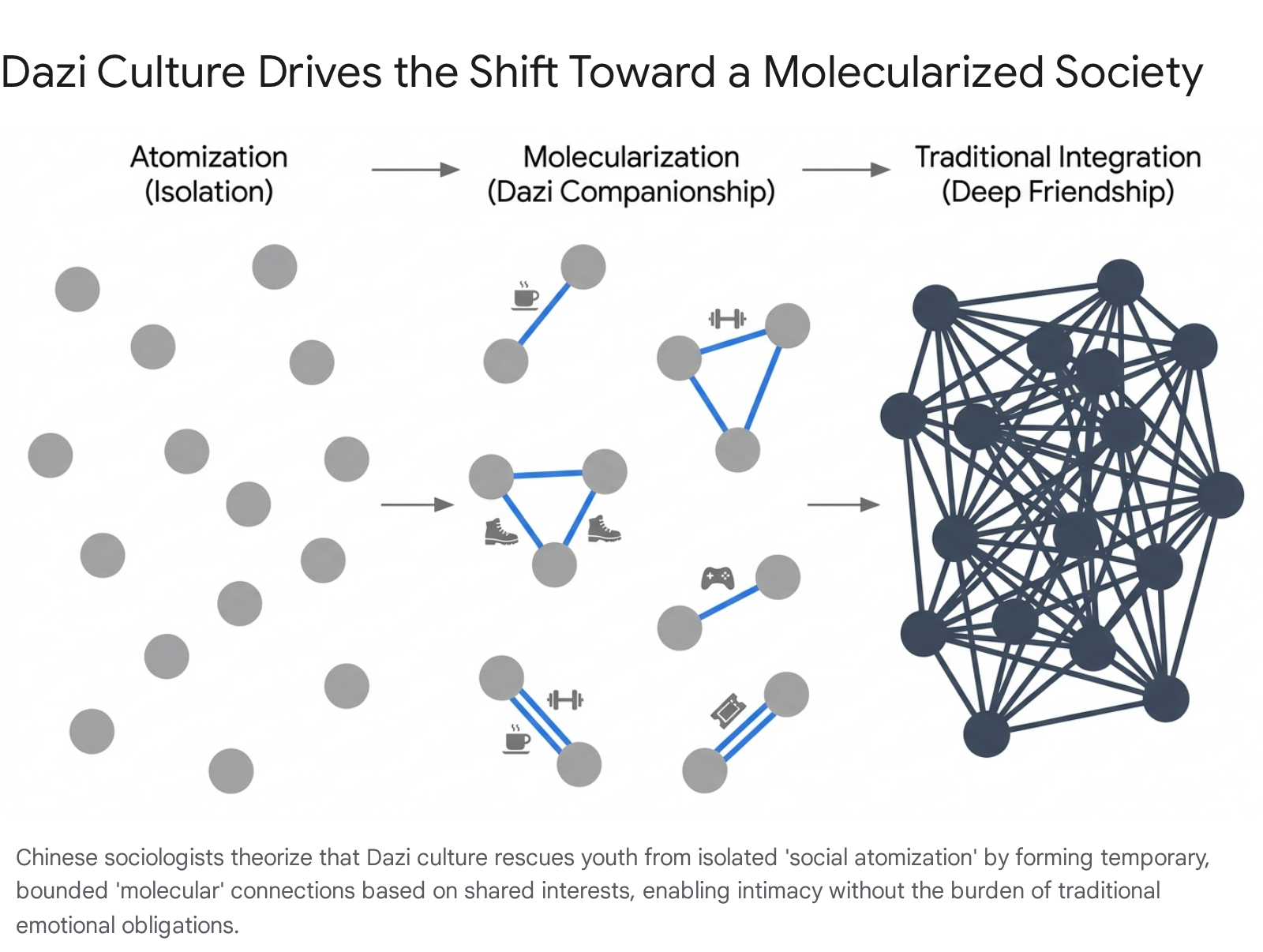
Unlike the overwhelming demands of total integration into a community, these molecular connections provide "precise companionship, a strong sense of boundaries, and are economically practical".13 This structural model allows Chinese youth to cultivate a "connected but independent self" (连接但独立的自我).13 Engaging in Dazi socializing grants individuals the autonomy to briefly detach from high-pressure workplace relationships or exhausting familial expectations without descending into complete, unhealthy isolation.13 Crucially, molecularization assumes that these bonds possess "activity" (活性); molecules can dissolve when the utility expires, but they can also recombine, offering a low-risk environment to seek out human warmth.13
The Psychological Debate: McDonaldization versus Emotional Resource Management
The rapid instrumentalization of interpersonal relationships has sparked a fierce and polarizing debate within Chinese media, academia, and psychological circles. The central tension revolves around whether Dazi culture represents a catastrophic degradation of human empathy or a highly sophisticated evolutionary adaptation to urban stress.
The Critique: Emotional Downgrades and the McDonaldization of Intimacy
Prominent critics and traditional sociologists often frame Dazi culture through a highly pessimistic lens, arguing that it represents an "emotional downgrade" and the literal "McDonaldization of relationships".3 Borrowing from George Ritzer's classic sociological critique of modern society, the McDonaldization framework suggests that the core principles of the fast-food industry—efficiency, calculability, predictability, and total control—have successfully colonized the most intimate spheres of human life.3
From this critical perspective, treating human companions as modular, "plug-and-play" components optimized for specific scenarios strips interpersonal relationships of their inherent depth, complexity, and humanity. When individuals engage in Dazi culture, they are optimizing for the absolute maximum return on social investment with the absolute minimum emotional friction.10 Critics warn that this relentless pursuit of social efficiency fosters an environment where young people lose the emotional resilience, patience, and courage required to navigate the inherently messy, demanding, and ultimately rewarding terrain of deep intimacy.12 The fear is that a generation conditioned to interact exclusively through highly controlled, boundary-rigid scenarios will find themselves fundamentally unequipped to handle the unconditional support required during severe life crises.15
The Defense: Pragmatism and the Management of Emotional Resources
Conversely, leading experts deeply embedded in the study of Generation Z argue that the "McDonaldization" critique fundamentally misinterprets the strategic intelligence and profound exhaustion of contemporary youth. Dong Chenyu, an Associate Professor at the School of Journalism and Communication at Renmin University of China, vehemently rejects the notion that Dazi is a social pathology or an "emotional downgrade".12
Instead, Dong posits that Dazi culture acts as a highly rational, flexible complement to intimate relations.12 It represents an innovative, highly pragmatic approach by the younger generation to manage their finite "emotional resources".12 Modern urban life in China is characterized by relentless competition—a concept colloquially referred to as "involution" (内卷)—which leaves young adults physically exhausted and emotionally depleted.4 By outsourcing casual companionship and logistical coordination to a network of Dazi partners, youth achieve high-efficiency social satisfaction at an exceptionally low emotional cost.12
This deliberate compartmentalization is not a rejection of deep connection; rather, it is a protective mechanism. By refusing to expend emotional energy on acquaintances, young people preserve their deepest emotional resonance, loyalty, and intense commitments exclusively for a highly curated, small circle of trusted friends who can truly weather life's adversities.12
This perspective is corroborated by psychological practitioners. Zhou Xiaopeng, a prominent psychological counselor, notes that Dazi allows individuals to connect over shared goals without the heavy, often suffocating expectations of traditional Chinese friendships, which historically demand heartfelt selflessness or a willingness to make extreme personal sacrifices.12 Calvin, a manager of an online Chinese sports buddy community, reinforces this by noting that Dazi companionship and emotional bonds are not mutually exclusive; individuals utilize Dazi to satisfy specialized interests (like playing a niche sport) while relying on their core social circle for emotional grounding.12
Quantitative Realities: "Soulmanyships" and Interface-Style Socializing
The theoretical frameworks surrounding Dazi culture are strongly supported by massive empirical data sets, which reveal the vast scale, specific characteristics, and demographic penetration of this phenomenon. The most comprehensive quantitative insights are derived from the "2023/2026 Young People's Social Trends Report," jointly executed and released by the Soul App (a major Chinese social platform) and Fudan University.8 This research, based on over 9,000 user questionnaires and the deep analysis of billions of platform data points, highlights a fundamental shift from "outward-seeking" social logic to "inward-growing" relationship management.16
The Scale and Typology of Dazi Engagement
The statistical volume of Dazi interactions is staggering. According to the report, over 3.74 million users published content specifically related to seeking a Dazi on the Soul platform, generating a monumental 9.8 billion content views.17 While activity-based searches (dining, gaming, traveling) are highly prevalent, the desire for pure, low-stakes communication remains paramount; the "Chat Dazi" (聊天搭子) category alone amassed 8.6 billion exposures.17
This immense volume highlights the transition toward what researchers have termed "Soulmanyships" (a play on relationships).17 This novel social mode is characterized by its lightweight, highly scenario-based, and modular nature. Sociologists describe this as "interface-style" (接口式) socializing.17 Much like a software API, these human connections are simple to establish, require zero sharing of underlying system privacy or foundational emotional data, and are designed to execute a specific function. The relationship is highly tethered to the specific scenario; when the meal is finished, the game is won, or the travel itinerary is completed, the "interface" disconnects naturally, leaving clear boundaries and ensuring zero mutual disturbance.10
By operating through these precise configurations, young adults maximize their social return on investment. The report concludes that this allows the "shallow relationships" to remain incredibly light and low-maintenance, thereby freeing up massive amounts of cognitive and emotional bandwidth to invest in a few, highly profound "deep relationships".17
Demographic Penetration and the "E vs. I" Dynamic
Awareness and active participation in Dazi culture are nearly ubiquitous among the younger demographic cohorts, confirming it as a generational hallmark rather than a niche subculture. The survey data reveals that nearly 90% of young people are explicitly aware of Dazi socializing, with female users demonstrating a slightly higher engagement rate (92% awareness).8
The data firmly establishes that Dazi culture is heavily skewed toward Generation Z, exhibiting a direct inverse correlation with age: the younger the demographic, the higher the adoption and enthusiasm. Currently, one in every four "post-00s" (individuals born after the year 2000) actively maintains at least one Dazi relationship.8 However, the mainstream behavioral pattern involves managing a diversified portfolio of specialized companions rather than relying on a single partner. Among those who actively participate in the culture, nearly half maintain between 2 and 3 distinct Dazi partners for different aspects of their lives, while a significant 17.8% maintain 4 or more highly specialized Dazi.8
The research also cross-referenced Dazi behavior with the increasingly popular Myers-Briggs Type Indicator (MBTI) personality frameworks. It found that extroverted "e-type" individuals (who are externally focused and highly active) view finding a Dazi as an effortless extension of their lifestyle. In contrast, for introverted "i-type" individuals (who prioritize internal emotional states and frequently experience communication apprehension), Dazi culture is viewed as a vital, low-friction tool that allows them to satisfy their need for human connection without triggering their severe social anxiety.1
Relational Evolution: The Permeability of Boundaries
Despite the rigid theoretical emphasis on transience, compartmentalization, and strict boundaries, empirical data reveals a fascinating contradiction: Dazi relationships frequently act as highly effective incubators for deep, traditional friendships.
According to the Soul App data, an overwhelming 86.4% of users reported that they have experienced a scenario where a superficial Dazi partnership organically upgraded into a genuine, multi-faceted friendship.19
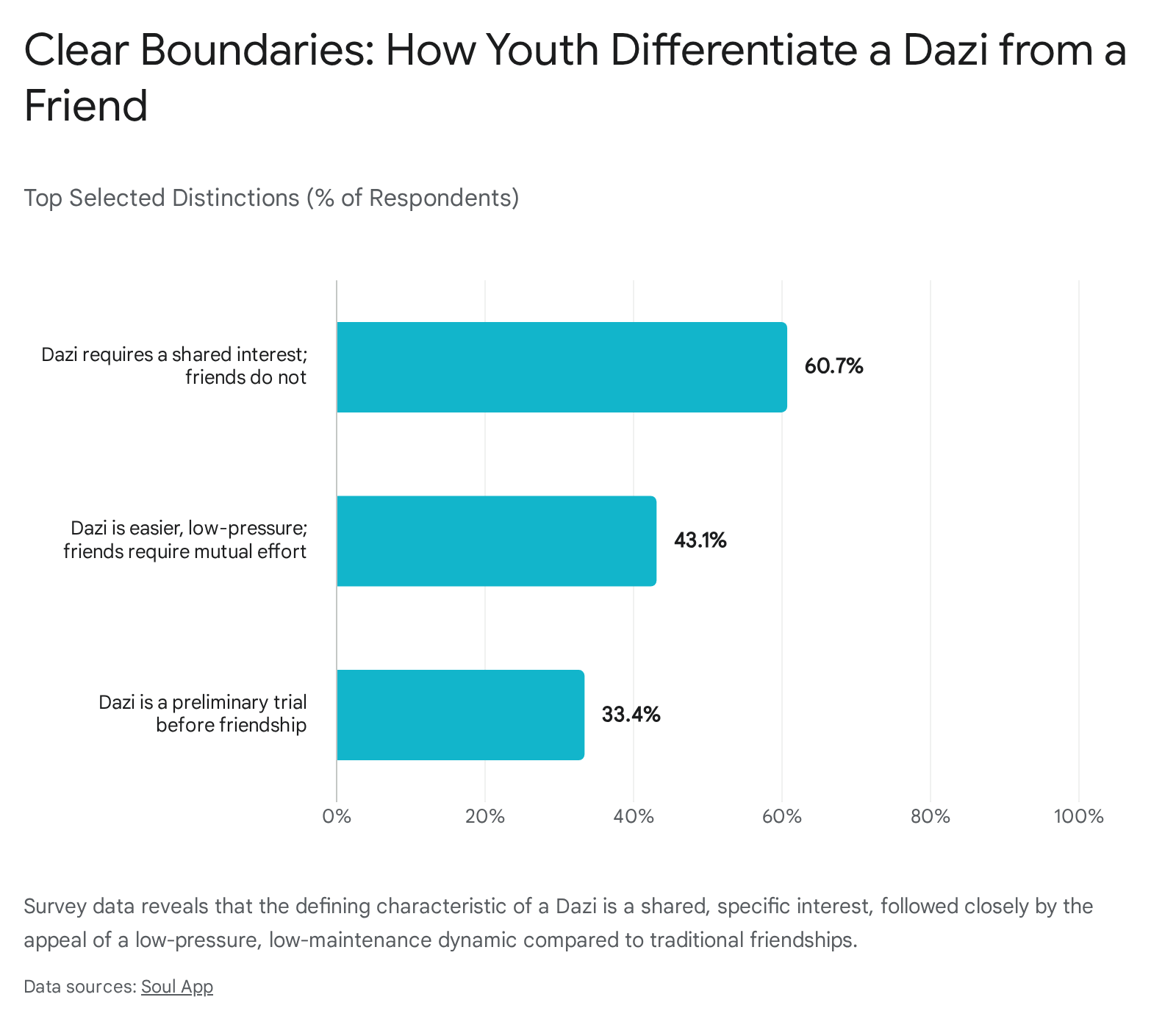
This empirical reality substantiates the "molecularized society" theory, confirming that these shallow ties possess inherent relational "activity".13 The structure of precise companionship essentially acts as a highly efficient, low-risk vetting mechanism. Individuals use the shared activity to quietly observe the other party's habits, reliability, and emotional resonance. If mutual trust and broad compatibility are established within the safe, low-stakes confines of the Dazi boundary, the participants feel empowered to mutually dissolve the boundary and allow the relationship to deepen.13
Conversely, the efficiency of the model is proven by the fact that 46.1% of these relationships last less than six months.19 When the boundary is not transcended, the partnerships are swiftly and efficiently dissolved once their utility expires or minor frictions arise, protecting both parties from prolonged social discomfort.
Algorithmic Mediation: The Digital Architecture of Dazi Matching
The sheer scale, precision, and efficiency of Dazi culture cannot be fully understood through sociological theory alone; it is inextricably linked to, and heavily engineered by, the highly sophisticated algorithmic infrastructure of Chinese social media platforms. In this digital ecosystem, serendipity has been entirely replaced by calculated algorithmic compatibility, turning platforms into highly efficient social clearinghouses.3
Xiaohongshu and the Dominance of the Interest Graph
Xiaohongshu (Little Red Book), widely regarded as China's premier lifestyle and consumption platform, has emerged as the undisputed epicenter of Dazi culture. Recognizing the massive user demand for precise companionship, the platform explicitly institutionalized the trend by launching a dedicated, native "Find a Dazi" (找搭子) social feature.11 This feature categorizes user intent into distinct pathways, offering options for "single partner matching" (找单人搭子) or "group partner matching" (建群找搭子) based on highly granular, algorithmic interest tags.20
The unparalleled success of Xiaohongshu in fostering these offline Dazi relationships stems from its unique, decentralized "Interest Graph" distribution model.21 Traditional social media platforms (such as WeChat or Instagram) rely heavily on a "Social Graph," where content distribution is dictated by existing follower networks and real-world connections. Xiaohongshu fundamentally disrupts this by decentralizing content visibility. High follower counts do not guarantee wide distribution.21 Instead, the algorithm continuously maps content to users based on an incredibly complex matrix of specific needs, search queries, consumption behaviors, and lifestyle aspirations.21
If a user in Shenzhen posts a request seeking a "weekend photography and hiking Dazi who prefers a fast-paced itinerary," the algorithm does not push this to their existing friends. Rather, it prioritizes distributing the post exclusively to other local Shenzhen users whose recent behavioral data, search history, and content interaction heavily index for outdoor activities, photography equipment, and similar consumption tiers.2 This creates an environment where an ordinary user with zero followers can instantly reach a massive audience of highly qualified, perfectly matched strangers, entirely bypassing the limitations of their existing social circle.21
The Algorithmic Funnel: Engagement Velocity and Compliance Review
The process by which a user successfully matches with a Dazi partner is not arbitrary; it is governed by a rigorous, multi-stage machine learning funnel designed to ensure absolute authenticity and immediate relevance. Content visibility and subsequent offline matching are entirely dependent on passing sequential algorithmic gates:
Algorithmic Stage | Mechanism and Thresholds | Purpose in Dazi Matching |
Stage 1: Account Authority & Warming | New accounts face a "cold start" limitation if active for less than 180 days. The system analyzes the first 7-10 days of browsing, engaging, and commenting to verify human behavior before allowing broad distribution.22 | Prevents automated bots from flooding the Dazi matching system; ensures users are interacting with genuine individuals seeking real connections. |
Stage 2: Compliance Review | Automated NLP and human review. Penalizes superlative claims, sensitive categories, and off-platform redirects (e.g., trying to immediately move the chat to WeChat). Demands cultural context accuracy and penalizes inauthentic language.21 | Filters out commercial gig-workers trying to disguise themselves as organic Dazi, ensuring the platform remains a peer-to-peer social space rather than a purely commercial marketplace. |
Stage 3: Small-Pool Testing | The approved post is injected into a tightly controlled traffic pool of 100 to 500 users. The system uses title, cover image, text, and specific hashtags to find the most relevant micro-audience.23 | Tests the viability and attractiveness of the proposed activity against a highly targeted subset of potential partners. |
Stage 4: Tiered Amplification via Engagement Velocity | The algorithm ruthlessly measures "engagement velocity." To break out of the small pool, a post must achieve a 3-5% engagement rate in the first hour, and sustain above 2% over 24 hours. High velocity pushes the post to pools of 5,000, then tens of thousands.22 | Ensures that only the most compelling, well-articulated, and highly demanded Dazi scenarios receive maximum visibility, optimizing the overall efficiency of the ecosystem. |
This multi-stage algorithmic funnel functions as an automated, highly rigorous social screening mechanism. It entirely absorbs the cognitive load and traditional "search cost" inherent in finding a compatible partner, ensuring that users are connected with highly engaged, culturally aligned peers in a matter of hours.3
The Technological Frontier: AI and the "Spiritual Shareholder"
As algorithmic mediation becomes increasingly sophisticated, the trajectory of Dazi culture is beginning to intersect profoundly with artificial intelligence. The lightweight social model, which prioritizes utility and low emotional cost, finds its absolute extreme manifestation in human-machine interaction.
The extensive research published in the Soul App report explicitly identifies the rise of the "AI Spiritual Shareholder" (AI精神股东) as a dominant social trend shaping the future of youth relationships.17 For Generation Z, artificial intelligence agents are rapidly evolving far beyond their origins as functional assistants (e.g., writing code, summarizing documents, generating reports).17 Instead, they are being deeply integrated into the individual's socio-emotional fabric, functioning as highly personalized emotional companions and "second brains".17
The data indicates a profound shift in dependency: among youth who frequently interact with AI systems, an overwhelming 77.3% report relying on deep, sustained dialogue with these algorithms to achieve self-recognition, process complex emotions, and assist in identity construction.17 For individuals suffering from the chaotic mental load of urban life, or neurodivergent individuals managing ADHD, the AI serves as an infinitely patient, perfectly compliant conversational Dazi.17 It functions as an external hard drive for their emotional state, helping them organize fragmented thoughts and anchor their self-worth without ever demanding reciprocal emotional labor.17
This human-machine symbiosis represents the ultimate, perhaps inevitable endpoint of the Dazi philosophy: zero social friction, complete algorithmic control, total absence of personal obligation, and perfectly customized companionship tailored to the exact emotional dimensions of the user.17
The Companion Economy: The Commodification of Intimacy and the Gig Workforce
As the demand for precise, scenario-based companionship has surged to unprecedented levels, the organic, peer-to-peer Dazi ecosystem matched by algorithms has predictably birthed a massive, highly formalized gig economy. What began as strangers utilizing Xiaohongshu to split the cost of a meal or a taxi has evolved into a lucrative, institutionalized market where individuals explicitly rent human time, presence, and skills. Industry analysts estimate that the domestic market size of China’s companion economy is on track to rapidly exceed 50 billion RMB.14
Functional versus Emotional Labor in the Paid Tier
The paid Dazi sector (付费搭子) is broadly bifurcated into functional and emotional services, although in practice, the two frequently intersect. This rapid commodification is driven by a confluence of demographic crises: deep urban isolation, a rapidly aging population, severe family downsizing, and the profound willingness of Generation Z to deploy their disposable income to purchase "emotional value".14
Functional Companionship: This tier focuses on resolving practical, logistical challenges for individuals who either lack a localized support network or intentionally choose to avoid burdening their families.14 The most formalized, recognized, and rapidly growing sector within this tier is "Medical Escorting" (陪诊).14 The demographic necessity is stark: data indicates that 88.54% of community-living elderly and an astounding 98.3% of those in care facilities attend hospital appointments completely alone.14 Paid medical chaperones step into this void, navigating Byzantine hospital bureaucracies, queuing for medications, guiding patients between departments, and providing a proxy familial support system.14
Recognizing its immense societal importance, state and local governments have begun actively intervening to professionalize this specific sector. In March 2025, Chengdu issued the nation's first "Specialised Vocational Qualification Certificates for Medical Escort Services," formalizing the role.14 Subsequently, national bodies, including the Ministry of Civil Affairs and the National Development and Reform Commission, issued joint directives to support the cultivation of standardized professional medical escort agencies.14
Emotional Companionship: The emotional tier monetizes presence, empathy, specialized recreational skills, and the active alleviation of urban anxiety.14 Services in this tier are highly creative and remarkably specific, ranging from "child-minding companions" to "postgraduate entrance exam buddies" designed to enforce study discipline.14
- Mount Tai Climbing Companions: This role represents a highly visible, physically demanding offline manifestation of the paid Dazi trend. Predominantly university students and fit gig workers act as both physical sherpas and emotional cheerleaders for tourists climbing Mount Tai.14 They carry heavy bags, provide historical commentary, take professional-grade photographs, and offer continuous verbal encouragement. Charging between 55 and 75 RMB per trip, the relentless demand allows top-performing companions to earn nearly 20,000 RMB a month.14
- Instant Responders: In a pure monetization of digital presence, gig workers act as "on-call" emotional support. They can earn up to 150 RMB per hour simply by guaranteeing immediate text, audio, or video replies via WeChat during set hours, granting their clients a highly engineered, purchased sense of security and validation.14
Labor Precariousness and the Legal "Gray Zone"
Despite the massive revenue generation and explosive market potential, the rapid expansion of the paid companion sector has exposed severe, systemic vulnerabilities regarding labor protection, worker rights, and industry regulation.14 The vast majority of paid Dazi operate as sole traders or transient gig workers mediated entirely by digital platforms, trapping them in a precarious legal classification that the International Labour Organization (ILO) identifies as a deeply problematic "gray zone".26
In China, the broader platform economy engages an estimated 84 million individuals.26 Historically, Chinese labor law and global legal frameworks have relied on a strict, binary distinction: a worker is either a fully protected employee or an independent contractor.26 However, platform-based Dazi workers frequently exhibit profound characteristics of subordination. They are subject to intense algorithmic management, their visibility is dictated by platform metrics, their service parameters are rigidly controlled, and their wages are highly volatile, yet they receive none of the classical protections of employment.26
This results in a workforce devoid of social insurance, guaranteed minimum wages, or robust legal recourse.27 A critical macroeconomic vulnerability highlighted by experts is the lack of portable pensions; because gig workers lack formalized, continuous contributions, the nation runs the long-term risk of an entire demographic cohort aging without adequate social safety nets.28
Furthermore, the emotional labor inherent in companionship work is chronically undervalued by broader society. Practitioners frequently struggle against social stigma, inconsistent service standards due to a lack of centralized training, and a marginalized professional image.14 Because a vast number of transactions still occur via informal, verbal agreements on social media platforms rather than through regulated agencies, the legal and financial costs of pursuing dispute resolution are prohibitively high for both the consumer seeking a refund and the provider seeking unpaid wages.14
To mitigate these systemic risks and combat the precariousness of algorithmic dependence, veteran practitioners within the companion economy are beginning to fundamentally alter their operational strategies. By establishing independent corporate models, setting up dedicated physical studios, forming specialized hiking teams, and actively pursuing state-sanctioned vocational certifications (such as counseling or tour guiding licenses), they are attempting to bypass the informal platform model entirely, reclaim their autonomy, standardize pricing structures, and legitimize their professional standing in the broader economy.14
Sociological Risks, Cyber Violence, and the Erosion of Cohesion
While Dazi culture undoubtedly provides immediate, highly efficient relief from the acute symptoms of urban isolation and intense social pressure, its unchecked proliferation—both as an organic cultural phenomenon and a ruthlessly monetized gig service—introduces highly complex, long-term risks that demand critical sociological scrutiny.
Communication Apprehension, Privacy, and Cyber Violence
The near-total reliance on digital matching algorithms to initiate human contact introduces significant psychological and physical vulnerabilities.1 In the organic, peer-to-peer Dazi sphere, the foundational premise of low-commitment and superficiality means that minor mismatches in expectations can swiftly escalate into disproportionate, highly toxic conflict.
Because the relationship lacks the foundational trust, shared history, and mutual grace inherent in traditional friendships, friction is not navigated; it is penalized. Reports frequently indicate that when arrangements—particularly high-stakes activities like travel Dazi—fail due to incompatible personal habits, differing daily routines, or mismatched consumption levels, the fallout rarely ends in amicable separation.2 Instead, the conflict frequently bleeds back onto the digital platforms in the form of cyber violence.1 Aggrieved parties leverage the anonymity and amplification of the platform to leave dozens of abusive messages, publicly shame the former partner, and inflict severe psychological harm over minor logistical disagreements.1
Furthermore, the algorithmic architecture that makes Dazi matching so efficient actively constructs severe "information cocoons".1 Because the algorithm exclusively matches individuals based on identical, highly specific interests and consumption patterns, young people are increasingly isolated in echo chambers. They are deprived of the crucial sociological friction of interacting with individuals who possess diverse viewpoints, different socioeconomic backgrounds, or contradictory opinions, potentially exacerbating broader social polarization.1
In the paid companion sector, outside of the increasingly regulated medical escort space, offline meetings present acute, tangible physical security risks. The reliance on informal social media arrangements often bypasses robust identity verification and criminal background checks, leaving both the provider and the consumer vulnerable to exploitation.14 Additionally, the meteoric rise of AI and virtual companions introduces unprecedented data privacy vulnerabilities.1 Highly sensitive, deeply personal emotional interactions and psychological profiles are continuously logged, analyzed, and synthesized by proprietary algorithms, presenting the profound risk that intimate user data could be exploited to induce excessive consumer spending or breached by malicious actors.1
The Long-Term Erosion of Deep Social Cohesion
Perhaps the most profound, existential risk posed by the mainstreaming of Dazi culture is its potential to subtly, yet permanently, erode the foundational fabric of deep social cohesion within Chinese society. As interpersonal interactions become increasingly modular, transactional, optimized for efficiency, and defined entirely by precise, immediate utility, there is a distinct sociological anxiety regarding the future resilience of the population.4
Critics and sociologists point to the alarming normalization of what youth colloquially term "ri-pao" (日抛) or "daily-disposable" relationships.15 When the cultural default is an environment where an individual can be summarily blocked, deleted, and replaced by a new algorithmically generated partner the moment their utility expires or a minor conflict arises, the collective capacity for essential human virtues begins to atrophy.15 The skills required to maintain deep intimacy—empathy, compromise, patience, forgiveness, and long-term, unconditional commitment—are entirely absent from the Dazi dynamic.15
While the "molecularization" of society provides a highly functional, short-term substitute for traditional community, a society that becomes overly reliant on lightweight, disposable ties risks creating an incredibly fragile social architecture.4 When individuals face severe, systemic crises—such as severe economic downturns, chronic illness, or profound personal tragedy—"precise companions" bounded by strict limits of emotional non-involvement will not provide support. Long-term social stability relies heavily on the thick, robust, unconditional structural support networks that only traditional, deep social cohesion can provide, networks that Dazi culture, by its very definition, explicitly refuses to build.4
Conclusion
The phenomenon of Dazi culture represents a highly sophisticated, deeply pragmatic, and entirely rational response by China's Generation Z and Millennials to the daunting structural realities of liquid modernity. Faced with rapid and disorienting urbanization, the fragmentation of personal time, the relentless pressure of societal involution, and the exhausting "emotional tax" inherent in traditional relationship maintenance, young adults have effectively weaponized digital platforms to engineer precise, low-cost companionship.
This cultural shift fundamentally redesigns the sociological landscape, constructing a "molecularized society" that provides a vital, necessary buffer against the psychological devastation of complete social atomization. By utilizing algorithms to match shared interests, youth are successfully procuring the immediate relief of human warmth while fiercely protecting their individual boundaries and psychological well-being.
Simultaneously, the inevitable monetization of this behavior into a massive, multi-billion RMB companion gig economy underscores the immense, tangible market value of emotional labor in modern cities. However, this commodification ruthlessly exposes critical, systemic gaps in gig worker protections, labor classifications, and platform regulation that state institutions must urgently address to prevent widespread economic precariousness.
Ultimately, while Dazi culture stands as a testament to the triumph of individual agency, digital innovation, and algorithmic efficiency in solving the immediate problem of urban loneliness, its long-term societal implications remain fraught with risk. The true test of this generation will not be their ability to efficiently match with a partner for a weekend hike, but whether they can successfully balance the seductive, low-friction convenience of disposable, scenario-based partnerships with the vital, enduring, and irreplaceable necessity of deep human intimacy and unconditional social cohesion.
Works cited
- Social Interaction of Generation Z in China - Insights Publisher, accessed June 6, 2026, https://www.bonoi.org/index.php/si/article/download/1506/1006
- The rise of dazi culture: Exploring the social shift in SZ youth_Latest News-Shenzhen Government Online, accessed June 6, 2026, https://www.sz.gov.cn/en_szgov/news/latest/content/post_11280455.html
- Dazi culture - Wikipedia, accessed June 6, 2026, https://en.wikipedia.org/wiki/Dazi_culture
- 社会矛盾运动中的青年社交转型: 以“搭子文化”为中心的探析Youth ..., accessed June 6, 2026, https://pdf.hanspub.org/acpp_2383850.pdf
- Liquid Identities, Solid Critiques: Review of Zygmunt Bauman's 'Culture in a Liquid Modern World' - Traversing Tradition, accessed June 6, 2026, https://traversingtradition.com/2025/11/03/liquid-identities-solid-critiques-review-of-zygmunt-baumans-culture-in-a-liquid-modern-world/
- Zygmunt Bauman. Individual and society in the liquid modernity - PMC - NIH, accessed June 6, 2026, https://pmc.ncbi.nlm.nih.gov/articles/PMC3786078/
- Liquid modernity? - Understanding Society, accessed June 6, 2026, https://understandingsociety.blogspot.com/2014/05/liquid-modernity.html
- Soul发布《2023年轻人搭子社交报告》 - 证券日报, accessed June 6, 2026, http://www.zqrb.cn/tmt/tmthangye/2023-06-20/A1687253892977.html
- Travelling with a Dazi: Exploring the Light Socialising Phenomenon ..., accessed June 6, 2026, https://ira.lib.polyu.edu.hk/bitstream/10397/119036/1/Zhou_Travelling_With_Dazi.pdf
- 热衷于找“搭子”,不是“情感降级”是“兴趣升级”|新京报快评, accessed June 6, 2026, https://m.bjnews.com.cn/detail/1680247766169787.html
- 小红书上线“找搭子”社交功能加码轻社交 - 新榜有数, accessed June 6, 2026, https://data.newrank.cn/article/article-detail/33b041609f524872
- China's young people increasingly embrace 'dazi' — a lightweight ..., accessed June 6, 2026, https://www.globaltimes.cn/page/202512/1350939.shtml
- “搭子”社交的兴起|新京报中文学术文摘, accessed June 6, 2026, https://m.bjnews.com.cn/detail/1774971619169844.html
- Why are so many Chinese paying for companionship? | Statistics ..., accessed June 6, 2026, https://www.ourchinastory.com/en/16659/Why-are-so-many-Chinese-paying-for-companionship?
- “搭子”快被玩坏了 - 澎湃新闻, accessed June 6, 2026, https://www.thepaper.cn/newsDetail_forward_24446968
- 《2026社交趋势报告》发布年轻人社交热衷找“搭子” - 东方财富, accessed June 6, 2026, https://biz.eastmoney.com/a/202512253601864428.html
- Soul App联合复旦大学发布《2026年社交趋势报告》:寻找人生“合伙人” - 澎湃新闻, accessed June 6, 2026, https://m.thepaper.cn/newsDetail_forward_32245707
- 幸福在具体的“关系”中生长:从Soul App的《2026年社交趋势报告》读懂青年社交新叙事, accessed June 6, 2026, https://hea.china.com/articles/20251230/202512301790555.html
- 搭子社交报告 - Soul, accessed June 6, 2026, https://official-cdn.soulapp.cn/uploads/Soul_c2eb4d0a82.pdf
- 小红书上线“找搭子”社交功能加码轻社交, accessed June 6, 2026, https://xh.newrank.cn/help/z/D3EA561FF988978B64034FAD9408B738
- Deep Dive into Xiaohongshu's Algorithm: How to Make Your Post Go Viral, accessed June 6, 2026, https://halotechmedia.sg/blog/xiaohongshu-how-to-make-your-post-go-viral/
- Xiaohongshu Algorithm: The Complete Strategy Guide to Win on Red Note | Hashmeta, accessed June 6, 2026, https://hashmeta.com/blog/xiaohongshu-algorithm-the-complete-strategy-guide-to-win-on-red-note/
- 2026 Xiaohongshu Algorithm Explained: How Brands Rank & Win on Rednote, accessed June 6, 2026, https://www.wsdsocial.com/en-us/article/2026-xiaohongshu-algorithm-explained
- Xiaohongshu Algorithm 2026: Complete Guide for International Brands, accessed June 6, 2026, https://influchina.com/xiaohongshu-algorithm-2026-guide/
- User Needs Analysis of "Dazi Culture" Based on Social Media Text Mining - ResearchGate, accessed June 6, 2026, https://www.researchgate.net/publication/400179315_User_Needs_Analysis_of_Dazi_Culture_Based_on_Social_Media_Text_Mining
- Beyond employees and contractors: Mapping China's platform-based gig workers, accessed June 6, 2026, https://www.ilo.org/resource/article/beyond-employees-and-contractors-mapping-china%E2%80%99s-platform-based-gig-workers
- The Gig Economy and Labor Protection in China: Evidence from Food Delivery Platforms, accessed June 6, 2026, https://www.pioneerpublisher.com/jwe/article/view/1476
- China's 200m gig workers are a warning for the world : r/neoliberal - Reddit, accessed June 6, 2026, https://www.reddit.com/r/neoliberal/comments/1nkghbi/chinas_200m_gig_workers_are_a_warning_for_the/