
Tile Reference Guide


Maw Long: Game Rules
Welcome to Maw Long, a specialized version of Mahjong that draws heavily from the classic Hong Kong variant. While we honor traditional play, several table rituals (such as the manual creation of the wall by players and specialized dice protocols) are automated by the application to streamline the gameplay. This guide focuses on the streamlined rules utilized by this software implementation.
I. Object of the Game
The primary goal is to form a complete hand by collecting sets of tiles before any opponent. A standard winning hand consists of 14 tiles, organized into 4 melds (sets of three or four matching/sequential tiles) and 1 pair (the "eyes").
Many Hong Kong tables also agree on a minimum Faan requirement — commonly 1 or 3 — below which a completed hand may not be declared. This is a house rule that varies from table to table, and Maw Long does not enforce one: any legally complete hand may be declared. The Faan value of every win is still calculated and shown in the results, so you can play to a minimum by agreement if you prefer.
II. Tile Definitions (144 Total)
We use a standard set of 144 tiles, including the specialized custom images you designed:
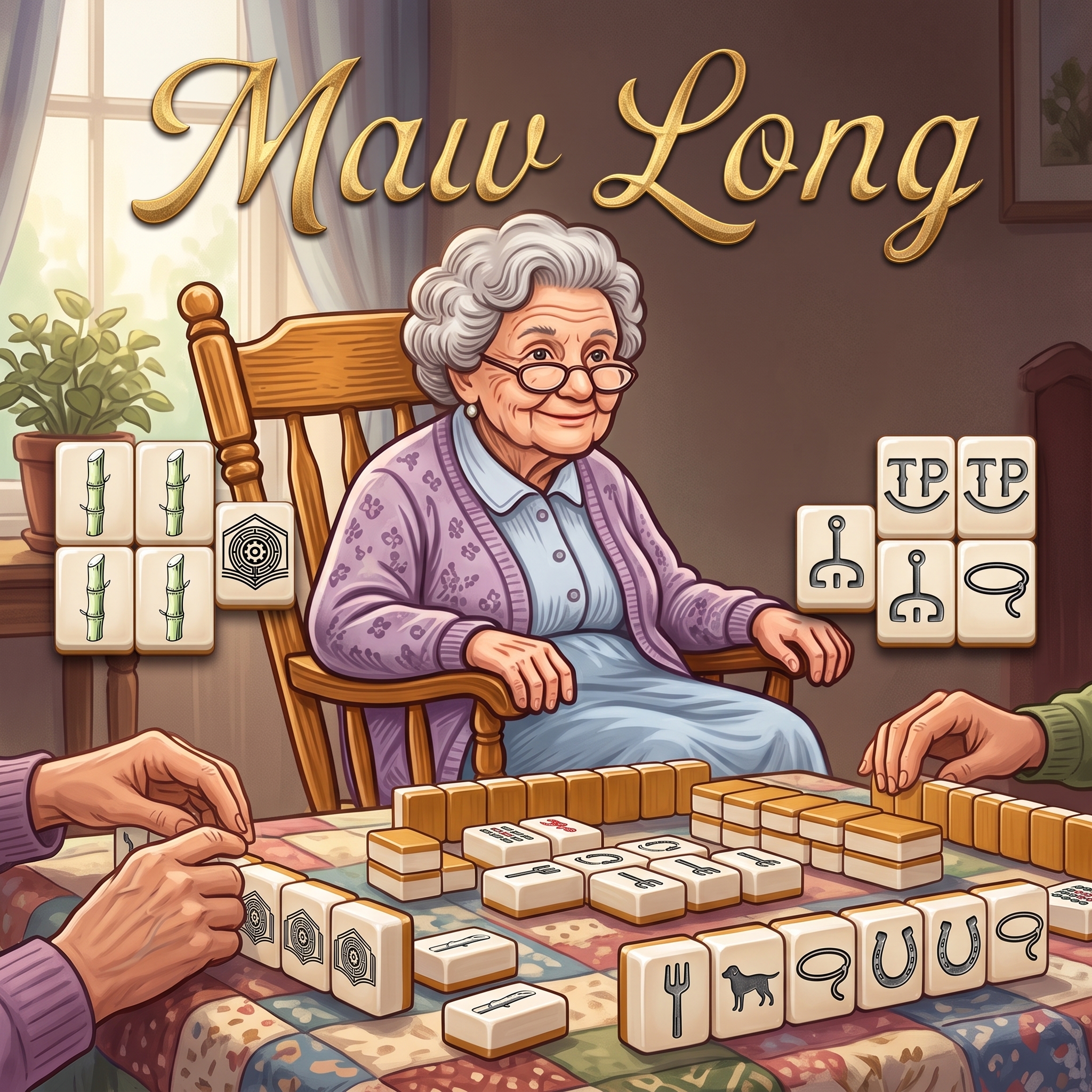
- American Symbols: Maw Long utilizes American Symbols in its design. The Bamboo suit is represented by sugar cane, and the Dots suit features sweet gum seed pods.
- Suits (108): Three suits (Dots, Bamboos, and Characters), each ranging from 1 to 9. There are four identical tiles for each number/suit combination.
- Honors (28): Four Winds (East, South, West, North) and three Dragons (Bison, Eagle, Bigfoot). There are four identical tiles for each Wind and Dragon type.
- Bonus Tiles (8): Four Seasons (Baseball, Football, Basketball, Hockey) and four Flowers (Bluebonnet, Cactus, Indian Paintbrush, California Poppy). These are unique tiles. If drawn, they are automatically "exposed," and the player draws a replacement from the wall. They are worth Faans but do not count toward forming the basic 14-tile winning hand. Each Flower and Season carries a number (1 to 4) matching a seat: East is 1, South is 2, West is 3 and North is 4.
III. Core Game Mechanics
The app automates seating and dealer rotation (Dealer starts as East). A hand begins with each of the four players/bots automatedly dealt 13 tiles. Gameplay proceeds counter-clockwise.
On their turn, the current player does one of the following:
- Standard Draw: Automatically draws one tile from the "Wall" (the automated deck). The player then chooses one tile from their hand to discard into the automated "Discard Pool" in the center of the table.
- Claim a Meld (Chow, Pung, or Kong): Immediately after an opponent discards a tile, a player may potentially claim it to complete a set (meld). If claimed, the player must discard a tile from their hand.
When an opponent discards a tile, it can be claimed by others:
- Claiming for a Win: Any player can claim a discard immediately to complete their winning hand. This takes precedence over other claims. If a win is claimed, the hand ends.
- Pung/Kong (Claiming matching sets): Any player can claim a discard to complete a Pung (three identical tiles) or a Kong (four identical tiles, which is treated as a 3-tile meld but grants a point bonus). A Kong/Pung claim has priority over a Chow claim. The meld must be "exposed" (flipped face-up).
- Chow (Claiming a sequence): The player whose turn immediately follows the discarder (sitting to their left) may claim the discard to complete a Chow (a sequence of three numbers in the same suit). The Chow must be exposed. This claim is lowest priority.
IV. Faans and Scoring
"Faans" are points awarded for specific tile combinations and patterns. JavaScript automatically calculates the Faan value when "Mahjong" (a win) is declared and displays the breakdown. As noted above, no minimum is required to declare a win. Below is a non-exhaustive list of scoring patterns implemented in this software:
- Base Win: A win that matches no other pattern is still worth 1 Faan.
- Common Winning Patterns (JavaScript Validated):
- Self-Draw: 1 Faan for winning on your own turn.
- Fully Concealed: 1 Faan for a self-drawn win with no claimed melds. A concealed Kong does not break this.
- All Chows (Ping Hu): 1 Faan if the hand consists of 4 Chows and a non-honor pair.
- Seat Wind / Round Wind: 1 Faan each for a Pung of the wind matching your seat or the current round.
- Dragon Sets: 1 Faan for each Pung or Kong of a Dragon (Bison, Eagle, Bigfoot).
- Mixed One Suit (Half Flush): 3 Faans if the hand uses one suit plus Winds/Dragons.
- All Pungs: 3 Faans if the hand consists entirely of Pungs and/or Kongs (plus the pair).
- Pure One Suit (Full Flush): 7 Faans if the entire hand consists of only one suit.
- Seat Flower / Seat Season: 1 Faan for each exposed Flower or Season whose number matches your seat (East 1, South 2, West 3, North 4).
- All Four Flowers / All Four Seasons: 2 Faans for holding a complete set of four Flowers, and 2 more for a complete set of four Seasons.
V. The Running Score
Maw Long keeps a running total across the session. The winner of a hand adds that hand's Faan value to their total; the other three seats score nothing. A washed-out hand (an exhausted wall) scores nothing for anyone. Each seat's total is shown on its panel, and the full standings appear at the end of every hand.
Deal Next Hand advances the dealer and keeps the running totals. Reset Game starts a fresh session and clears every score back to zero.
VI. The Opponents
The three bots evaluate their hands by counting how many tiles away from a win they are, then discard the tile that keeps them closest while leaving the widest set of useful draws. They claim a discard only when the claim actually moves them forward, and they will decline a Kong that would break up the hand they are building.
They also watch the table. When a seat starts exposing melds and looks close to a win, the other bots fold: they stop pushing their own hand and begin discarding tiles less likely to deal in, favoring tiles already seen in the discard pool. A bot in this state shows a "Defending" note on its panel. The bots see only what you see — the discards and the exposed melds — never the contents of a concealed hand.
VII. The Oracle
The 🔮 Oracle is an optional advisor for you alone. It appears whenever you have a decision to make: which tile to discard, or whether to claim a discard (Chow, Pung or Kong) or pass. The computer players never use it.
It works by dealing out the tiles you cannot see — the three hidden hands and the rest of the wall — many thousands of times, then playing each deal forward with every seat, including yours, played by the same rules the computer players use. Hidden hands that contradict what a seat has visibly done (for example, a hand still holding two copies of a tile that seat threw away) are thrown out and dealt again, so the deals it studies fit the table in front of you. Every option gets 50,000 such deals.
It has two settings, chosen at the top of its panel:
- Quick: plays one round of the table ahead, up to your next draw. Each option shows the chance that, after that round, you are closer to a complete hand than you are now (or have already won) and nobody has won against you. It takes a few seconds.
- Full: plays every deal to the end of the hand. Each option shows how often you win and the average Faans it earns per hand — the number that actually moves the running score, since only the winner scores. Options are ranked by that average. Full studies the discards the computer players' own rule would shortlist (the tiles that keep your hand closest to complete), and takes longer — usually well under a minute on a desktop, longer on a phone.
The best option is listed first with a plain-language reason. The fine print shows the number of deals, the time taken, the ± margin on every figure, and a note when two options are too close to separate. When the answer is exact rather than simulated (a Mahjong claim you can make right now), the Oracle says so.
