
The Intersection of GLP-1 Receptor Agonists and Oncology: Comprehensive Efficacy, Immunomodulation, and Risk Reduction Profiles
Executive Summary and Clinical Paradigm Shift
The therapeutic landscape for glucagon-like peptide-1 receptor agonists (GLP-1 RAs) has undergone a profound and rapid paradigm shift, expanding far beyond their original metabolic indications. Initially synthesized, developed, and approved by global regulatory bodies strictly for the management of type 2 diabetes mellitus and subsequently indicated for chronic weight management in the setting of obesity, these pleiotropic pharmacological agents are now demonstrating profound, highly statistically significant oncologic benefits.1 Exhaustive data presented at the 2026 American Society of Clinical Oncology (ASCO) Annual Meeting in Chicago, corroborated by a critical mass of recent epidemiological analyses, retrospective cohort studies, and international registry data, suggest an inverse relationship between GLP-1 RA exposure and both the primary incidence and the metastatic progression of multiple malignancies.1
The integration of GLP-1 RAs into the oncologic ecosystem spans multiple domains of clinical practice. These domains include the primary chemoprevention of solid tumors, the profound attenuation of metastatic progression in established localized disease, the potentiation of overall survival in patients receiving immune checkpoint inhibitors (ICIs), and the paradoxical mitigation of life-threatening immune-related adverse events (irAEs).5 Robust federated electronic health record (EHR) analyses utilizing rigorous propensity-score matching algorithms have revealed that GLP-1 RA exposure is associated with a 38% to 50% reduction in metastatic progression across key obesity-related solid tumors when compared head-to-head with other antidiabetic agents such as dipeptidyl peptidase-4 (DPP-4) inhibitors.1 Furthermore, large-scale, real-world data suggest that specific GLP-1 RAs substantially outperform traditional chemopreventive agents, such as aspirin, in the primary prevention of colorectal cancer, achieving risk reductions that exceed 40% in younger patient demographics.3
Mechanistically, these extensive antineoplastic benefits appear to transcend the simple downstream effects of systemic glycemic control and gross adipose tissue reduction. Emerging preclinical and genomic data point toward direct immunomodulatory, anti-proliferative, and anti-inflammatory effects mediated directly within the tumor microenvironment (TME).7 This comprehensive research report provides an exhaustive, granular synthesis of the landmark studies presented at ASCO 2026, seamlessly integrated with recent high-impact peer-reviewed publications from the Journal of the American Medical Association (JAMA), the British Medical Journal (BMJ), and the Journal of Clinical Oncology (JCO). The subsequent analysis critically evaluates the statistical robustness of these findings, interrogates the underlying cellular mechanisms, dispels prevailing pharmacological safety myths regarding thyroid and pancreatic malignancies, and projects the trajectory of future prospective randomized clinical trials in the oncology space.
Introduction and Biological Rationale for Antineoplastic Activity
The epidemiological link between systemic metabolic dysfunction, clinical obesity, and oncogenesis is unequivocally established in modern oncology. The physiological presence of excess adiposity, systemic insulin resistance, and chronic, low-grade, sterile inflammation orchestrates a metabolic milieu that is highly conducive to both the initiation and the sustained progression of tumorigenesis.2 Currently, thirteen distinct human malignancies are formally classified by oncological authorities as obesity-associated cancers (OACs). This classification encompasses breast, colorectal, endometrial, kidney, pancreatic, gallbladder, ovarian, esophageal, and hepatocellular carcinomas, alongside meningioma and multiple myeloma.2
Historically, pharmacological interventions targeting metabolic dysfunction have yielded mixed or modest oncologic outcomes. Traditional agents, such as exogenous insulins or insulin secretagogues (e.g., sulfonylureas), often exacerbate the mitogenic environment by increasing systemic levels of insulin, a known growth factor for malignant tissues.2 Conversely, the advent of GLP-1 RAs has introduced a highly targeted pharmacologic mechanism capable of simultaneously addressing hyperinsulinemia, excess total body weight, and systemic inflammation without inducing anabolic mitogenesis.1 The mechanisms by which GLP-1 RAs exert their profound antineoplastic effects are increasingly understood to be multimodal, operating concurrently through indirect metabolic improvements and direct, intracellular cellular signaling cascades within the malignant cells themselves.8
Systemic Metabolic Modulation and Mitogen Deprivation
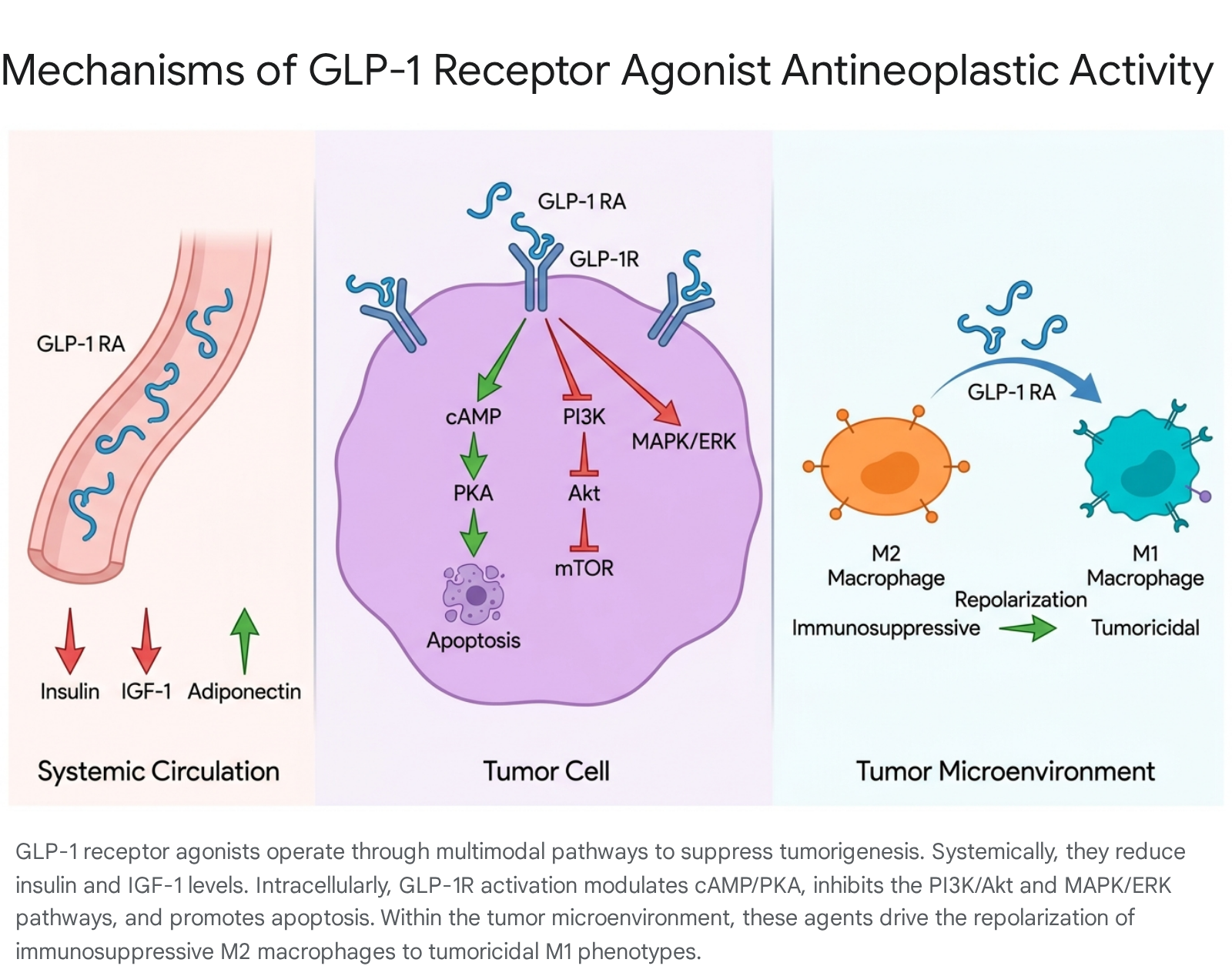
At the most macro level, GLP-1 RAs exert their antineoplastic influence by fundamentally altering the systemic endocrine environment. By stimulating glucose-dependent insulin secretion from pancreatic beta cells while simultaneously and potently suppressing inappropriate glucagon release from alpha cells, GLP-1 RAs induce a state of euglycemia, thereby reducing systemic hyperinsulinemia.1 Systemic insulin and its closely related counterpart, insulin-like growth factor 1 (IGF-1), are extraordinarily potent mitogens.1 These molecules bind to cell surface receptors on nascent neoplastic cells, initiating aggressive downstream signaling cascades that promote unchecked cellular division and inhibit physiological apoptosis. By lowering the circulating concentrations of these hormones, GLP-1 RAs effectively deprive developing neoplasms of critical, life-sustaining endocrine growth signals.1
Suppression of Chronic Inflammatory Pathways
Chronic inflammation is universally recognized as a core hallmark of cancer, playing a particularly prominent role in the pathogenesis of gastrointestinal malignancies such as colorectal cancer and pancreatic ductal adenocarcinoma.8 GLP-1 RAs exert profound, systemic anti-inflammatory effects that vastly exceed those of other antidiabetic agents like DPP-4 inhibitors.1 At the molecular level, GLP-1 receptor activation results in the direct inhibition of the NLRP-3 inflammasome and the MyD-88 signaling pathway.9
The blockade of these critical inflammatory conduits leads to a marked reduction in both systemic and myocardial concentrations of key pro-inflammatory cytokines, including interleukin-1 (IL-1), interleukin-6 (IL-6), and interleukin-8 (IL-8).9 Concurrently, the administration of GLP-1 RAs has been shown to enhance circulating levels of adiponectin, an adipose-derived hormone that further curtails the inflammatory cascade and promotes metabolic homeostasis.9 By extinguishing the smoldering, low-grade inflammation characteristic of metabolic syndrome, GLP-1 RAs remove the constant cellular stress and localized tissue damage that frequently serve as catalysts for malignant transformation.8
Intracellular Signaling, Apoptosis, and Proliferation Inhibition
The therapeutic reach of GLP-1 RAs extends well beyond the pancreas and adipose tissue. GLP-1 receptors (GLP-1Rs) are expressed heterogeneously on various cell types throughout the body, including directly on the surfaces of multiple malignant cell lines.1 The direct binding of a GLP-1 RA to a tumoral GLP-1R triggers a complex intracellular cascade. The primary initial event is the increased production of intracellular cyclic AMP (cAMP), which subsequently activates protein kinase A (PKA).9
Concurrently, GLP-1 RAs have been shown in preclinical models to modulate and downregulate the phosphatidylinositol 3-kinase (PI3K)/Akt/mTOR survival pathway, a notoriously hyperactive cascade in many human cancers that drives cellular survival and chemoresistance.9 Furthermore, GLP-1 RA exposure inhibits the extracellular signal-regulated kinase (ERK)/MAPK mitogenic pathway.12 The profound inhibition of these critical oncogenic axes fundamentally restricts tumor cell proliferation and actively blunts metastatic spread.8 For instance, this signaling modulation interferes with epithelial-mesenchymal transition (EMT)—the process by which stationary tumor cells gain the mobility required to enter the bloodstream and metastasize—while simultaneously inducing programmed cell death through the modulation of apoptotic cascades involving Caspase-3 activity.8 Preclinical models demonstrate that agents like exendin-4 (a GLP-1 RA) can directly inhibit the proliferation of MCF-7, MDA-MB-231, and KPL-1 breast cancer cells in a highly dose-dependent manner by modulating apoptosis-related genomic expression.13
Immunomodulation within the Tumor Microenvironment (TME)
Perhaps the most revolutionary aspect of GLP-1 RA pharmacology elucidated in recent years is their profound capacity to modulate the immune landscape directly within the tumor microenvironment (TME). The TME is frequently populated by immunosuppressive cells that shield the tumor from the body's natural immune surveillance. Among these, M2-polarized tumor-associated macrophages are notoriously complicit in promoting tumor growth, angiogenesis, and immune evasion.7
Emerging preclinical data demonstrate that specific GLP-1 RAs, notably semaglutide, possess the pharmacological ability to shift macrophage polarization away from this immunosuppressive, tumor-promoting M2 phenotype.7 Instead, semaglutide drives these immune cells toward the pro-inflammatory, tumor-suppressive M1 phenotype.7 This critical repolarization is mediated in large part through the intracellular suppression of PPAR-gamma, an effect that has been consistently replicated in isolated, cultured immune cell assays.7 Furthermore, treatment of isolated splenocytes with semaglutide has been shown to markedly increase the percentage of cells expressing crucial anti-tumor cytokines, including IL-1 beta, tumor necrosis factor-alpha (TNF-alpha), and interferon-gamma (IFN-gamma).7 This direct immunomodulation strongly suggests that GLP-1 RAs enhance endogenous anti-tumor immunity, rendering tumors inherently more susceptible to natural immune clearance and radically amplifying the efficacy of exogenous immunotherapies.7
Attenuation of Metastatic Progression: Landmark ASCO 2026 Findings (Abstract 3143)
While historical oncological epidemiology has predominantly focused on analyzing the incidence of de novo malignancies within populations utilizing metabolic medications, understanding the role of these potent metabolic modulators in patients with established neoplastic disease represents a critical, largely unmet clinical need. One of the most consequential, highly anticipated presentations at the 2026 ASCO Annual Meeting was Abstract 3143, which rigorously investigated whether the initiation of GLP-1 RA therapy following a localized cancer diagnosis fundamentally alters the aggressive trajectory of metastatic progression.4
Exhaustive Study Design and Cohort Characteristics
Led by lead study author Mark David Orland, MD, and an extensive team of researchers from the Taussig Cancer Institute at the Cleveland Clinic, the investigators executed a massive, real-world data analysis utilizing the TriNetX Global Health Research Network.1 TriNetX is a vast, federated database of electronic health records that aggregates anonymized patient data from comprehensive health systems globally, providing an unprecedented scale for observational oncologic research.1 The retrospective cohort study meticulously identified an expansive population of patients who had been definitively diagnosed with stage I, stage II, or stage III obesity-related cancers.1
To isolate the specific antineoplastic effects of GLP-1 RAs and rigorously control for confounding metabolic, demographic, and treatment-related variables, the researchers employed a highly sophisticated 1:1 propensity score matching algorithm.1 The control group selected for this head-to-head comparison consisted of patients utilizing dipeptidyl peptidase-4 (DPP-4) inhibitors, commonly referred to as gliptins.1 The selection of DPP-4 inhibitors as the active comparator was highly deliberate. DPP-4 inhibitors share a related metabolic mechanism with GLP-1 RAs—they function by preventing the enzymatic degradation of endogenous, naturally produced GLP-1—but they critically lack the high potency, the extensive, clinically significant weight-loss induction, and the profound, systemic anti-inflammatory properties characteristic of exogenous GLP-1 RA administration.1
The propensity matching algorithm was exceptionally stringent, rigorously balancing the two cohorts across a vast array of covariates. These included baseline patient demographics, maximum body mass index (BMI), precise glycemic control factors (such as hemoglobin A1c), smoking status and history, the presence of specific metabolic and cardiovascular comorbidities, the frequency of general health and cancer screenings, prior and concurrent oncologic surgical and systemic treatments, and all other concurrent pharmacological medications.4
Following this exhaustive matching process, the final analytical cohort comprised 12,112 perfectly matched patients, heavily distributed with 6,056 patients initiating GLP-1 RAs and 6,056 initiating gliptins.14 The demographic distribution of this global cohort was broadly representative, comprising approximately 55% to 60% White individuals, 20% to 25% Black or African American individuals, and 10% to 15% Asian individuals.1 The targeted analysis focused exclusively on seven specific, highly morbid obesity-related solid tumors: breast adenocarcinoma, prostate adenocarcinoma, non-small cell lung cancer (NSCLC), colorectal adenocarcinoma (CRC), hepatocellular carcinoma (HCC), renal cell carcinoma (RCC), and pancreatic adenocarcinoma.1
Profound Clinical Efficacy: Prevention of Stage IV Metastatic Disease
The primary, highly objective clinical endpoint of the study was the documented progression of the malignancy from localized or regionally advanced disease (stage I-III) to stage IV (metastatic) disease. The clinical findings presented at ASCO 2026 were highly statistically significant and demonstrated an extraordinary, consistent protective effect across multiple, biologically distinct tumor histologies.1
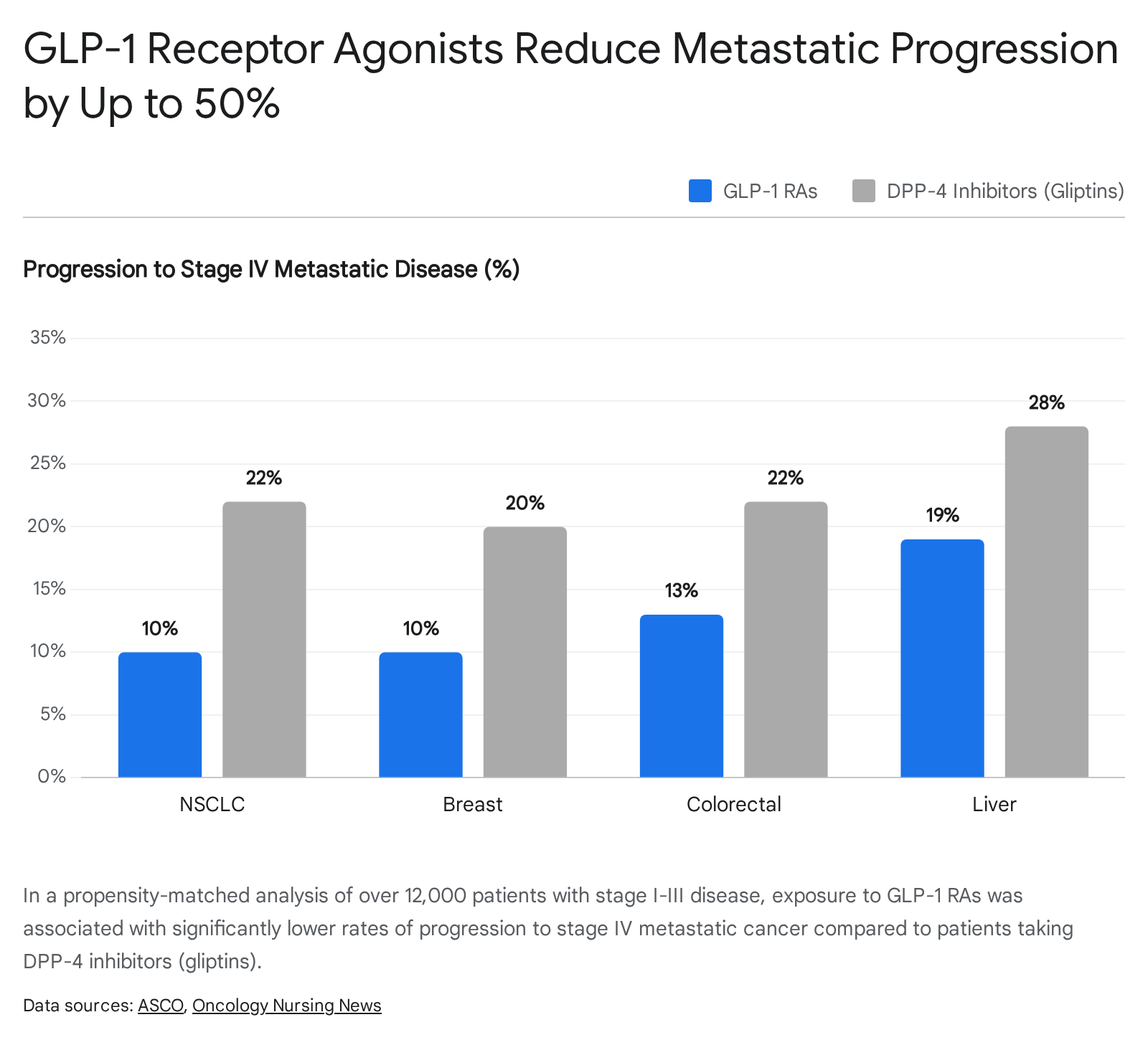
In four of the seven evaluated malignancies—specifically NSCLC, breast cancer, colorectal cancer, and hepatocellular carcinoma—patients exposed to GLP-1 RAs experienced a massive 38% to 50% lower likelihood of progressing to stage IV metastatic disease when compared directly to the closely matched DPP-4 inhibitor control group.1 The absolute risk reductions and the relative percentage variances between the cohorts provide a stark visualization of the clinical magnitude of these metabolic interventions.
Cancer Type | GLP-1 RA Cohort Progression to Stage IV (%) | Gliptin (DPP-4i) Cohort Progression to Stage IV (%) | Relative Risk Reduction | Statistical Significance |
Non-Small Cell Lung Cancer (NSCLC) | 10% | 22% | 54.5% | Significant |
Breast Adenocarcinoma | 10% | 20% | 50.0% | Significant |
Colorectal Adenocarcinoma | 13% | 22% | 40.9% | Significant |
Hepatocellular Carcinoma (Liver) | 19% | 28% | 32.1% | Significant |
Prostate Adenocarcinoma | Numerically Lower | Baseline | Not Calculated | Non-Significant |
Renal Cell Carcinoma (Kidney) | Numerically Lower | Baseline | Not Calculated | Non-Significant |
Pancreatic Adenocarcinoma | Numerically Lower | Baseline | Not Calculated | Non-Significant |
Comprehensive Data Source: Abstract 3143, 2026 ASCO Annual Meeting 1
While prostate adenocarcinoma, pancreatic adenocarcinoma, and renal cell carcinomas also demonstrated numerical reductions in metastatic progression events within the GLP-1 RA cohort relative to the gliptin cohort, these specific subset differences did not reach formal statistical significance.1 This lack of statistical significance in these three malignancies could potentially be attributed to insufficient statistical powering due to lower event rates within the specific study follow-up period, or it may reflect deeply differing metabolic dependencies and distinct tumor biology among these specific tumor types that render them less susceptible to GLP-1R modulation.1
Genomic Correlation: GLP-1 Receptor Expression and Overall Survival
To elevate this research beyond observational epidemiology and provide a highly robust biological corollary to these profound clinical observations, the investigators systematically analyzed genomic sequencing data derived from The Cancer Genome Atlas (TCGA).1 The primary objective of this genomic deep dive was to assess the fundamental relationship between intrinsic, baseline tumor GLP-1 receptor (GLP-1R) expression and long-term overall survival outcomes.1
The extensive genomic analysis thoroughly corroborated the real-world clinical EHR data. Across the vast aggregate of the seven solid tumors evaluated in the study, high intrinsic expression of the GLP-1R gene within the actual tumor tissue was highly significantly correlated with massively improved overall survival metrics. Patients harboring tumors characterized by high GLP-1R expression experienced a remarkable 33% lower overall risk of death compared directly to those patients possessing tumors with low GLP-1R expression (Hazard Ratio = 0.67; 95% Confidence Interval [CI], 0.54–0.83; p < 0.001).1
This protective genomic association was uniquely and extraordinarily pronounced in the context of breast cancer. Within the breast adenocarcinoma cohort, high tumor GLP-1R expression conferred a massive 45% reduction in absolute mortality risk (HR = 0.55; 95% CI, 0.35–0.87; p = 0.011).1 These robust genomic findings strongly and mechanistically suggest that the endogenous GLP-1 signaling axis exerts an intrinsic, native tumor-suppressive role within these tissues.1 Consequently, the pharmacological hyperactivation of this axis via the administration of potent, long-acting exogenous GLP-1 RAs capitalizes directly on a native biological vulnerability within the tumor architecture, directly contributing to the clinically observed reductions in metastatic spread.1
Importantly, throughout this massive real-world evaluation, the safety profile of the GLP-1 RA cohort remained remarkably consistent and favorable. Despite historical, widely publicized concerns regarding the potential for these agents to induce severe pancreatic or gastric inflammation, the actual documented clinical instances of these inflammatory conditions were not elevated in the GLP-1 RA cohort relative to the gliptin cohort, reinforcing the therapeutic index of these medications in fragile oncologic populations.1
Breast Cancer: Primary Prevention, Progression Inhibition, and Combination Therapies
The complex interplay between systemic metabolism and breast cancer pathogenesis is heavily mediated by the peripheral conversion of androgens to estrogens within excess adipose tissue, the presence of chronic low-grade inflammation, and pathological insulin signaling.5 Consequently, GLP-1 RAs, through their multimodal mechanism of action, have emerged as a highly compelling, multi-targeted modality across the entire continuum of breast cancer care, spanning from primary incidence reduction in high-risk screening populations to the intricate management of advanced, treatment-refractory metastatic disease.
Primary Incidence Reduction in Screening Populations
A massive, highly rigorous real-world observational study originating from the University of Pennsylvania (presented at ASCO 2026 as Abstract 10506 and published concurrently in JCO Oncology Practice) exhaustively evaluated the impact of GLP-1 RAs on primary breast cancer incidence among a vast cohort of women eligible for routine screening mammography.16 The study initially evaluated an expansive, diverse cohort of 217,025 unique female patients who had undergone standard breast imaging.16 To ensure high clinical relevance, the cohort was subsequently restricted to 111,646 women aged 45 to 80 years with a calculated BMI of 25 or greater (indicating overweight or obesity status).16
Employing a highly stringent, algorithmically driven greedy nearest-neighbor propensity score matching methodology, the researchers controlled for a vast array of confounding variables, including precise age, race, documented ethnicity, highest recorded lifetime BMI, mammographic breast density (a major independent risk factor), and a formal history of clinical type 2 diabetes.16 Through this process, they successfully matched 30,528 patient observations, a cohort containing exactly 600 incident, radiologically confirmed breast cancer cases.16
The complex logistic regression analysis revealed a profound, statistically irrefutable protective effect: Documented GLP-1 RA exposure prior to the breast imaging exam date was associated with a massive and statistically significant reduction in overall breast cancer incidence. In the fully propensity-matched cohort, GLP-1 RA exposure yielded an Odds Ratio (OR) of 0.695 (95% CI, 0.590–0.819; p < 0.0001).16 Crucially, this robust 30.5% reduction in relative risk remained completely independent of concurrent diabetes status and baseline BMI.16 This independence strongly suggests that the chemopreventive effect is not merely a secondary, passive byproduct of gross weight loss, but rather actively involves direct anti-inflammatory, immune-modulating, and hormonal modulation pathways that act directly upon the breast tissue microenvironment.5
Augmenting Systemic Therapies in Advanced Metastatic Breast Cancer
In the highly complex advanced disease setting, the strategic integration of GLP-1 RAs into established standard-of-care oncologic regimens is demonstrating unprecedented, potentially practice-changing survival advantages. For patients diagnosed with hormone receptor-positive (HR+), human epidermal growth factor receptor 2-negative (HER2-) metastatic breast cancer, the unequivocal standard first-line systemic therapy typically involves a combination endocrine therapy (ET) backbone paired synergistically with a potent cyclin-dependent kinase 4/6 (CDK4/6) inhibitor (e.g., palbociclib, ribociclib, or abemaciclib).18
A highly anticipated real-world, retrospective, propensity score-matched analysis presented at ASCO 2026 (Abstract 1070) revealed that the concomitant addition of GLP-1 RAs to a CDK4/6 inhibitor and endocrine therapy backbone was associated with a massive 30% reduction in the overarching risk of all-cause mortality in patients with HR+/HER2- metastatic breast cancer.5 This finding is highly significant not solely for its raw efficacy, but also for its profound implications in clinical toxicity management.
CDK4/6 inhibitors, while highly effective, carry massive metabolic and hematological monitoring burdens.5 They frequently induce severe cytopenias (requiring intense complete blood count surveillance), promote challenging gastrointestinal toxicities, and disrupt systemic metabolism.5 The co-administration of GLP-1 RAs appears to actively stabilize the systemic metabolic environment. More importantly, this combination potentially mitigates and delays well-known oncogenic treatment resistance pathways—such as PI3K/AKT/mTOR pathway cross-talk and the development of acquired ESR1 mutations—thereby vastly extending the durability and clinical efficacy of the CDK4/6 inhibition.5
Complementary data presented at earlier prestigious symposia, such as the San Antonio Breast Cancer Symposium (SABCS) by Safi et al., deeply support and expand upon these findings. In cohorts of patients with pre-existing, established breast cancer, formal semaglutide exposure was closely correlated with a 46% reduction in all-cause mortality over an extended 5.5-year follow-up period.22 Furthermore, these patients exhibited an extraordinary 74% lower risk of invasive or metastatic cancer progression relative to meticulously matched controls not utilizing GLP-1 RAs.22 Notably, this comprehensive study identified through granular EHR analysis that higher attained pharmacological doses of semaglutide were consistently associated with vastly improved overall survival trajectories entirely independent of the total degree of body weight lost, further substantiating a powerful, direct pharmacological antineoplastic effect on the tumor biology itself.13
Colorectal Cancer: Redefining the Pharmacological Standard in Risk Reduction
Colorectal cancer (CRC) represents one of the most prominent, lethal, and rapidly rising obesity-associated malignancies globally, particularly among younger demographics. The exhaustive ASCO 2026 presentations, synergistically combined with landmark peer-reviewed cohort studies published in 2024, definitively solidify the role of GLP-1 RAs as uniquely potent modulators of CRC risk, incidence, and long-term survival.
Head-to-Head Chemoprevention: GLP-1 RAs vs. Aspirin
For decades, daily low-dose aspirin has reigned as the accepted pharmacological standard for CRC primary prevention in high-risk individuals, despite its known gastrointestinal and hemorrhagic side effects. At ASCO 2026, Dr. Colton Jones and colleagues presented a revolutionary, massive-scale, real-world, head-to-head comparison directly evaluating the efficacy of GLP-1 RAs against aspirin for the primary prevention of CRC.3 Utilizing the vast TriNetX global network across 106 separate health systems, the investigators meticulously matched 140,828 patients receiving GLP-1 RAs with exactly 140,828 patients receiving aspirin.3 To absolutely ensure the integrity of the data and guarantee that results reflected true primary prevention (rather than the delayed detection of pre-existing, undiagnosed malignancies), a rigorous 6-month clinical lead-in period was applied.3
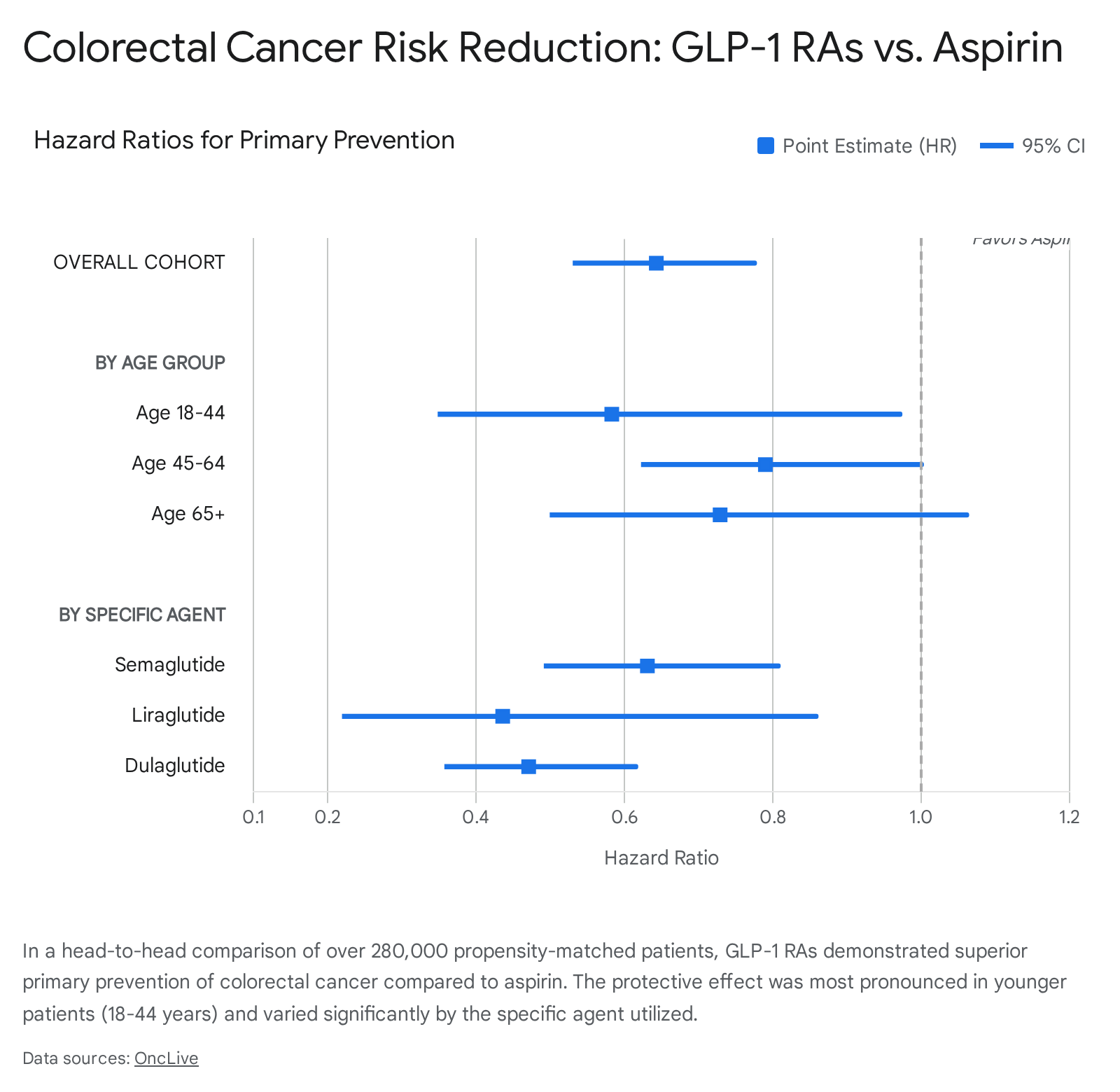
At a median, highly robust follow-up of 6 years, patients utilizing GLP-1 RAs demonstrated a profoundly significant 35.7% lower overall risk of developing de novo colorectal cancer compared directly to those taking daily aspirin (HR = 0.643; 95% CI, 0.531–0.778).3 The protective magnitude of the GLP-1 RAs varied significantly and revealingly based on specific patient demographics and the exact pharmacological formulation utilized:
Demographic / Agent Category | Relative Risk Reduction vs. Aspirin | Hazard Ratio (95% CI) | Statistical Significance |
Overall Cohort | 35.7% | 0.643 (0.531–0.778) | Highly Significant |
High-Risk Patients (Family Hx) | 42.1% | 0.579 (0.401–0.837) | Highly Significant |
Age 18 to 44 Years | 41.7% | 0.583 (0.349–0.974) | Significant |
Age 45 to 64 Years | 21.0% | 0.790 (0.623–1.003) | Borderline / Significant |
Age 65+ Years | 27.1% | 0.729 (0.500–1.064) | Borderline / Significant |
Diabetic Status (Present) | 41.2% | 0.588 (0.471–0.734) | Highly Significant |
Diabetic Status (Absent) | 41.2% | 0.588 (0.471–0.734) | Highly Significant |
Liraglutide (Specific Agent) | 56.4% | 0.436 (0.220–0.861) | Highly Significant |
Dulaglutide (Specific Agent) | 52.9% | 0.471 (0.358–0.618) | Highly Significant |
Semaglutide (Specific Agent) | 36.9% | 0.631 (0.492–0.810) | Highly Significant |
Comprehensive Data Source: ASCO 2026, Jones et al. TriNetX Database Study 3
The age stratification data is particularly paradigm-shifting. The most profound, extreme risk reduction was observed precisely in the youngest demographic studied. Patients aged 18 to 44 years experienced a massive 41.7% reduction in CRC risk (HR = 0.583; 95% CI, 0.349–0.974).3 This is a critical finding of immense clinical importance given the alarming, unexplained epidemiological rise in aggressive, early-onset colorectal cancer in young adults globally.3
Furthermore, the efficacy was not perfectly uniform across the entire GLP-1 RA drug class. Liraglutide demonstrated the highest individual efficacy with a massive 56.4% absolute risk reduction, followed closely by dulaglutide at 52.9%, and semaglutide at a still-potent 36.9%.3 Newer, dual-agonist agents like tirzepatide did not demonstrate statistical significance in this specific cohort analysis, though investigators appropriately noted this is overwhelmingly likely due to their much recent market introduction, resulting in shorter real-world follow-up durations and substantially smaller sample sizes within the EHR database.3 Finally, the magnitude of CRC risk reduction was virtually identical between patients possessing a formal diagnosis of diabetes (41.2% reduction) and patients without diabetes (41.2% reduction), completely reaffirming that the chemopreventive mechanisms operate independently of baseline glycemic dysregulation.3
Importantly, the GLP-1 RA cohort demonstrated a vastly superior overall safety profile compared to the aspirin cohort. Patients on GLP-1 RAs experienced significantly lower incidences of acute kidney injury (1.15% vs. 2.8%; HR = 0.369; p =.0001), clinical gastric ulcers (0.50% vs. 0.55%; HR = 0.815; p =.038), and catastrophic gastrointestinal bleeding (2.1% vs. 2.0%; HR = 0.852; p =.018).3
Broad-Spectrum Risk Reduction Across the 13 Obesity-Associated Cancers
The highly specific CRC findings are comprehensively supported and massively expanded upon by monumental cohort studies published by Wang et al. in JAMA Network Open and JAMA Oncology (2024). Analyzing an unprecendented dataset of EHRs from over 1.65 million drug-naive patients initially diagnosed with type 2 diabetes, the investigators meticulously compared the long-term incident risk of all 13 recognized obesity-associated cancers between patients newly prescribed GLP-1 RAs versus those prescribed either insulins or metformin.3
Compared directly with insulin regimens, GLP-1 RA use was associated with profound, highly statistically significant relative risk reductions across 10 of the 13 evaluated malignancies.11 The most dramatic, practice-altering relative risk reductions were observed in gallbladder cancer (HR = 0.35), meningioma (HR = 0.37), pancreatic cancer (HR = 0.41), and hepatocellular carcinoma (HR = 0.47).11 Furthermore, the incidence of multiple myeloma was reduced (HR = 0.59), alongside massive reductions in ovarian cancer (HR = 0.52), esophageal cancer (HR = 0.60), endometrial cancer (HR = 0.74), and kidney cancer (HR = 0.76).11 As expected, colorectal cancer incidence was consistently reduced by 46% relative to insulin exposure (HR = 0.54).11
However, deep comparative pharmacology is critical to appropriately contextualize these sweeping findings. When GLP-1 RAs were strictly compared to metformin—a first-line, inexpensive oral anti-diabetic agent renowned for decades for its own potent AMPK-activating, anti-neoplastic properties—the immense chemopreventive advantages of GLP-1 RAs were largely neutralized.2 GLP-1 RAs did not demonstrate a statistically significant decreased risk for any of the 13 cancers when compared directly to metformin, and were paradoxically associated with a statistically significant, albeit slight, increased relative risk of kidney cancer specifically (HR = 1.54; 95% CI, 1.27–1.87).2 This deep comparative nuance underscores that while GLP-1 RAs are vastly, undeniably superior to insulin (which is inherently anabolic and highly mitogenic) for cancer prevention, they represent a parallel, rather than strictly superior, oncologic prevention strategy when compared head-to-head with metformin.
Unprecedented Survival Outcomes in Established CRC
Moving beyond primary prevention, GLP-1 RAs appear to fundamentally alter the raw survival dynamics in fully established, advanced neoplastic disease. A pivotal 2025 analysis conducted by Cuomo, utilizing massive datasets from the University of California (UC) Health Data Warehouse, comprehensively evaluated long-term outcomes in 6,871 patients bearing established, confirmed diagnoses of colon cancer across all UC Health facilities.3
Patients concurrently utilizing GLP-1 RAs alongside their standard oncologic care exhibited an extraordinary, almost unparalleled 62% reduction in the strict odds of 5-year mortality (OR = 0.38; 95% CI, 0.21–0.64).3 In absolute terms, the 5-year mortality rate was a mere 15.5% for the GLP-1 RA exposed cohort, compared with a devastating 37.1% in those matched patients not utilizing the agents.3 Crucially, this profound, massive survival benefit persisted firmly intact even after rigorous statistical adjustments for patient age, precise BMI, advanced disease severity, and a host of other complex confounding variables.3 Revealingly, the statistical mortality benefit was definitively most pronounced in morbidly obese patients presenting with a BMI greater than 35, highlighting the profound interplay between severe metabolic dysfunction and tumor aggressiveness.3
Systemic Immunomodulation: The Synergy of GLP-1 RAs and Immune Checkpoint Inhibitors (ICIs)
The introduction of immune checkpoint inhibitors (ICIs)—such as targeted PD-1, PD-L1, and CTLA-4 monoclonal antibodies—has revolutionized medical oncology. However, their therapeutic efficacy remains highly variable across populations and is frequently complicated by the rapid onset of severe, unpredictable, and potentially life-threatening immune-related adverse events (irAEs). The intricate biological intersection of systemic metabolic dysfunction, chronic pathological inflammation, and native immune surveillance has led elite researchers to urgently investigate whether GLP-1 RAs can safely co-exist with, or actively enhance, ICI therapy.
Abstract 11000, presented by Jajja et al. at ASCO 2026, provided definitive, highly awaited clarity on this complex pharmacological dynamic.6 In a massive, federated EHR-based study spanning 113 diverse healthcare organizations within the TriNetX Research Network, researchers meticulously identified adult patients diagnosed with both solid and hematologic malignancies who were actively undergoing treatment with PD-1/PD-L1 or CTLA-4 inhibitors.6 Utilizing complex algorithms, they successfully and rigorously propensity-matched 3,807 patients receiving concurrent GLP-1 RAs to a vast control cohort of 173,423 non-exposed ICI patients, perfectly balancing demographics, metabolic comorbidities, and baseline clinical characteristics.6
Extreme Long-Term Survival Advantages
The primary survival outcomes derived from Kaplan-Meier analyses and Cox proportional hazards models strongly and definitively favored the concurrent administration of GLP-1 RAs. While the 1-year overall survival endpoint did not yield a statistically significant difference (HR = 0.65; 95% CI, 0.59–0.71; log-rank p = 0.521), the survival curves separated profoundly and continuously over extended time horizons.6
- 3-Year Overall Survival: Concurrent GLP-1 RA exposure was associated with a highly significant 31% reduction in the hazard of death at three years (HR = 0.69; 95% CI, 0.64–0.75; log-rank p < 0.001).6
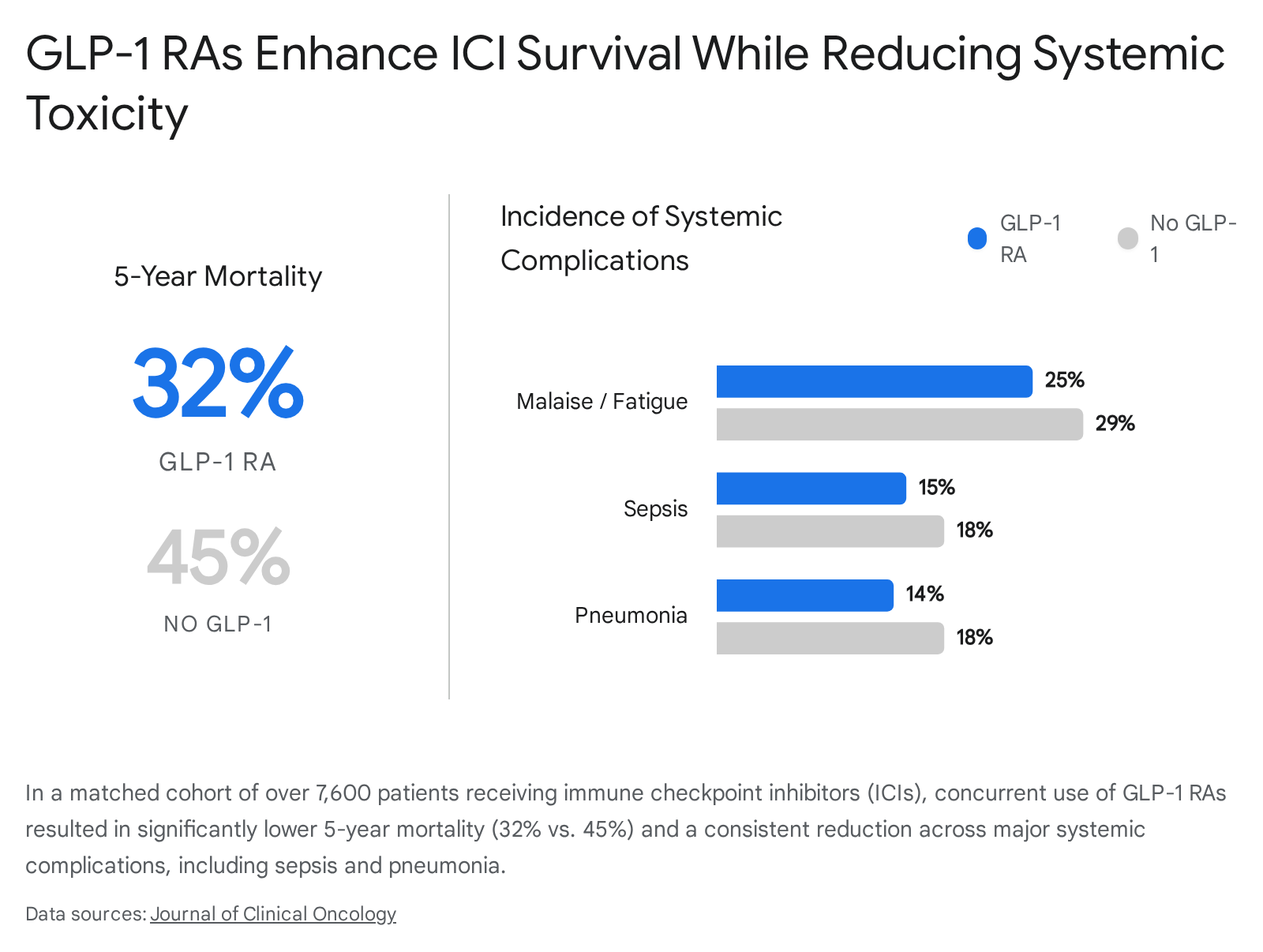
- 5-Year Overall Survival: The clinical durability of the effect persisted and deepened, demonstrating a 29% reduction in mortality hazard at five years (HR = 0.71; 95% CI, 0.65–0.76; log-rank p < 0.001).6 At the 5-year milestone, absolute recorded mortality was drastically lower in the GLP-1 RA cohort (32%, or 1,091 of 3,411 patients) compared to the tightly matched non-GLP-1 cohort (45%, or 1,545 of 3,410 patients).6
These monumental findings were perfectly mirrored in a complementary, histology-specific cohort study focusing exclusively on metastatic colorectal cancer (mCRC) (Abstract 3605, Rawal et al.).25 Among meticulously propensity-matched mCRC patients receiving ICIs (138 matched patients per cohort), GLP-1 RA exposure yielded a massive 32% relative risk reduction in absolute mortality at exactly 1 year (27.5% mortality vs. 40.6% mortality).25 This astonishing survival association persisted durably through 3 years (RR = 0.67) and 5 years (RR = 0.67), resulting in a substantially higher 5-year absolute survival probability (50.5% vs. 41.5%).25
The Paradoxical Mitigation of Immune-Related Adverse Events (irAEs)
Counterintuitively, the profound enhancement of overall survival—which in the realm of immunotherapy typically correlates intimately with dangerous over-activation of the immune system—was paired simultaneously with a massive reduction in the clinical burden of dangerous irAEs and severe systemic infectious complications.5
Adverse Event / Systemic Complication | Incidence in GLP-1 Cohort (5-Year) | Incidence in Non-GLP-1 Cohort (5-Year) | Statistical Variance / Odds Ratio |
Malaise & Severe Fatigue | 25% | 29% | Significantly Reduced |
Sepsis | 15% | 18% | Significantly Reduced |
Pneumonia | 14% | 18% | Significantly Reduced |
Severe Cachexia | 4% | 5% | Significantly Reduced |
Neutropenia (at 3 years) | 5.7% | 6.5% | OR 0.87 (95% CI, 0.71–1.06) |
Pyrexia (at 3 years) | Reduced (absolute -2.5%) | Baseline | OR 0.73 (95% CI, 0.61–0.87) |
Comprehensive Data Source: Abstract 11000, 2026 ASCO Annual Meeting, Jajja et al. 6
This extraordinary clinical paradox—massively improved ICI therapeutic efficacy occurring seamlessly alongside radically reduced autoimmune and systemic toxicity—is deeply rooted in the unique cellular mechanism of action of GLP-1 RAs. By potently inhibiting the NLRP-3 inflammasome and downregulating non-specific inflammatory cytokines, GLP-1 RAs effectively extinguish systemic, low-grade, pathological inflammation without compromising or blunting the targeted, highly specific antigen-driven cytotoxic T-cell response absolutely required for tumor eradication.9 Furthermore, by mitigating severe cachexia, lowering the incidence of pneumonia (10.9% vs 17.4%; HR 0.58 in mCRC cohorts), preventing heart failure exacerbations (23.9% vs 31.9%; HR 0.75), and reducing systemic malaise, patients maintain the critical physiological performance status required to tolerate prolonged, life-saving ICI regimens without fatal interruptions.6
It is absolutely critical to note, however, that while broad systemic irAEs are vastly reduced, oncology care teams must remain highly vigilant regarding highly specific toxicities. Detailed EHR analyses revealed that GLP-1 RA co-exposure with ICIs is linked to distinct, elevated ophthalmic safety signals.5 Specifically, these patients experience statistically higher rates of diabetic retinopathy progression (HR = 1.75) and non-arteritic anterior ischemic optic neuropathy (HR = 1.51).5 Consequently, aggressive, routine ophthalmology screening is now a mandated clinical protocol in this concurrent treatment setting, particularly for patients presenting with pre-existing diabetes and known retinopathy risk factors.5
Genitourinary Malignancies: Bladder Cancer and the Amplification of BCG Response
Intravesical Bacillus Calmette-Guérin (BCG) immunotherapy remains the absolute, unrivaled cornerstone of clinical treatment for high-risk non-muscle-invasive bladder cancer (HR-NMIBC).27 Because the efficacy of BCG relies almost entirely on the localized induction of an intense anti-tumor immune response directly within the bladder urothelium, any systemic pharmacological agents that modulate general immune function have profound implications for its clinical success or failure.
Abstract 4620, presented by Dr. Benyamin Yaniv and colleagues at ASCO 2026, exhaustively evaluated this dynamic utilizing the massive TriNetX US Research Network to retrospectively analyze HR-NMIBC patients treated extensively with BCG between November 2015 and November 2025.27 Following highly rigorous propensity score matching to control for baseline demographics and severe comorbidities, the researchers meticulously compared 787 patients who had formal GLP-1 RA exposure prior to and completely overlapping during their BCG therapy with 787 perfectly matched unexposed controls.27 The cohort was predominantly composed of older, White males (mean age 73 years; 85% White; 80% male), perfectly reflecting standard bladder cancer demographics.27 Within the exposed group, semaglutide served as the overwhelmingly predominant pharmacological agent (utilized by 67%), followed by dulaglutide (37%) and tirzepatide (21%).27
The robust clinical outcomes definitively supported the biological immunomodulatory hypothesis. While the raw rates of localized superficial NMIBC recurrence (RR = 0.98; p = 0.84), radical surgical cystectomy (RR = 0.94; p = 0.65), and distant gross metastasis (RR = 0.83; p = 0.19) did not reach formal statistical significance between the cohorts, the most critical, life-altering survival endpoints were profoundly and positively impacted.27
HR-NMIBC Clinical Endpoint | Relative Risk (RR) | 95% Confidence Interval (CI) | P-Value | Statistical Significance |
10-Year All-Cause Mortality | 0.65 | 0.45 – 0.93 | 0.017 | Highly Significant |
Progression to Muscle-Invasive Disease (MIBC) | 0.43 | 0.26 – 0.89 | 0.018 | Highly Significant |
Localized NMIBC Recurrence | 0.98 | Not Reported | 0.84 | Non-Significant |
Radical Cystectomy Requirement | 0.94 | Not Reported | 0.65 | Non-Significant |
Distant Metastasis | 0.83 | Not Reported | 0.19 | Non-Significant |
Comprehensive Data Source: ASCO 2026, Abstract 4620, Yaniv et al. 27
Patients exposed to GLP-1 RAs demonstrated a highly significant 35% reduction in absolute 10-year mortality.27 Most crucially for urological oncologists, the GLP-1 RA cohort was vastly protected against the aggressive progression from superficial disease to lethal, deeply infiltrating muscle-invasive bladder cancer (MIBC), experiencing a massive 57% lower absolute risk of disease progression.27 These genitourinary findings strongly validate the core biological hypothesis that GLP-1 RAs do not simply induce passive weight loss, but actively, biologically augment therapeutic anti-tumor immunity within highly localized, targeted treatment vectors such as intravesical BCG instillation.27
Pharmacological Safety Signals and Dispelling the Pancreatic and Thyroid Cancer Myths
The meteoric global rise in the prescription and utilization of GLP-1 RAs has historically been heavily tempered by lingering, pervasive safety concerns within the medical community. These concerns primarily revolve around theoretical, early-stage risks of acute pancreatitis, the subsequent development of pancreatic cancer, and the highly specific induction of medullary thyroid carcinoma (MTC). However, massive, population-scale epidemiological analyses, exhaustive multi-national registries, and recent rigorous meta-analyses have now largely dispelled these historical apprehensions, fundamentally reframing the long-term safety profile of these agents in clinical practice.
The Medullary Thyroid Cancer (MTC) Controversy
GLP-1 RAs currently carry a severe, mandated FDA boxed warning regarding the potential risk of MTC, which accounts for a mere 3-4% of all clinical thyroid cancers.28 This heavy regulatory precaution originated entirely in early, preclinical rodent toxicology studies, wherein highly dosed laboratory rats and mice rapidly developed aggressive C-cell hyperplasia and subsequent tumors.28 Investigators noted that GLP-1 receptors were highly, densely expressed in rodent C-cells, and chronic artificial stimulation inevitably led to rapid tumor formation.30
However, profound, insurmountable biological divergence exists between mammalian species. Human thyroid C-cells express vastly lower baseline densities of GLP-1 receptors compared directly to rodents, and the downstream cellular signaling responses fundamentally differ.29 Furthermore, extensive human clinical trials and longitudinal post-market surveillance have completely failed to establish any clinically meaningful, sustained elevation in serum calcitonin—the primary biological marker of active C-cell stimulation and MTC—following the prolonged use of GLP-1 RAs in humans.30
Exhaustive human clinical evidence definitively contradicts the early rodent models. A monumental, landmark Scandinavian cohort study published recently in the BMJ analyzed pristine, nationwide healthcare register data across Denmark, Norway, and Sweden.28 Comparing 145,410 patients initiating GLP-1 RAs directly against 291,667 closely matched patients initiating DPP-4 inhibitors over a mean, highly robust follow-up of 3.9 years, the massive study found absolutely no increased risk of general thyroid cancer (HR = 0.93; 95% CI, 0.66–1.31).31 The specific hazard ratio for the feared medullary thyroid cancer was 1.19 (95% CI, 0.37–3.86), which is entirely statistically non-significant.31 An additional active-comparator sub-analysis plotted against SGLT2 inhibitors yielded similarly negative, reassuring findings regarding thyroid cancer risk (HR = 1.16; 95% CI, 0.65–2.05).31 The authors firmly concluded that the upper limit of the statistical confidence interval was consistent with absolutely no more than a 31% possible increase in relative risk in extreme outlier scenarios, and equally possible is a 34% massive reduction in risk.32
Furthermore, historical, lower-quality observational studies reporting a positive clinical association between GLP-1 RAs and thyroid cancer are heavily and fatally confounded by detection bias.28 Patients prescribed GLP-1 RAs undergo vastly more frequent medical evaluation, endocrinological screening, and intensive weight-loss monitoring, leading directly to substantially higher rates of incidental radiological imaging and the subsequent, inevitable detection of pre-existing, utterly indolent, benign thyroid nodules.28 Leading, high-volume surgical institutions, such as the renowned Clayman Thyroid Center (which personally evaluates and manages over 2,000 complex thyroid cancer patients annually), report absolutely no observable clinical pattern of MTC or any other thyroid malignancy linked in any capacity to GLP-1 RA utilization.28
Pancreatic Safety and Risk Reduction
Similar, deeply ingrained clinical concerns regarding the induction of pancreatic cancer have been unequivocally dismantled and completely reversed by recent, massive-scale data. As definitively demonstrated in Dr. Wang's 2024 JAMA Network Open cohort study comprising over 1.65 million verified patients, GLP-1 RA use was definitively not associated with any increased pancreatic tumorigenesis.11
In a stunning reversal of historical fears, when compared directly to matched patients utilizing insulin regimens, continuous GLP-1 RA exposure was actually associated with a staggering, highly protective 59% reduction in the absolute risk of developing incident pancreatic cancer (HR = 0.41).11 While acute, transient pancreatitis remains a known, documented, albeit extremely rare, adverse pharmacological event requiring standard clinical vigilance, the overwhelming epidemiological data firmly and undeniably position GLP-1 RAs as highly protective against the long-term, catastrophic development of lethal pancreatic malignancies.11
Summary and Predictions for Future Oncological Studies
The staggering volume of rigorous data presented at the 2026 ASCO Annual Meeting represents a definitive watershed moment in the deep intersection of metabolic endocrinology and targeted medical oncology. The aggregated evidence unequivocally and repeatedly supports the assertion that GLP-1 receptor agonists possess highly potent, multimodal, and systemic antineoplastic properties. Across massive, perfectly propensity-matched real-world global cohorts, GLP-1 RAs have demonstrated an unprecedented, reproducible ability to reduce primary cancer incidence 3, actively halt the aggressive progression to metastatic stage IV disease across diverse, highly lethal solid tumors 1, drastically improve long-term, 5-year survival metrics in fully established malignancies 3, and synergize powerfully and safely with advanced immunotherapies.6
The complex biological mechanisms underwriting these monumental clinical outcomes extend far, far beyond simple glycemic control and the physical reduction of body weight. By potently downregulating systemic insulin and IGF-1 mitogenic signaling, directly inhibiting the intracellular PI3K/Akt/mTOR and MAPK/ERK survival pathways, extinguishing chronic systemic inflammation (via potent NLRP-3 and MyD-88 inhibition), and inducing the radical repolarization of the tumor microenvironment toward a highly tumoricidal M1 macrophage phenotype, GLP-1 RAs act as comprehensive, multi-pathway suppressors of the entire oncogenic cascade.7 Concurrently, massive-scale international registry data spanning millions of patients have completely dismantled legacy pharmacological fears regarding thyroid and pancreatic safety signals, confirming a highly favorable, life-extending risk-benefit profile.11
Predictions for Future Trajectories and Clinical Trial Architecture
- The Rapid Transition to Prospective Randomized Controlled Trials (RCTs): The current, undeniable evidentiary base, while mathematically massive and rigorously propensity-matched, relies predominantly on retrospective electronic health records (e.g., TriNetX, UC Health). Real-world observational data are inherently, statistically susceptible to unmeasured residual confounding and subtle immortal time bias.37 The immediate future of this specific oncological field will be defined entirely by the launch of rigorous, multi-site, placebo-controlled RCTs designed specifically, from the ground up, with oncologic primary endpoints. Current trials already underway, such as NCT07314528, are evaluating the addition of semaglutide to total neoadjuvant chemoradiotherapy (TNT) in locally advanced rectal cancer to assess direct impacts on pathological complete response rates.38 Similarly, trials in endometrial cancer (NCT06751589) are actively testing tirzepatide and semaglutide alongside cytotoxic chemotherapy.39 These imminent trials will definitively isolate the variables of specific drug formulations and perfectly define optimal dosing architectures for primary cancer prevention versus therapeutic oncological augmentation.
- Formal Integration into NCCN Standard-of-Care Guidelines: As these prospective data rapidly mature over the next 24 to 36 months, GLP-1 RAs are highly predicted to become formally and permanently integrated into the rigid National Comprehensive Cancer Network (NCCN) clinical practice guidelines. Their primary, immediate deployment will likely occur in two massive domains: first, as a mandated prophylactic standard-of-care for cancer survivors at high risk for catastrophic recurrence (particularly in the breast and colorectal spaces), and second, as a mandatory metabolic adjunct prescribed concurrently alongside highly toxic systemic regimens (such as ICIs and CDK4/6 inhibitors) to actively mitigate severe adverse events, prevent systemic cachexia, and stave off rapid pharmacological resistance.5
- The Era of Biomarker-Driven Application: The revelation derived from TCGA genomic data that high intrinsic tumor GLP-1 receptor expression heavily correlates with a massive 33% to 45% reduction in absolute mortality risk heralds a completely new era of personalized, biomarker-driven metabolic oncology.1 Future, highly advanced diagnostic protocols will inevitably incorporate routine GLP-1R tumor expression genomic profiling, allowing clinical medical oncologists to precision-target high-dose exogenous GLP-1 RA therapy explicitly to those patients whose sequenced tumors exhibit the greatest intrinsic, genomic vulnerability to this specific signaling axis.
In definitive conclusion, GLP-1 receptor agonists have fundamentally and irreversibly transcended their humble origins as simple anti-diabetic and weight-loss agents. They now firmly stand at the absolute vanguard of an entirely new class of targeted metabolico-oncologic therapeutics, offering a highly tolerable, systemically active, and wildly effective intervention capable of completely dismantling the metabolic and inflammatory physiological foundations upon which all modern malignancies inherently thrive.
Works cited
- GLP-1s May Reduce Metastatic Progression of Certain Obesity ..., accessed June 3, 2026, https://www.asco.org/about-asco/press-center/glp-may-reduce-metastatic-progression
- Glucagon-Like Peptide 1 Receptor Agonists and 13 Obesity-Associated Cancers in Patients With Type 2 Diabetes - PMC, accessed June 3, 2026, https://pmc.ncbi.nlm.nih.gov/articles/PMC11227080/
- Emerging Evidence Positions GLP-1 Receptor Agonists as a Novel Strategy to Reduce CRC Risk | OncLive, accessed June 3, 2026, https://www.onclive.com/view/emerging-evidence-positions-glp-1-receptor-agonists-as-a-novel-strategy-to-reduce-crc-risk
- Can GLP-1 receptor agonists mitigate cancer progression? A ..., accessed June 3, 2026, https://ascopubs.org/doi/10.1200/JCO.2026.44.16_suppl.3143
- GLP-1 Receptor Agonists Show Promise in ASCO 2026 Research | Oncology Nursing News, accessed June 3, 2026, https://www.oncnursingnews.com/view/glp-1-receptor-agonists-show-promise-in-asco-2026-research
- The association of GLP-1 receptor agonist use with survival and ..., accessed June 3, 2026, https://ascopubs.org/doi/10.1200/JCO.2026.44.16_suppl.11000
- GLP-1 receptor agonists and cancer: current clinical evidence and translational opportunities for preclinical research - PMC, accessed June 3, 2026, https://pmc.ncbi.nlm.nih.gov/articles/PMC12578377/
- GLP-1 Receptor Agonists in Solid Tumour Therapy: Exploring Their Anticancer Potential and Underlying Molecular Pathways - PMC, accessed June 3, 2026, https://pmc.ncbi.nlm.nih.gov/articles/PMC12652922/
- Glucagon-like Peptide 1 Receptor Agonists in Cardio-Oncology: Pathophysiology of Cardiometabolic Outcomes in Cancer Patients - PMC, accessed June 3, 2026, https://pmc.ncbi.nlm.nih.gov/articles/PMC11508560/
- Glucagon-Like Peptide 1 Receptor Agonists and 13 Obesity-Associated Cancers in Patients With Type 2 Diabetes - PubMed, accessed June 3, 2026, https://pubmed.ncbi.nlm.nih.gov/38967919/
- Can GLP-1 Receptor Agonists Prevent Obesity-Associated Cancers in Patients With Type 2 Diabetes - The ASCO Post, accessed June 3, 2026, https://ascopost.com/news/july-2024/can-glp-1-receptor-agonists-prevent-obesity-associated-cancers-in-patients-with-type-2-diabetes/
- GLP-1 Receptor Agonists: Beyond Their Pancreatic Effects - Frontiers, accessed June 3, 2026, https://www.frontiersin.org/journals/endocrinology/articles/10.3389/fendo.2021.721135/full
- The Impact and Safety of GLP‐1 Agents and Breast Cancer - PMC, accessed June 3, 2026, https://pmc.ncbi.nlm.nih.gov/articles/PMC12186097/
- GLP-1 RAs May Reduce Metastatic Progression in Certain Obesity-Related Cancers, accessed June 3, 2026, https://ascopost.com/news/may-2026/glp-1-ras-may-reduce-metastatic-progression-in-certain-obesity-related-cancers/
- Study Suggests GLP-1 Drugs May Slow Spread of Certain Cancers | Moffitt, accessed June 3, 2026, https://www.moffitt.org/endeavor/archive/study-suggests-glp-1-drugs-may-slow-spread-of-certain-cancers/
- GLP-1 Agonists Are Associated With a Significant Reduction in ..., accessed June 3, 2026, https://ascopubs.org/doi/10.1200/OP-26-00485
- GLP-1 medications linked to lower breast cancer risk in women, accessed June 3, 2026, https://www.news-medical.net/news/20260602/GLP-1-medications-linked-to-lower-breast-cancer-risk-in-women.aspx
- Promising Results for Elacestrant Combinations in ER-Positive, HER2-Negative Metastatic Breast Cancer: ELEVATE Trial Findings - Conference Correspondent, accessed June 3, 2026, https://www.conference-correspondent.com/highlights/asco/asco-2025-breast-cancer-faculty-commentary/promising-results-for-elacestrant-combinations-in-er-positive-her2-negative-metastatic-breast-cancer-elevate-trial-findings
- CDK4/6 inhibitor (CS Bay Therapeutics) - Drug Targets, Indications, Patents - Synapse, accessed June 3, 2026, https://synapse.patsnap.com/drug/b65f9792cbe54bb9984e10d40819ec3b
- Menarini Group Presents Updated Data Underscoring the Combinability of Elacestrant (ORSERDU®) in Patients with ER+, HER2- Metastatic Breast Cancer (mBC) at the ASCO 2025 Annual Meeting, accessed June 3, 2026, https://www.menarini.com/en-us/news/news-detail/menarini-group-presents-updated-data-underscoring-the-combinability-of-elacestrant-orserdu174-in-patients-with-er-her2-metastatic-breast-cancer-mbc-at-the-asco-2025-annual-meeting.html
- Breast Cancer | ASCO Daily News, accessed June 3, 2026, https://dailynews.ascopubs.org/topics/breast-cancer
- 5 New Findings About GLP-1s and Breast Cancer, accessed June 3, 2026, https://www.breastcancer.org/news/GLP-1s-research-SABCS
- Semaglutide is associated with improved breast cancer survival, lower metastatic burden, and a dose–survival relationship unco - medRxiv, accessed June 3, 2026, https://www.medrxiv.org/content/10.64898/2026.04.23.26351609v1.full.pdf
- GLP-1 Receptor Agonists May Improve Survival, Reduce irAEs in ICI-Treated Patients, accessed June 3, 2026, https://www.cancernetwork.com/view/glp-1-receptor-agonists-may-improve-survival-reduce-iraes-in-ici-treated-patients
- Association of concurrent GLP-1 receptor agonist use with survival outcomes in patients with metastatic colorectal cancer receiving immune checkpoint inhibitors. - ASCO Publications, accessed June 3, 2026, https://ascopubs.org/doi/10.1200/JCO.2026.44.16_suppl.3605
- Association of concurrent GLP-1 receptor agonist use with survival outcomes in patients with metastatic colorectal cancer receiv, accessed June 3, 2026, https://ascopubs.org/doi/pdf/10.1200/JCO.2026.44.16_suppl.3605
- ASCO 2026: Association of GLP-1 Receptor Agonist Therapy with BCG Response in High-Risk NMIBC, accessed June 3, 2026, https://www.urotoday.com/conference-highlights/asco-2026/asco-2026-bladder-cancer/169358-asco-2026-association-of-glp-1-receptor-agonist-therapy-with-bcg-response-in-high-risk-nmibc.html
- Do GLP-1 Weight-Loss Shots Like Ozempic and Mounjaro Really Raise Thyroid Cancer Risk?, accessed June 3, 2026, https://www.thyroidcancer.com/blog/do-glp-1-weight-loss-shots-like-ozempic-and-mounjaro-really-raise-thyroid-cancer-risk
- Do GLP-1 Weight-Loss Shots Like Ozempic and Mounjaro Really Raise Thyroid Cancer Risk?, accessed June 3, 2026, https://www.thyroidcancer.com/files/GLP1s-Thyroid-Cancer.pdf
- Evaluating Thyroid Cancer Risk After GLP-1 Receptor Agonist Administration, accessed June 3, 2026, https://www.cancernetwork.com/view/evaluating-thyroid-cancer-risk-after-glp-1-receptor-agonist-administration
- Large study fails to find link between GLP-1 agonists and thyroid cancer - Epocrates, accessed June 3, 2026, https://www.epocrates.com/online/article/large-study-fails-to-find-link-between-glp-1-agonists-and-thyroid-cancer
- Glucagon-like peptide 1 receptor agonist use and risk of thyroid cancer: Scandinavian cohort study | The BMJ, accessed June 3, 2026, https://www.bmj.com/content/385/bmj-2023-078225
- Re: Glucagon-like peptide 1 receptor agonist use and risk of thyroid cancer: Scandinavian cohort study | The BMJ, accessed June 3, 2026, https://www.bmj.com/content/385/bmj-2023-078225/rr
- GLP-1s in Oncology: Exploring Risks and Potential Benefits, accessed June 3, 2026, https://www.jhoponline.com/web-exclusives/glp-1s-in-oncology
- Risk of 13 Obesity-Associated Cancers Among Patients Receiving... - ResearchGate, accessed June 3, 2026, https://www.researchgate.net/figure/Risk-of-13-Obesity-Associated-Cancers-Among-Patients-Receiving-Glucagon-Like-Peptide-1_fig2_382027189
- Glucagon-like peptide-1 receptor agonists and pancreatic cancer risk: target trial emulation using real-world data - PMC, accessed June 3, 2026, https://pmc.ncbi.nlm.nih.gov/articles/PMC11884861/
- GLP-1 receptor agonist utilization and survival outcomes in a large U.S. community oncology cohort. - ASCO Publications, accessed June 3, 2026, https://ascopubs.org/doi/10.1200/JCO.2026.44.16_suppl.11017
- Study Details | NCT07314528 | Evaluating the Impact of GLP-1 Receptor Agonists With Total Neoadjuvant Therapy in Rectal Cancer | ClinicalTrials.gov, accessed June 3, 2026, https://clinicaltrials.gov/study/NCT07314528
- NCT06751589 | A Study of a Weight Loss Intervention in People With Endometrial Cancer | ClinicalTrials.gov, accessed June 3, 2026, https://clinicaltrials.gov/study/NCT06751589