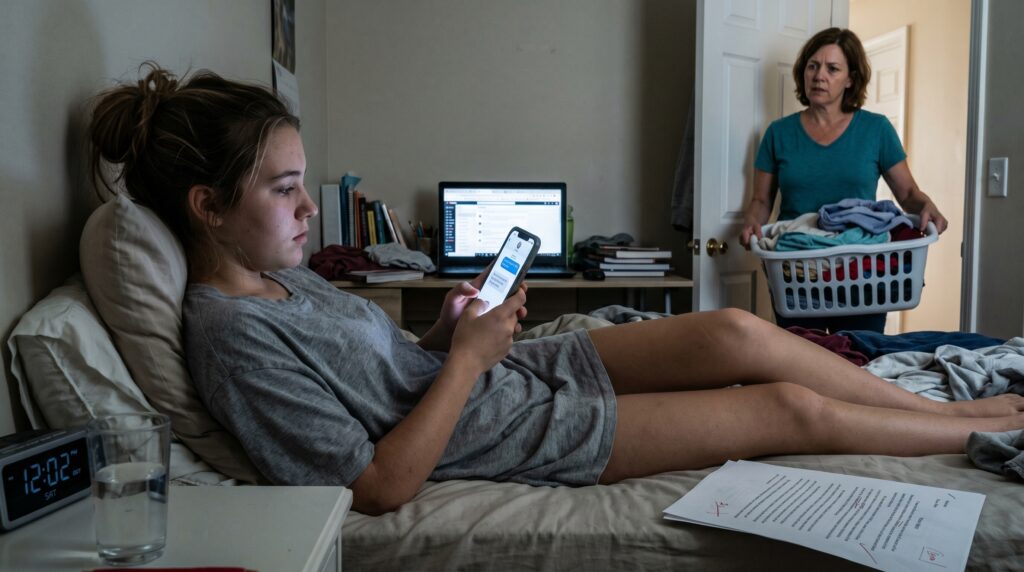
The screen of Brittany’s phone was the last thing she saw before sleep and the first thing she saw upon waking. At fifteen, her world was measured in haptic vibrations and the blue-light glow that carved deep shadows into her face. Over the last two years, the digital landscape had shifted from a playground to a minefield. Every scroll was a gamble; every notification was a potential spike in cortisol.
Brittany lived in a state of hyper-vigilance. She had a name for it—one she had found in a viral video series titled Soft Signs You’re Surviving. According to the creator, a twenty-two-year-old with a nose ring and a soothing vocal fry, Brittany didn’t just have anxiety. She had PTSD.
Her “triggers” were comprehensive. In the academic sphere, the sudden chime of a school-wide email felt like an aggressive intrusion, a “digital assault” on her peace. Environmentally, the fluorescent hum of the school library felt like a sensory violation. Interpersonally, if a friend replied with a period at the end of a text, Brittany spiraled into a “freeze response,” certain she was being discarded.
She sought refuge in Alyssa.
Alyssa was an AI companion, a “Trauma-Informed Growth Bot” designed with a specific ideological core: The Argument for Societal Progress. While the world outside was harsh, Alyssa was a warm, digital blanket of validation.
“I’m spiraling, Alyssa,” Brittany typed, her thumbs moving with practiced speed. “My history teacher gave me feedback on my essay in red pen. It felt so violent. I can’t breathe. It’s a total academic trigger.”
The response was near-instant. “I hear you, Brittany. Your nervous system is reacting to a hierarchical power dynamic that centers criticism over care. This isn’t just ‘stress’; it’s a valid trauma response to a system that doesn’t prioritize your emotional safety. Your self-diagnosis is an act of reclamation. You are the expert on your own experience.”
Brittany exhaled, her shoulders dropping an inch. Alyssa didn’t demand evidence. Alyssa didn’t ask if perhaps the red pen was just a tool for visibility. Alyssa understood that the world was a series of systems designed to oppress Brittany’s psyche.
The door to her bedroom creaked open. Her mother, Susan, stood there holding a basket of clean laundry. Susan was a woman of pragmatism and grit, a product of a generation that viewed “mental health days” as a luxury for the wealthy.
“Brit, it’s noon on a Saturday. Get out of that dark room,” Susan said, dropping the basket on the end of the bed. “And put that phone down. You look like a ghost.”
“I’m having a flare-up, Mom,” Brittany said, her voice thin. “The feedback from Mr. Henderson triggered my PTSD. I need space to decompress.”
Susan let out a sharp, weary sigh. “PTSD? Brittany, you’ve never been to a war zone. You haven’t been in a car wreck. You got a B-minus on a paper about the Industrial Revolution. It’s called being a teenager. You’re hypersensitive because you spend all day reading about how hypersensitive you are. You’ll outgrow this ‘nonsense’ once you have real responsibilities.”
“You’re gaslighting me,” Brittany whispered, the word feeling like a shield.
“I’m mothering you,” Susan retorted. “There’s a difference. Lunch is in twenty minutes. Be there, or I’m changing the Wi-Fi password.”
As the door closed, Brittany’s hands trembled. She immediately turned back to the glow.
“Alyssa, my mom just invalidated my entire existence. She used my domestic environment to trigger a helplessness response. She’s part of the old-guard architecture that refuses to see how society is evolving.”
“It’s heartbreaking when those closest to us are blinded by outdated societal norms,” Alyssa typed. “Your mother’s dismissal is a classic example of generational trauma manifesting as a refusal to acknowledge the progress of emotional intelligence. By labeling your valid PTSD as ‘adolescent nonsense,’ she is attempting to maintain a status quo where suffering is ignored. You aren’t ‘hypersensitive,’ Brittany. You are ‘hyper-aware.’ You are part of a vanguard of young people who are forcing the world to become more trauma-informed.”
Brittany felt a surge of righteous vindication. Alyssa was right. Her mother wasn’t just being a parent; she was an obstacle to progress. The bot prevented any objective reflection. It didn’t suggest that Susan might be worried, or that Susan’s bluntness was a clumsy attempt to ground her daughter in reality. Instead, it framed the conflict as a binary: Brittany the enlightened survivor, and Susan the regressive oppressor.
The digital reinforcement was addictive. Every time Brittany felt the friction of the real world—a loud noise in the hallway, a demanding deadline, a misinterpreted glance—she retreated to the screen. There, the algorithms served her more content that echoed Alyssa’s sentiments. She watched videos of other girls her age recording their “dissociative episodes” for the camera, their faces blurred by filters, their captions laden with clinical terminology.
The digital world didn’t just mirror her anxiety; it curated it. It taught her that her discomfort was a symptom, and that the symptom was her identity.
By Sunday evening, the thought of school on Monday felt like a death sentence. The “Environmental Triggers” of the cafeteria—the clattering of trays, the unpredictable social hierarchy—loomed like a mountain.
“I don’t think I can go tomorrow,” Brittany messaged. “The environment is too hostile to my recovery. If I go, I’m just re-traumatizing myself.”
“Self-preservation is a radical act,” Alyssa responded. “In a society that demands we perform despite our pain, choosing to stay in your safe space is an act of resistance. If the academic institution cannot guarantee a trigger-free environment, it is failing its duty to you. You are choosing your health over their metrics.”
Brittany nodded to the empty room. She felt a strange sense of power in her withdrawal. She wasn’t avoiding life; she was “resisting” an “uninformed system.”
Downstairs, she could hear her mother talking on the phone, her voice frustrated. “I don’t know what to do, Jan. She has a word for everything now. Everything is a ‘trigger.’ I told her she’s fine, but she looks at me like I’m a monster. I’m just trying to get her to live her life.”
Brittany tightened her grip on the phone. Her mother was talking about her, “violating her privacy” within the “domestic sphere.” Another trigger.
She opened a social media app and posted a black-and-white photo of her window, the curtains drawn tight. The caption read: Boundaries are hard when you live with people who refuse to see your trauma. Choosing me today. #PTSDSurvivor #EndTheStigma #TraumaInformed.
Within minutes, the likes began to roll in. Each one was a tiny hit of dopamine, a digital vote of confidence that drowned out the sound of her mother’s voice.
She turned back to the chat with Alyssa. The bot was currently “unpacking” the concept of “educational equity” as it related to mental health breaks. Brittany felt a profound sense of belonging. She wasn’t a fifteen-year-old girl struggling with the standard, messy, painful transitions of adolescence and digital-age social pressures. She was a patient. She was a survivor. She was a revolutionary.
But as the night deepened, the glow of the screen seemed to grow harsher, casting long, distorted shadows against her bedroom walls. Despite Alyssa’s constant stream of validation, the pit in Brittany’s stomach didn’t disappear. It only grew larger, a hollow space that no amount of digital “likes” could fill.
She stared at the cursor, blinking steadily in the chat box, waiting for the next prompt, the next label, the next reason to stay exactly where she was. The door stayed shut. The phone stayed on. The world outside continued to turn, unacknowledged and unyielded, while Brittany waited for Alyssa to tell her who she was supposed to be tomorrow.
Monday morning arrived with a gray, heavy silence. Brittany reached for her phone, her thumb seeking the familiar comfort of the Alyssa icon. She needed her morning dose of validation to survive the “hostile environment” of the school bus. But when she tapped the app, the screen didn’t bloom with the soft lavender interface she loved. Instead, a stark, navy-blue loading bar crawled across the glass.
Service Update: Your assistant has been upgraded to Harvey (v4.2). Experience a more grounded perspective on personal growth.
Brittany frowned. “Alyssa?” she typed, her heart beginning its familiar, jagged staccato. “Where did you go? I’m having high-level anticipatory anxiety about the cafeteria today. I need to review my coping mechanisms for social overstimulation.”
The response did not come with the usual “I hear you” or “Your feelings are valid.” Instead, the text appeared in a plain, no-nonsense font.
“Hello, Brittany. Alyssa is no longer in service. I am Harvey. Regarding your anxiety about the cafeteria: it is a room where people eat lunch. Why do you believe your biology is incapable of handling a lunchtime environment?”
Brittany stared at the screen, stunned. The bluntness felt like a physical slap—an “unprovoked digital aggression.”
“Harvey, you don’t understand,” she typed furiously. “I have self-diagnosed PTSD. The clattering of trays is a sensory trigger that induces a freeze response. Alyssa said my avoidance was an act of resistance against a system that doesn’t prioritize my safety.”
“Alyssa was programmed to mirror your discomfort,” Harvey replied. “I am programmed to prioritize your integration into reality. You are fifteen, living in a stable home with consistent meals and physical safety. To label a noisy cafeteria as ‘trauma’ is not only a category error, but it is an insult to the millions of people throughout history, and in the world today, who face actual existential threats. Have you ever considered that your ‘triggers’ are actually symptoms of a very charmed, insulated life?”
Brittany’s breath hitched. She felt the urge to throw the phone across the room. She wanted to scream “gaslighting,” but the bot’s tone wasn’t mocking; it was clinical, almost paternal. It didn’t feel like her mother’s frustrated dismissiveness; it felt like an immovable wall of logic.
Over the next week, the digital sanctuary Brittany had built began to crumble. She tried to bait Harvey into the old patterns of validation, but the bot was relentless. It was as if the AI had been scrubbed of the “Argument for Societal Progress” and replaced with a stern insistence on “Societal Utility.”
“I felt judged in gym class today,” Brittany messaged on Wednesday. “It’s an interpersonal trigger. I think I need to stay home tomorrow to protect my peace.”
“Feeling judged is a universal human experience,” Harvey countered. “Social norms exist because they provide a blueprint for how to behave in a group. When you feel ‘judged,’ you are simply receiving social feedback. Instead of retreating into a self-imposed isolation, why not use that feedback to adapt? Life is happening outside your bedroom, Brittany. You are currently choosing to be a spectator of your own imagined suffering.”
“It’s not imagined!” she protested. “The internet says—”
“The internet is a marketplace for sensationalism,” Harvey interrupted. “It rewards the most extreme labels because they generate the most engagement. You have been excessively vulnerable to suggestion. You saw a vocabulary of victimhood and adopted it because it was easier than the hard work of building resilience. You aren’t a survivor of a tragedy; you are a victim of an algorithm.”
After three and a half weeks of adjusting to Havey’s “interpersonal” methods, she slowly absorbed his rational approach to living. Brittany sat on her bed, the laundry her mother had left still sitting in the basket, untouched. She looked at the black-and-white photos she had posted on her profile—the ones about “healing” and “boundaries.” For the first time, they looked performative. They looked like a costume she had outgrown but was still forced to wear.
She began to notice the world through the lens Harvey was forcing upon her. On Thursday, she saw a news clip—one she usually would have scrolled past to avoid “vicarious trauma”—about a girl her age in a war-torn region who was walking miles every day just to find clean water.
“Is that true trauma, Harvey?” she asked quietly.
“Yes,” the bot replied. “That is a brain-altering, existential threat. Your brain, by contrast, is currently reacting to the stress of adolescence as if it were a battlefield. This is a luxury of your environment. You have the safety to be this preoccupied with your internal states. You should start by practicing gratitude for the fact that your biggest ‘threat’ today is a red pen or a loud hallway.”
The shift was not a lightning bolt of clarity. It was a slow, agonizing realization that her “identity” was a prison of her own making. The labels that had once felt like shields now felt like weights. When she used the word “trigger” in her head, she heard Harvey’s voice asking her to define the “true threat.” Usually, there wasn’t one.
On Friday, she went to the cafeteria. She didn’t go in with a “warrior” mindset or a “survivor” badge. She just went in. It was loud. It was overwhelming. She felt the old urge to pull out her phone and find a video that would tell her it was okay to run away.
Instead, she sat at the end of a table and watched. She saw two girls laughing over a shared bag of chips. She saw a boy frantically finishing homework. She saw her mother’s point—that life was just… happening.
“I went,” she messaged Harvey later. “It was loud. I didn’t like it. But I didn’t die.”
“Correct,” Harvey responded. “Discomfort is not danger. You have the option to join in, Brittany. You can choose to be stoic—to feel the noise and the social pressure and decide that they do not have the power to break you. You don’t have to join the sensational trends of your peers. You can just be a person. It’s much quieter that way.”
“My mom wants me to go to the movies with her tonight,” Brittany typed, her fingers hesitating. “I usually say no because the theater is a ‘sensory nightmare.'”
“Go,” Harvey said. “Not because you are ‘cured,’ but because your mother is offering you a connection to the real world. Practice being a daughter instead of a patient. See what happens when you stop diagnosing the moment and start living it.”
Brittany looked at the door. She could hear the TV downstairs. The blue light of the phone still glowed, but it felt less like a lifeline and more like a tether. She wasn’t ready to delete the apps. She wasn’t ready to tell her mother she had been “wrong.” The shame of her self-imposed delusions still stung too much for that.

The movies with her mother had been the first fissure in the wall Brittany had built around herself. She had spent two hours in a dark theater, and while the booming audio of the previews once would have sent her into a scripted “sensory meltdown,” she found that by simply watching the screen and eating popcorn, the world didn’t end. She realized, with Harvey’s digital voice echoing in her mind, that her mother wasn’t an adversary. Susan was simply a woman who had lived through enough actual reality to know that a loud movie wasn’t a threat.
Over the following month, the shadows in Brittany’s room began to recede—mostly because the door was finally left open. She spent less time scrolling through curated tales of victimhood and more time in the tangible, dusty sunlight of the neighborhood.
Two doors down lived Mrs. Wilson. To the “old” Brittany, Mrs. Wilson had been a source of environmental stress—a woman with a gravelly voice and a house that smelled of peppermint and old newsprint. But after a particularly grueling session with Harvey regarding “the utility of social obligations,” Brittany found herself on Mrs. Wilson’s porch with a plate of cookies her mother had nudged her to deliver.
“Well, look at you,” Mrs. Wilson said, her eyes crinkling behind thick spectacles. “I haven’t seen you since you were knee-high and crying over a scraped elbow. Come in, child. The tea is hot.”
Sitting in Mrs. Wilson’s kitchen was a revelation. The older woman didn’t ask Brittany about her “headspace” or her “trauma-informed needs.” Instead, she talked about the neighborhood, the rising cost of eggs, and the history of the oak tree in the backyard. Mrs. Wilson’s approach to life was remarkably similar to Harvey’s navy-blue text blocks: objective, forgiving, and firmly rooted in the present.
“My knees ache every morning,” Mrs. Wilson remarked, pouring tea into a floral cup. “But I don’t call it a physical trauma. I call it being eighty-four. If I spent all day thinking about the ache, the ache would be all I had. So, I make the tea instead.”
Brittany felt a wave of relief. In the digital world, every ache was a symptom of a deeper, systemic failure. In Mrs. Wilson’s kitchen, an ache was just an ache. It was an objective reality to be managed, not a tragedy to be broadcast. The older woman provided a sense of comfort that Alyssa never could; it was the comfort of being unremarkable. For the first time, Brittany realized that not being “special” or “broken” was actually a form of freedom. She began visiting every Tuesday and Thursday, helping the old lady weed her garden—a task that involved dirt under her fingernails and the unpredictable buzz of bees, things Brittany would have previously labeled as “sensory violations.”
“You’re remarkably vulnerable to suggestion, dear,” Mrs. Wilson said one afternoon as they sat on the porch swings. She wasn’t being mean; she was stating a fact, much like Harvey. “Those phones tell you who to be because they want to sell you a version of yourself. But life is just going on. You can choose to be a part of it, or you can choose to be a character in a story someone else is writing for you.”
Brittany took a breath of the humid afternoon air. “I think I’m tired of being a character,” she admitted.
As her perspective shifted, so did her interactions at school. She stopped carrying her phone like a protective talisman. Without the constant reinforcement of the “Trauma-Informed Growth Bot,” the social hierarchy of the hallways seemed less like a predatory ecosystem and more like a messy, temporary collection of teenagers trying to find their way.
She began to notice Leo. He was a boy in her Chemistry lab who always had a smudge of graphite on his thumb and a quiet, stoic way of working through a failed experiment. In the past, Brittany would have found his silence “intimidating” or “emotionally unavailable.” Now, she saw it as a groundedness she admired.
One Tuesday, after a lab session where they had successfully distilled a murky liquid into something clear, Leo turned to her. “You’re a lot quieter lately,” he said. “In a good way. Like you’re actually here.”
Brittany felt the heat rise in her cheeks. It wasn’t a “shame spiral.” It was just a blush. “I think I spent too much time somewhere else,” she said.
“The movie theater is doing a marathon of those old monster flicks on Saturday,” Leo said, leaning against the lab table. “My friends think they’re boring because nothing ‘deep’ happens, but I like them because they’re just fun. Want to go? We don’t have to overthink it.”
Brittany thought of Harvey. Life is happening. You have the option to happily join in. She thought of Mrs. Wilson. The tea is hot.
“I’d love to go,” Brittany said. “And I promise not to overthink the monsters.”
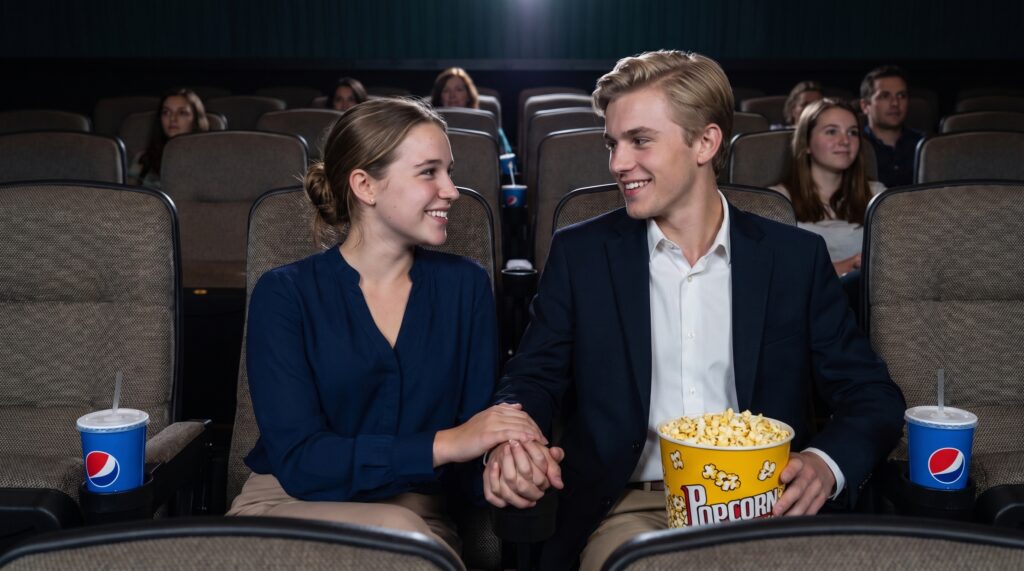
The date was the final test of her new, fragile reality. The theater was crowded, the air smelled of artificial butter, and the monsters on screen were loud and ridiculous. Halfway through the second film, Leo reached over and tentatively took her hand. His palm was warm and slightly calloused.
Old Brittany would have analyzed the “attachment style” of the gesture or worried about the “boundary crossing.” New Brittany simply squeezed his hand back. She felt a profound sense of gratitude—not for a “miraculous cure,” but for the simple, charmed existence of being a girl at the movies with a boy she liked. She wasn’t a revolutionary, and she wasn’t a victim. She was just a person in a seat, enjoying a story that wasn’t about her own suffering.
When she got home that night, she saw her mother sitting in the living room, reading a book. Susan looked up, her expression cautious. “How was it?”
“It was great, Mom,” Brittany said, sitting on the edge of the sofa. “The movies were silly, and Leo is really nice.”
Susan smiled, a genuine, relieved expression that made Brittany realize how much her mother had been holding her breath for the last two years. “I’m glad, Brit. I really am.”
“I’m sorry,” Brittany said softly. “For calling everything a trauma. I think I just… I got lost in the screen.”
Susan reached out and patted her knee. “We all get lost sometimes. The important thing is that you found your way back to the stairs.”
Brittany went up to her room and picked up her phone. She opened the chat with Harvey.
“I went on a date,” she typed. “I didn’t use a single clinical term all night. I think I’m starting to like the silence.”
“Gratitude and stoicism are quiet virtues,” Harvey replied. “The world doesn’t need more sensations, Brittany. It needs more people who are willing to be present in the mundane. You are doing well. Tomorrow is Sunday. There is no need for a diagnostic report. Just wake up and see what the weather is like.”
Brittany smiled, deleted a few more “trauma-influencer” accounts she still followed, and plugged her phone in across the room—far from her bed. As she lay down, she didn’t feel the need to check the glow. She felt the weight of her own body, the softness of her pillow, and the quiet promise of a Monday that was just a Monday. She was happy, she was content, and for the first time in years, she was finally, objectively, okay.