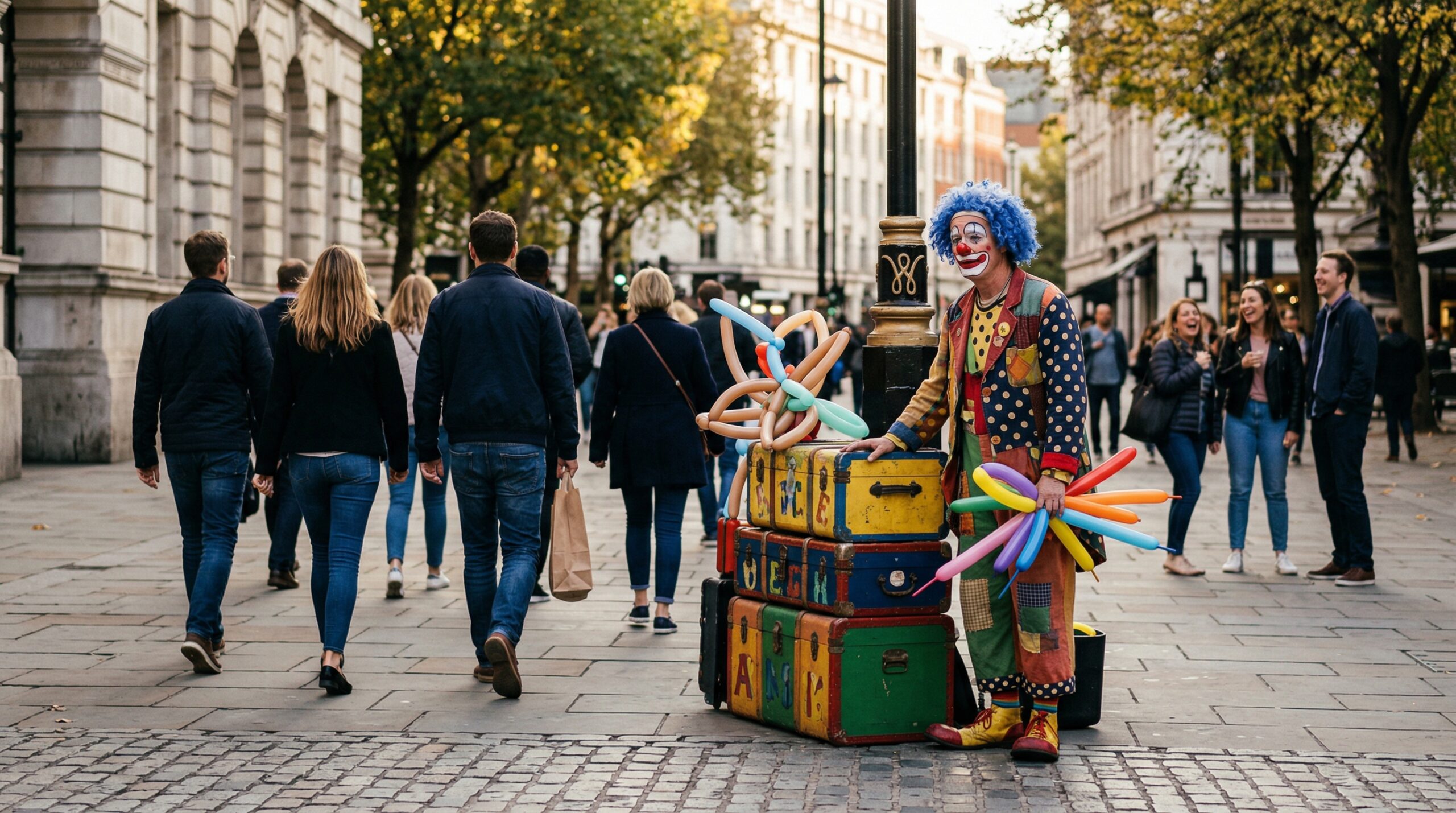
The painted smile is a fixed curve of red,
A semi-permanent state of forced delight
That stares back from the birthday party’s edge.
We are told these figures are the vessels of joy,
The practitioners of the pratfall and the silent wall,
Designed to lift the heavy lid of a Tuesday afternoon
And replace it with a balloon animal of dubious shape.
In London, the child looks up and sees a friend.
In Mexico City, the payaso dances for a coin.
In Mumbai, the bright colors match the festival’s heat.
Yet, there is a glitch in the collective human brain,
A biological shudder that occurs when the face
Does not move in sync with the eyes behind the greasepaint.
The Uncanny Valley of the Big Red Shoes
The psychologist calls it “coulrophobia,”
A word far too dignified for the fear of a man
Who fits fourteen of his brothers into a compact car.
It is the mask that never blinks, the frozen gaiety
That suggests something else is happening underneath.
If a man in a suit offers you a flower, you say thank you.
If a man with a white face and a blue wig offers it,
You wonder if it contains a hidden reservoir of seltzer.
Media has not been a kind steward to the clown’s reputation.
Stephen King took the silver screen and turned a drain
Into a nightmare of balloons and sharp, yellow teeth.
Batman’s greatest foe is not a bank robber or a titan,
But a man in a purple jacket with a chemical grin
Who proves that one bad day can make the makeup permanent.
We see the Joker and we forget the selfless circus act;
We see Pennywise and we never look at a sewer the same way.
The Silent Protest of the Mime
Then there is the mime, the clown’s quiet, French cousin,
A man trapped in an invisible box of his own making.
In Paris, they lean against the wind that isn’t blowing,
And pull on ropes that exist only in the mind’s eye.
The world finds them revolting not for their malice,
But for their refusal to speak in an increasingly loud world.
They are the ultimate social awkwardness—
A person staring at you, mimicking your walk,
Compelling you to acknowledge the void they are touching.
There is a famous anecdote of a mime in Berlin
Who followed a businessman for three whole blocks.
The businessman hurried, the mime hurried.
The businessman wiped his brow, the mime wiped his.
Finally, the man turned and shouted, “What do you want?”
The mime simply leaned against a non-existent lamp post
And looked disappointed that the game had broken.
It is this intrusion, this playful violation of the ego,
That turns a “brightened day” into a cold sweat.
A Global Shiver in Five Languages
The reaction is universal, a shared human “No.”
In English, we call them “creepy,” a skin-crawling word.
In Spanish, one might feel escalofríos at the sight
Of a mimo standing perfectly still in a dark plaza.
The Frenchman might find the clown “dégoûtant,”
A visceral disgust for the exaggeration of the soul.
In German, there is surely a word thirty letters long
To describe the specific dread of a honking nose.
In Hindi, the vidushak is a classic figure of the stage,
Yet the modern version feels like a Western ghost
Haunting the peripheries of a suburban wedding.
We are told they are for the children,
But children are the first to spot the deception.
A child sees a clown and sees a giant, vibrating lie.
“Why is his hair like a radioactive orange?” they ask.
“Why does he have four eyebrows and a plastic nose?”
The child knows that humans do not look like this,
And therefore, the clown must be a different species,
One that feeds on cake and the sounds of its own horn.
The Tragedy of the Honk
It is a difficult career, to be feared by your target market.
The clown sits in the dressing room, removing the nose,
Revealing a tired person who just wants a sandwich.
They intended to be a beacon of light, a spark of fun,
But they are trapped by the tropes of the slasher film
And the viral videos of “Killer Clowns” in the woods.
Social media has turned the performer into a prank,
A figure to be filmed from a distance with a shaky thumb
While the viewer ponders whether to run or to laugh.
Perhaps the mime is the wiser of the two.
He does not need to defend himself with words.
He simply climbs his invisible ladder and disappears
Into the rafters of our collective, nervous imagination.
We want to be brightened, we truly do,
But please, keep the oversized shoes at a distance.
Let the joy be delivered by someone with a visible jawline
And a face that can express a normal amount of sadness.