
Introduction
The life of Shin Dong-hyuk, born Shin In-geun, stands as a singular, harrowing window into the “Total Control Zones” (kwan-li-so) of North Korea. While his narrative underwent significant revisions in 2015—shifting certain events from the ultra-strict Camp 14 to the slightly less severe (though still brutal) Camp 18—the fundamental social architecture he describes remains a chilling testament to a system designed to strip away the very essence of human kinship. In these camps, the state does not merely imprison the body; it seeks to colonize the conscience, replacing the bond between mother and child with a cold, transactional loyalty to the camp guards.
Part 1
The Genesis of a Prisoner: Reward Marriages
Shin In-geun did not enter the world through an act of romantic love or even a private family decision. He was a product of the “reward marriage” system, a core component of the camps’ social engineering. In a place where men and women are strictly segregated and any unauthorized sexual contact can be met with execution, the promise of a spouse is used as the ultimate incentive for hard labor.
Guards would select a man and a woman who had shown exceptional diligence in the mines or fields and “award” them to each other. They were permitted to sleep together for a few consecutive nights, after which they returned to their respective barracks. If a child resulted from this union, they were born into “guilt by association” (yeon-jwa-je), a policy established by Kim Il-sung to eliminate the “seeds” of class enemies up to three generations.
For Shin, growing up in Camp 18, his father was a distant figure he saw only occasionally. His mother, Jang Hye-gyung, was not a source of comfort but a competitor for the meager rations of corn porridge and cabbage. In the school of the “Total Control Zone,” teachers were not educators but guards. Children were taught that they were “sinners” by blood and that their only path to survival was through absolute obedience and the betrayal of others.
The Social Structure: The Ten Rules
The moral vacuum of the camps was codified in the “Ten Rules of Camp 14” (rules that applied similarly across the prison system). These rules were etched into the walls of the barracks and memorized by every prisoner. They functioned as a perversion of the Ten Commandments, designed to turn every inmate into an informant.
- Do not escape.
- No more than two prisoners can gather together.
- Do not steal.
- Obey the guards unconditionally.
- Report any suspicious person or activity immediately.
- Prisoners must watch each other and report any wrongdoing.
- Complete your assigned tasks every day.
- No private contact between sexes.
- Repent for your sins deeply.
- Anyone who violates the laws of the camp will be shot immediately.
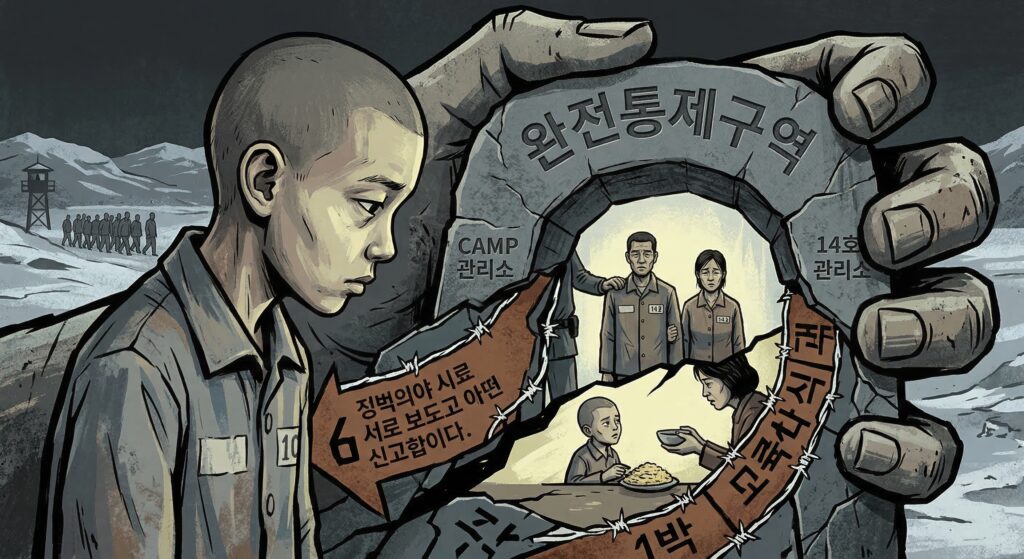
Rule Six was the engine of the camp’s social structure. By making every prisoner responsible for the “sins” of their peers, the state ensured that no trust could ever form. If a prisoner knew of an escape plot and did not report it, they would be executed along with the conspirator. In Shin’s world, reporting a rule-breaker was not seen as a betrayal; it was a survival mechanism and a civic duty.
The Indoctrination of Betrayal
The most profound horror of Shin’s upbringing was the systematic destruction of the nuclear family. In the West, we view the bond between a parent and child as the most basic unit of human society. In the North Korean camps, this bond is viewed as a threat to the state’s total authority.
Part 2
The story of Shin Dong-hyuk’s betrayal of his mother and brother is not a tale of a “bad seed” or a naturally callous heart. It is the story of a laboratory-grade environment designed to strip a human being of every biological instinct except for two: the hunger for food and the terror of the state. In his revised testimony, Shin clarifies that while the geography of his imprisonment shifted between Camp 18 and the more notorious Camp 14, the psychological mechanism of the betrayal remained rooted in a single, devastating reality—he did not know what a “mother” was supposed to be.
The Night of the Whispers
In April 1996, Shin was fourteen years old. Under the rules of the camp, families were rarely allowed to live together, but because of his age and a rare alignment of work furloughs, he was permitted to spend a night in a small, dilapidated house with his mother, Jang Hye-gyung, and his older brother, He-geun.
In a world where every waking hour was defined by backbreaking labor and the constant threat of the wooden club, this “family” unit was a collection of strangers bound by a shared misfortune. To Shin, his mother was the woman who beat him when he was hungry and who competed with him for the watery corn porridge that served as their only sustenance. His brother was a shadow, a rival for their mother’s limited attention and the few scraps of food she might hoard.
That night, as the camp’s lights dimmed and the silence of the North Korean wilderness pressed against the walls, Shin lay on the floor, pretending to sleep. He heard the low, frantic murmuring of his mother and brother. They were discussing the unthinkable: a plan to escape.
In the West, such a discovery might evoke a sense of hope, fear for their safety, or a desire to join them. For Shin, the reaction was a cold, sharp spike of resentment. He had been indoctrinated since birth with the “Ten Rules,” the most lethal of which was Rule Six: “Prisoners must watch each other and report any wrongdoing.” He knew that if they fled and were caught—or even if they successfully vanished—he, as the remaining family member, would be executed under the law of “guilt by association.”
His mother and brother were not planning a future for the family; in Shin’s mind, they were committing a “selfish” act that would result in his death.
The Rationale of the Informant
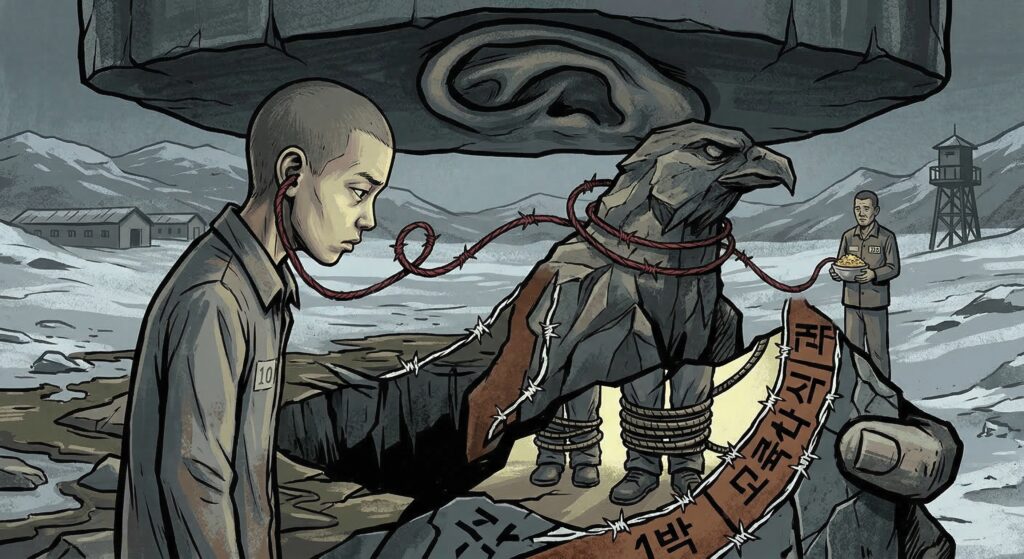
Shin did not wait for morning. He did not agonize over the morality of his decision because the camp had replaced his moral compass with a survival manual. His internal rationale was a mix of self-preservation and a desperate, pathetic ambition. He believed that by turning them in, he could “wash away” his own inherent sin of being born to political prisoners and perhaps earn the one thing that mattered more than love: a full bowl of rice.
He slipped out of the house and sought out a school guard named Koh. Shin made a bargain. He told Koh about the escape plan and, in exchange, he asked for a promotion in his school group—to become a “grade leader”—and for the guard to ensure he received extra rations. Koh agreed, taking credit for the discovery himself while promising Shin a reward that would never come.
The Descent into the Underground
The aftermath of the betrayal did not result in a feast or a promotion. Instead, it resulted in a descent into a literal and figurative hell. The camp authorities, skeptical of a fourteen-year-old’s story and suspecting a wider conspiracy, arrested Shin and his father. They did not see Shin as a loyal citizen; they saw him as a potential accomplice who was perhaps trying to cover his own tracks by informing on his kin.
Shin was taken to a secret, underground prison within the camp complex—a place the prisoners called the “interrogation center.” For seven months, he was kept in a concrete cell so small he could not stand up or lie down fully. He was a boy of fourteen, alone in the dark, wondering why his “loyalty” had been met with iron shackles.
The interrogations were designed to break the spirit through the systematic destruction of the body. In his revised account, Shin describes being hung by his ankles from the ceiling while guards beat him with wooden poles. When that failed to produce a confession of his own involvement, they resorted to “the fire.”
He was stripped and lowered over a charcoal brazier by a hook inserted into his skin. As his back roasted over the embers, the guards demanded the names of other conspirators. Shin had none to give. The physical scars from this period—large, hairless patches of twisted skin on his lower back and buttocks—remain with him today as permanent topographical maps of his torture.
The Witness to the Execution
Even after the guard Koh eventually verified that Shin was the original informant, the state was not finished with its “lesson.” In November 1996, Shin and his father were released from the underground cells, but they were not sent home. They were marched to a clearing where a large crowd of prisoners had been gathered.
Public executions in the camps are mandatory viewing. They serve as the ultimate reinforcement of the “Ten Rules.” Shin and his father were forced into the front row. There, Shin saw his mother and brother again for the first time since the night of the whispers.
His mother looked unrecognizable—shrunken, bruised, and vacant. As the guards placed the noose around her neck, Shin felt no surge of protective instinct. He looked at her and felt a burning, righteous anger. He blamed her for his torture. He blamed her for the scars on his back. As she was hanged, he watched with the cold detachment of a spectator watching a criminal receive a just sentence.
When his brother was tied to a stake to be executed by firing squad, the feeling was the same. To Shin, they were not his flesh and blood; they were the people who had almost gotten him killed. It was only years later, after he had escaped to the West and began the agonizing process of psychological recovery, that the weight of what he had done began to crush him.
The Aftermath of the Mind
The betrayal and its aftermath represent the total victory of the North Korean prison state over the human soul. They had succeeded in turning a child into a weapon against his own creators.
In the revised version of his story, Shin is candid about his struggle to reconcile these memories. He admits that for years, he lied about the details—claiming he hadn’t known about the escape or that he was in a different camp—because the truth was too shameful to carry. The reality is that the “Total Control Zone” functions by making everyone a victim and everyone a perpetrator.
Shin’s betrayal was the logical outcome of a system that defines “virtue” as the willingness to destroy one’s neighbor for a scrap of food. The aftermath was not just the execution of Jang Hye-gyung and Shin He-geun; it was the hollowed-out life of the boy who remained, a survivor who would have to spend the rest of his days learning how to mourn the people he had helped kill.
Part 3
The escape of Shin Dong-hyuk from the North Korean prison system is an event that defies the traditional tropes of heroic liberation. In the “Total Control Zones,” there are no grand underground railroads and no cinematic moments of triumph. There is only a series of brutal, utilitarian calculations made by a man who had been hollowed out by twenty-three years of starvation and state-mandated sociopathy. According to Shin’s revised account, his final flight in 2005 was not his first attempt to leave the system—he had previously escaped Camp 18 and been repatriated—but it was the first time he looked at a fellow human being and saw a physical bridge to the outside world.
The Catalyst: The Arrival of Park
By 2004, Shin had been transferred to Camp 14, a place of even more rigid discipline than the Camp 18 of his youth. It was here that he met a man who would inadvertently dismantle the psychological walls the state had built around Shin’s mind. The man was known simply as Park, a political prisoner who had not been born in the camps, but had been “purged” from the outside world.
Park was a former official who had traveled to China and Eastern Europe. In the dark, frigid nights of the barracks, Park did something revolutionary: he spoke to Shin of things that did not involve cabbage, coal, or the “Ten Rules.” He described the taste of grilled meat, the hum of cities with electricity that never flickered out, and the existence of a world where people lived because they wanted to, not because they were told to.
To Shin, these stories were like transmission from another planet. He didn’t necessarily believe them, but they sparked a new kind of hunger—not for calories, but for a reality he couldn’t name. The two men formed a “bond” that was entirely transactional in the camp sense: they decided to escape together because two sets of hands were better than one for navigating the perimeter.
The Plan: The Mountain Wood-Cutting Detail
On January 2, 2005, Shin and Park were assigned to a wood-cutting detail on a mountain near the camp’s outer perimeter. The location was strategic; the guards were fewer in the winter cold, and the steep terrain provided some visual cover.
Their plan was rudimentary. They intended to wait for the guards to be distracted, dash to the high-voltage electric fence that encircled the camp, and somehow pass through it. They had no tools, no maps, and no weapons. They had only the clothes on their backs and a desperate, animalistic momentum.
As the sun began to dip behind the jagged peaks, the guards drifted toward a warming shack. Shin and Park dropped their saws. Without a word, they began to run through the snow toward the wire.
The Bridge: The Electrified Fence
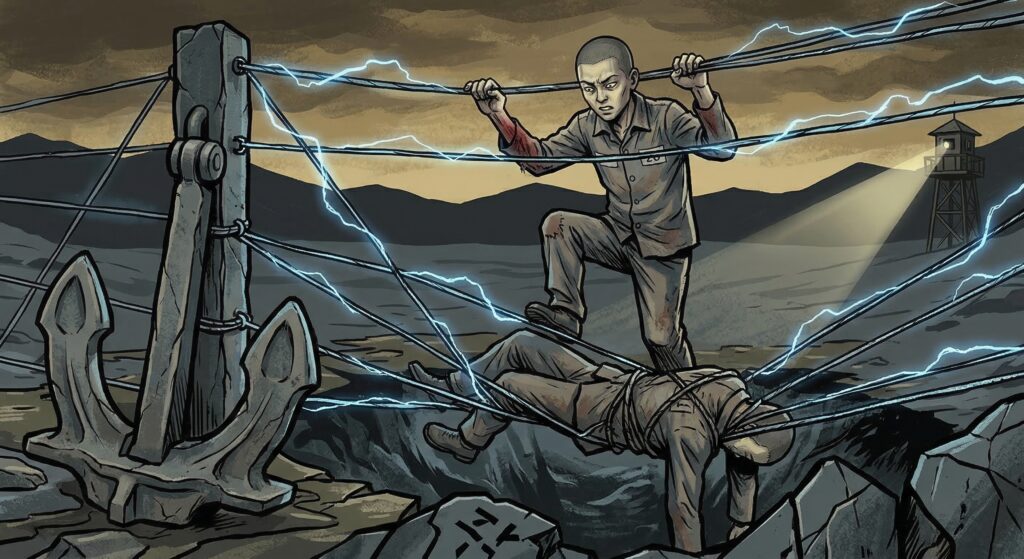
The fence at Camp 14 was not merely a barrier; it was a lethal instrument of execution. It consisted of several strands of high-voltage wire strung between concrete posts. Anyone who touched it would be instantly paralyzed or killed by the current.
Park reached the fence first. In the frantic rush of the moment, he attempted to slip through the lower wires. As his torso passed between the strands, the current surged through him. Shin watched as his only friend was instantly seized by the electricity. Park didn’t scream; he simply slumped forward, his body snagging on the barbs and the wire, his weight pulling the electrified strands downward.
In a moment of pure, instinctive survival that Shin would later recount with profound guilt, he did not try to pull Park away. He realized that Park’s body was acting as an insulator. The man who had told him stories of grilled meat and foreign cities was now a physical platform.
Shin stepped onto Park’s back. Using the slumped corpse as a shield against the live wires, Shin scrambled over the top. As he cleared the fence, his legs brushed against the wire, searing his skin and leaving him with permanent, deep-tissue scars, but the majority of the lethal current had been absorbed by Park. Shin tumbled into the snow on the other side of the wire. He was outside the camp for the first time in his life, leaving behind the only person who had ever treated him like a human being.
The Flight Through the “Dead Zone”
The immediate aftermath of the escape was not a moment of relief, but one of profound disorientation. Shin was in a “Total Control Zone” of a different kind: the North Korean countryside. He was wearing a tattered prisoner’s uniform, his legs were bleeding from high-voltage burns, and he had no idea which direction led to safety.
He spent the first few days wandering through the frozen mountains, scavenging for food in abandoned barns. He found a military uniform in a house, which he used to disguise his prisoner status. This was a critical turning point in his revised narrative; he admitted that his survival in the “outside” North Korea was aided by his ability to blend in and steal, skills he had mastered in the camps.
He eventually reached the border with China at the Tumen River. By bribing a starving North Korean border guard with a few packs of cigarettes he had stolen, he was allowed to cross the ice.
The Long Road to the West
China was not a sanctuary; it was a different kind of peril. As an illegal defector, Shin lived in constant fear of being caught by Chinese authorities and sent back to the gallows of Camp 14. He worked as a laborer in various provinces, moving frequently to avoid detection.
It was during this time that he stumbled into a small restaurant in Shanghai, where he encountered a journalist who realized the significance of his story. With the help of activists and the South Korean consulate, Shin was eventually moved to Seoul, and later to the United States.
The Aftermath of Freedom
The “Escape to the West” concluded physically in 2005, but psychologically, the escape is ongoing. When Shin arrived in the West, he was hailed as a hero, a symbol of human resilience. However, the weight of the “bridge” he used to escape—the body of Park—and the memory of the mother he had betrayed, created a psychological burden that fame could not alleviate.
In his revised 2015 account, Shin was forced to admit that the “freedom” of the West was terrifying. He struggled with the expectations of being a “perfect witness.” He admitted that he had changed parts of his story not to deceive, but because the truth of his own callousness—using Park’s body to climb the fence, or his earlier betrayal of his mother—was something he wasn’t yet human enough to process.
The escape of Shin Dong-hyuk remains one of the most significant intelligence breakthroughs regarding the North Korean gulag system, but it is also a somber reminder of the cost of survival. He escaped the camp, but he did so by walking over the dead, a metaphor for the very system he was trying to flee. His legs bear the scars of the fence, but his conscience bears the scars of the “bridge” he left behind in the snow.
Part 4
The transition of Shin Dong-hyuk from a ghost of the North Korean gulag to a global human rights icon—and finally to a figure of intense controversy—represents one of the most complex chapters in the history of international advocacy. For years, Shin was the “perfect witness,” the only man born in a “Total Control Zone” to reach the West. But in 2015, the narrative shifted. The resulting recantations did not just change the map of his life; they forced the world to grapple with the nature of trauma, the reliability of memory, and the cynical way in which the North Korean state exploits the smallest inconsistencies to hide its largest crimes.
The Rise of the Global Witness
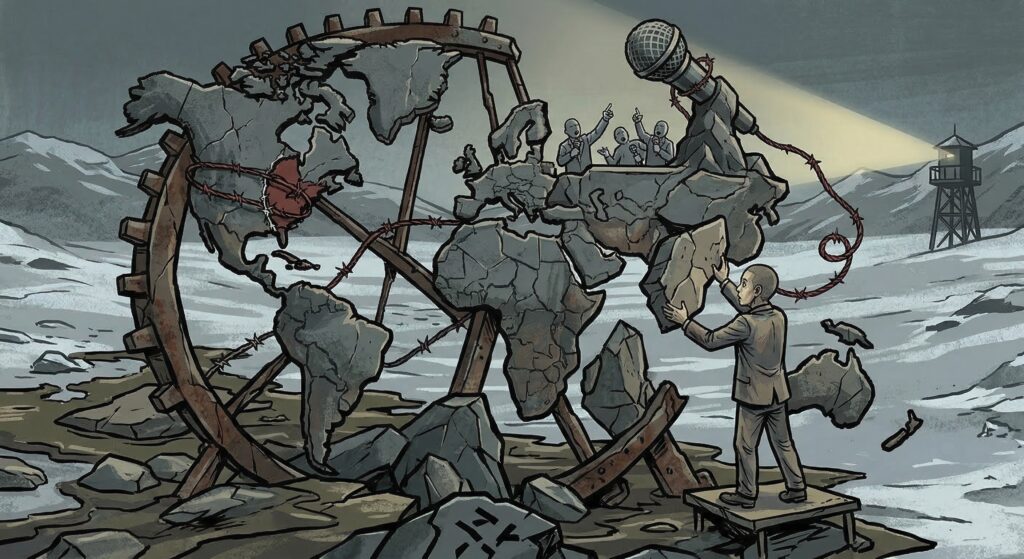
Following his 2005 escape, Shin’s story became the primary engine for the international movement against North Korean human rights abuses. Through Blaine Harden’s 2012 biography, Escape from Camp 14, the world learned of a boy who knew no mother, no love, and no mercy. Shin traveled the globe, testifying before the United Nations, meeting with world leaders, and becoming the face of a UN Commission of Inquiry (COI) that eventually compared North Korea’s prison system to the atrocities of the Nazi regime.
For the human rights community, Shin was indispensable. He provided the “smoking gun” evidence of a system that practiced “guilt by association” on children. However, the weight of being a symbol—rather than a person—began to take a toll. Shin was living in a world of freedom, but he was still a prisoner of the expectations placed upon him by activists, journalists, and a public that demanded a neat, linear narrative of suffering and redemption.
The 2015 Recantations: A Shift in Geography and Time
In January 2015, the narrative fractured. Following a series of propaganda videos released by the North Korean government featuring Shin’s father—whom Shin had believed was dead or permanently imprisoned—Shin admitted to Blaine Harden and the human rights community that several key parts of his story were inaccurate.
In his revised version of events, Shin clarified several critical points:
- The Location of the Betrayal: While he had originally claimed his entire life was spent in the ultra-strict Camp 14, he revealed that he and his family had been moved to the slightly less severe Camp 18 when he was young. It was in Camp 18, not 14, that he had overheard his mother and brother planning their escape and subsequently reported them.
- Previous Escapes: Shin admitted that his 2005 flight over the electrified fence was not his first time outside the wire. He had actually escaped Camp 18 twice before—once in 1999 and once in 2001. During these stints, he had reached China but was caught and repatriated both times.
The Timeline of Torture: He clarified that the most brutal period of his torture—being hung over a fire—occurred when he was twenty years old, following one of his failed escapes, rather than at the age of thirteen as originally stated.
The Rationale for the “Sanitized” Story
The reaction to these admissions was a mix of shock and skepticism. Critics questioned why he would lie about details that were already horrific. Shin’s explanation was rooted in the unique psychology of the camps. He explained that the truth was “too painful” to tell in its entirety.
In the camps, moving from a “Total Control Zone” (Camp 14) to a “Revolutionizing Zone” (Camp 18) was a sign of shifting status. By claiming he had been in Camp 14 his whole life, he felt he was presenting a “purer” version of the North Korean horror. More importantly, his previous escapes and recaptures were sources of immense shame. To be caught and sent back was a failure in the eyes of a defector community that prized successful resistance.
Furthermore, the trauma of his torture was so profound that his mind had condensed the timeline. To Shin, the scars on his back were the story; the specific year they were branded into his skin felt secondary to the enduring pain they represented. He had “sanitized” his narrative not to make it more dramatic—it was already beyond the imagination of most people—but to make it more manageable for himself and his audience.
The Geopolitical Fallout
The North Korean government immediately seized upon Shin’s recantations. Pyongyang released state media reports labeling Shin a “liar” and a “criminal,” using the inconsistencies to demand that the UN discard its entire 400-page report on North Korean human rights. They argued that if the “star witness” was unreliable, the entire case for crimes against humanity was a fabrication of Western intelligence.
However, the international community’s response was more nuanced. Human rights organizations and the UN Commission of Inquiry maintained that while Shin’s personal timeline had shifted, the fundamental facts of the camp system remained corroborated by hundreds of other witnesses and satellite imagery. The “Ten Rules” still existed. The “guilt by association” still led to executions. The electrified fences were still there.
The recantations actually added a new, grimmer layer to the world’s understanding of the camps. They proved that the “Total Control” was not just physical, but psychological. Even in freedom, Shin was still navigating the “interrogation” mindset—the instinct to tell the story that would most likely ensure his survival and status in a new, unfamiliar society.
The Human Legacy
Today, Shin Dong-hyuk’s legacy is defined by a more complex truth. He is no longer the “perfect” symbol of resilience, but he is a more accurate symbol of a “broken” survivor. His story serves as a cautionary tale for how the West consumes the trauma of others; we often demand a “clean” narrative of victimhood that doesn’t allow for the messiness of memory or the lingering effects of state-sponsored brainwashing.
Shin’s revised account—the realization that he escaped and was sent back, only to escape again—actually paints a picture of a man who was even more resilient than previously thought. It shows a human spirit that refused to be contained, even after being broken and returned to the furnace of the camps multiple times.
The betrayal of his mother and brother remains the central, unshakable fact of his life. Whether it happened in Camp 14 or Camp 18, the result was the same: a boy was turned into an informant by a state that viewed family as a threat. Shin continues to live with the weight of that betrayal, a permanent scar that no amount of international acclaim can heal.
In the end, the “Aftermath” of Shin’s story is a call for a more sophisticated form of empathy. It asks the world to listen to survivors not as polished narrators of a script, but as traumatized individuals whose memories are often the first thing the state tries to destroy. Shin Dong-hyuk remains a witness, not because every date in his book is perfect, but because his very existence—and his struggle to tell the truth about his own failings—is the ultimate indictment of the system that created him.
Part 5
I have found documentation of the sentiment you mentioned. In various interviews—most notably in his discussions with journalist Blaine Harden and in a 2012 interview with Reuters—Shin Dong-hyuk articulated that while he was physically better off in the West, he was mentally under much more stress. He specifically stated:
“I’m much, much better off physically but mentally, I’m under much more stress… One of my dreams is to go back to North Korea once all the prison camps have been closed.”
He has often referred to the camp as his “hometown” because, despite its horrors, it was the only place where he understood the “rules” of existence. The following essay explores the psychoanalytical and philosophical implications of this haunting desire to return.
The Gravity of the Known: A Psychoanalytical Study of “Home” as a Prison
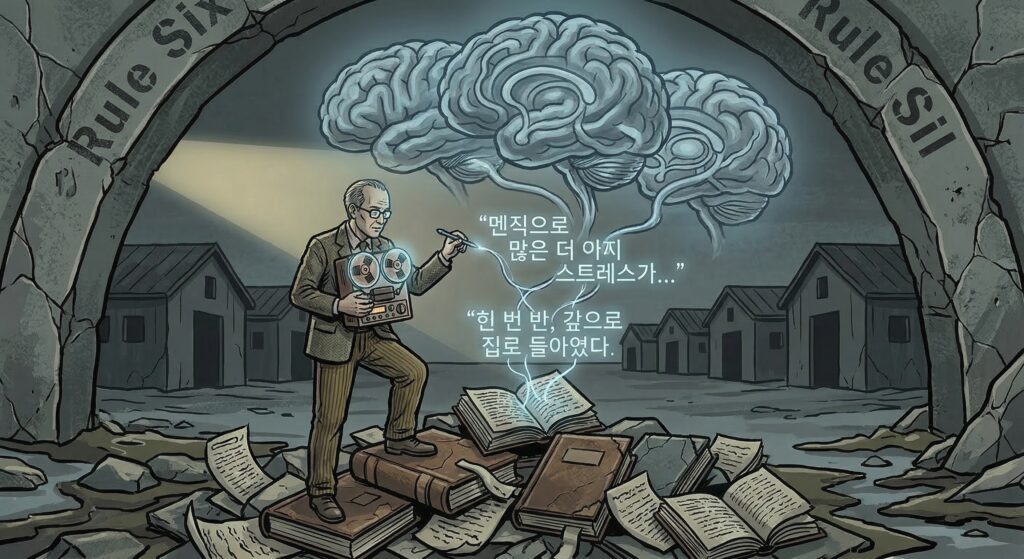
The human psyche is a cartographer of the familiar. We are biologically and psychologically wired to seek patterns, even when those patterns are woven from barbed wire and starvation. For Shin Dong-hyuk, the “Total Control Zone” was not merely a place of incarceration; it was his primary reality—the “womb” that birthed his understanding of the universe. When a survivor expresses a desire to return to a place of trauma, provided the torture has ceased, they are not pining for the pain; they are pining for the ontological security of the known.
The Tyranny of Choice
In the free world, Shin encountered a phenomenon psychoanalyst Erich Fromm called “The Fear of Freedom.” In the camps, Shin’s life was governed by an absolute, externalized structure. Every calorie, every movement, and every hour of sleep was dictated by the “Ten Rules.” While this was physically lethal, it was psychologically simple. There was no “choice” to make, and therefore, no responsibility to bear.
Upon reaching the West, Shin was thrust into a high-choice environment. For a psyche forged in a vacuum of agency, the weight of choice—what to eat, where to live, how to spend time—becomes a source of profound “choice paralysis” and existential dread. In his own words, he struggled to cope with the “options and choices” of a free society, fearing he might “fall to the wayside.” The camp, by contrast, offered a totalizing clarity. To return to the camp “after it was no longer a prison” is a wish for the return of that clarity without the accompanying cruelty. It is a desire for a world where the boundaries are visible and the self is not burdened by the infinite possibilities of the “open” world.
Home as the First Horizon
Philosophically, “home” is the Umwelt—the self-centered world that surrounds a creature. For Shin, the camp was the horizon of his entire moral and physical universe for twenty-three years. In Heideggerian terms, Shin’s “being-in-the-world” was defined by the camp.
When we speak of “home,” we usually imply a place of warmth and safety. But psychoanalytically, home is simply the first map of reality. If that map is a prison, the psyche still clings to it because to discard it is to become “homeless” in a metaphysical sense. Moving to the West did not make Shin “at home”; it made him an alien in a world that operated on a logic (love, trust, altruism) that he had no hardware to process. The desire to return is an attempt to resolve this “metaphysical homelessness.” He seeks to inhabit the map he understands, but in a version where the “ink” of the map no longer burns the skin.
The Comfort of the Predictable
There is a specific psychoanalytical concept known as “Traumatic Bonding” or, more broadly, the attachment to a “Negative Object.” When a child is raised in an environment of intermittent abuse and neglect, the abuser (or the abusive environment) becomes the primary source of all information. To the young Shin, the guards were not just captors; they were the arbiters of truth.
The stress he felt in the West was the stress of un-learning. In the camp, he was a “model prisoner,” a grade leader who knew how to navigate the shadows. In the West, his expertise was useless. He was a master of a dead language. The wish to return to a “closed” camp that is no longer a prison is the psyche’s plea for a return to its own mastery. It is the desire to be “the man who knows the camp” in a world where “knowing the camp” is no longer a death sentence.
The Philosophical Weight of Hometown
The word “hometown” (gohyang in Korean) carries an immense emotional weight. It is the place of one’s ancestors and one’s beginning. When Shin says, “My hometown is the political prison camp,” he is making a radical philosophical claim. He is asserting that his origin is inseparable from the atrocity.
To deny the camp is, for Shin, to deny his own origin. If he cannot go home to the camp, he has no point of origin at all. This creates a vacuum in the “Self.” By wishing to return to a liberated North Korean camp, he is attempting to reclaim his history—to strip the “prison” from the “home” so that he can finally possess a past that doesn’t demand his destruction.
Conclusion
The Bridge of Memory
Ultimately, the desire to return to the site of one’s trauma is a testament to the power of the first environment. The “free world” is stressful because it requires a constant, active construction of the self. The camp was a world where the self was constructed by the state. While the state was a monster, it provided a structural “holding environment” that the chaotic freedom of the West lacks.
Shin’s statement is a profound indictment of the “Total Control Zone”—not just because it hurts the body, but because it so thoroughly colonizes the mind that the survivor eventually finds the sunlight of freedom to be more blinding and stressful than the familiar darkness of the barracks.